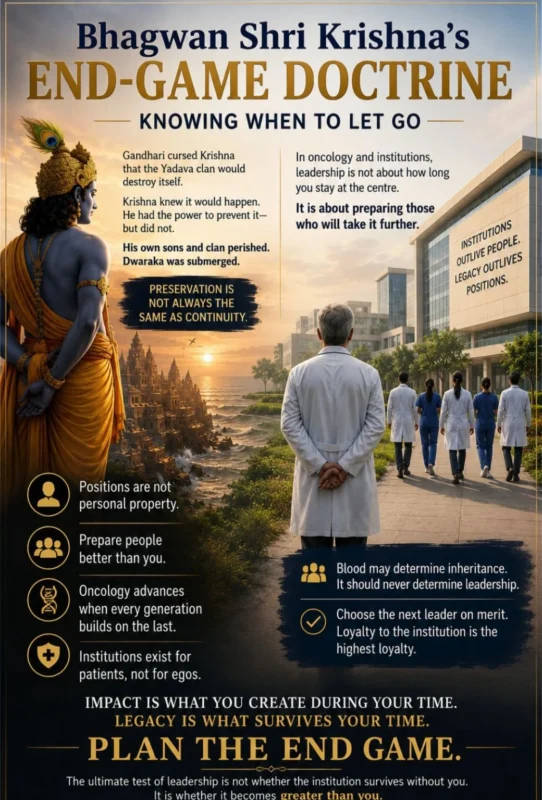
Amol Akhade, Senior Consultant Medical Oncologist and Hemato-Oncologist at Fortis Hospitals Mumbai, shared on LinkedIn:
“Krishna’s End-Game Doctrine: Knowing When to Let Go
One of the most profound and uncomfortable episodes in the story of Bhagwan Krishna comes after the Kurukshetra war.
Gandhari, devastated by the death of her sons, cursed Krishna. She believed that Krishna, despite having the power to prevent the destruction of the Kuru dynasty, had chosen not to.
Her curse was that the Yadava clan would eventually meet the same fate.
Krishna knew what was coming. According to the traditional account, he had the power to prevent it – but did not.
Years later, the Yadavas destroyed themselves. Krishna’s own sons died. His own clan perished. Dvaraka, the magnificent city associated with him, was eventually abandoned and submerged.
Why would Krishna allow his own dynasty, his own sons and his own city to disappear?
Perhaps because he understood a truth leaders often struggle with:
Preservation is not always the same as continuity.
We become attached to what we build. Positions become identities. Institutions become extensions of ourselves. And eventually, protecting the institution can become indistinguishable from protecting our position within it.
This is true for every field including oncology.
Senior oncologists may continue to practise, teach and mentor for decades – and rightly so. Experience is invaluable. But the issue is not age. It is whether our continued presence is creating value or preventing the next generation from creating theirs.
At some point, the question changes from:
‘Can I continue?’
to:
‘Should I continue to occupy this space when another generation is ready?’
We hold positions too long. Succession is postponed. Younger colleagues wait. Institutions become dependent on individuals rather than stronger because of them.
And family makes succession even harder. We naturally want our children to inherit what we built. But an institution is not a family heirloom.
Blood may determine inheritance. It should never determine leadership.
If our children are the most capable, give them the baton. If someone else is better, choosing them is loyalty to the institution – and ultimately to the patients it serves.
The real measure of a senior oncologist is therefore not only patients treated, papers published or years spent in the chair.
It is also:
How many people did I prepare to become better than me?
Krishna did not preserve his clan simply because it was his. He did not preserve his sons simply because they were his sons. He allowed an era to end.
Perhaps that is the deeper lesson from Bhagwan Krishna: leadership is not only the courage to build and protect. It is also the wisdom to recognise when an era has run its course – and the humility to let the next one begin.
Impact is what you create during your time. Legacy is what survives your time. Plan the end game.
Because the ultimate test of leadership is not whether the institution survives without you. It is whether it becomes greater than you. ”