





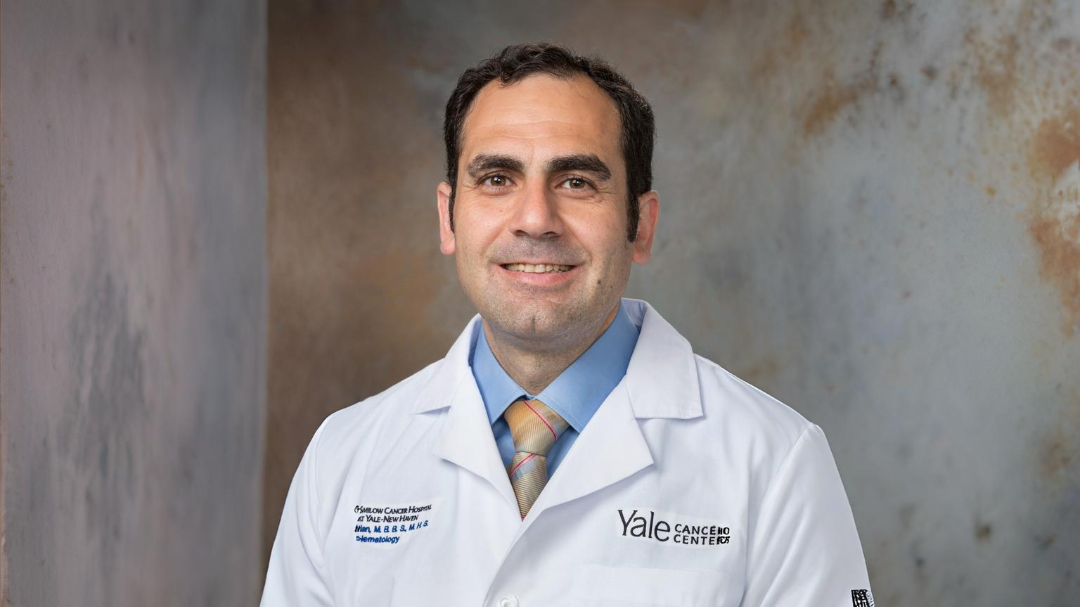
Amer Zeidan, Professor of Medicine, Chief of Hematologic Malignancies, Director of Heme Clinical Research at Yale University, shared a post on LinkedIn:
“Proud of our collaborative work between the International Consortium for Myelodysplastic Syndromes (icMDS), GenoMed4All, and Synthema which was just published in HemaSphere EHA.
MDSsm are biologically diverse cancers and need personalized treatment approaches. The IWG_PM introduced the MDS taxonomy, that categorizes patients into 16 genetic subgroups. This study sought to validate and enhance the clinical relevance of the MDS taxonomy by analyzing a large retrospective cohort (n = 5136) and transcriptomic data from a prospective cohort (n = 477). The taxonomy successfully identified subgroups with distinct clinical characteristics and disease progression patterns.
However, incorporating gene interactions from taxonomy subgroups did not improve the prognostic performance of the Molecular International Prognostic Scoring System (IPSS-M). We further assessed whether the taxonomy could guide management in patients receiving disease-modifying therapies.
Except for the ‘TP53-complex‘ subgroup, taxonomy classifications were not predictive of hypomethylating agent response or transplant outcomes. Nonetheless, they correlated with overall survival, suggesting that while both IPSS-M and the taxonomy capture disease biology, other non-genetic factors may influence treatment response. RNA sequencing confirmed the biological distinctiveness of the taxonomy groups.
Transcriptomic profiling of CD34+ bone marrow cells revealed unique, homogeneous gene expression patterns, particularly within the AML-like, biTET2, SF3B1, and TP53-complex subgroups. Further integration of multi-omics data may refine MDS classification, improving clinical decision-making and guiding the development of targeted therapies.”
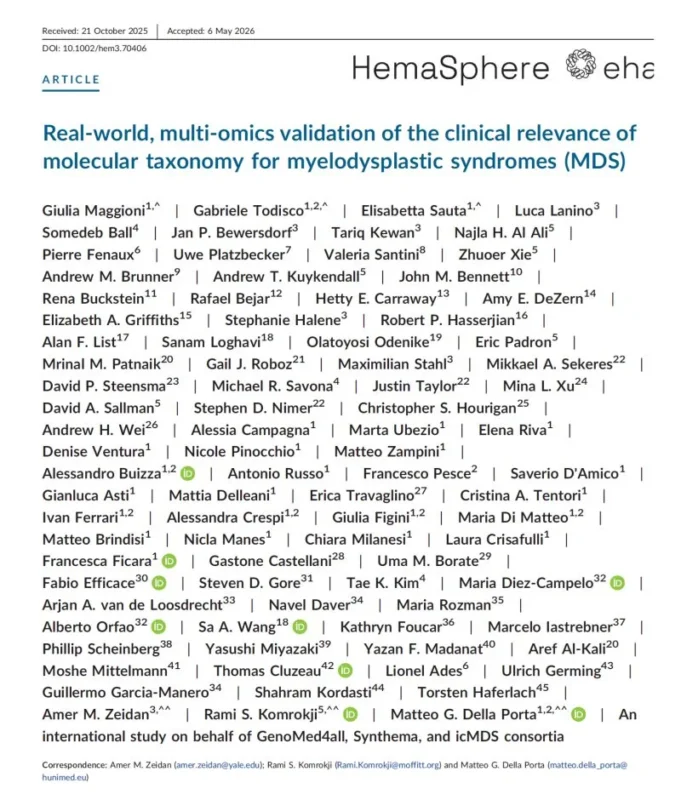
Title: Real-world, multi-omics validation of the clinical relevance of molecular taxonomy for myelodysplastic syndromes (MDS)
Authors: Giulia Maggioni, Gabriele Todisco, Elisabetta Sauta, Luca Lanino, Somedeb Ball, Jan P. Bewersdorf, Tariq Kewan, Najla H. Al Ali, Pierre Fenaux, Uwe Platzbecker, Valeria Santini, Zhuoer Xie, Andrew M. Brunner, Andrew T. Kuykendall, John M. Bennett, Rena Buckstein, Rafael Bejar, Hetty E. Carraway, Amy E. DeZern, Elizabeth A. Griffiths, Stephanie Halene, Robert P. Hasserjian, Alan F. List, Sanam Loghavi, Olatoyosi Odenike, Eric Padron, Mrinal M. Patnaik, Gail J. Roboz, Maximilian Stahl, Mikkael A. Sekeres, David P. Steensma, Michael R. Savona, Justin Taylor, Mina L. Xu, David A. Sallman, Stephen D. Nimer,
Christopher S. Hourigan, Andrew H. Wei, Alessia Campagna, Marta Ubezio, Elena Riva, Denise Ventura, Nicole Pinocchio, Matteo Zampini, Alessandro Buizza, Antonio Russo, Francesco Pesce, Saverio D’Amico, Gianluca Asti, Mattia Delleani, Erica Travaglino, Cristina A. Tentori, Ivan Ferrari, Alessandra Crespi, Giulia Figini, Maria Di Matteo, Matteo Brindisi, Nicla Manes, Chiara Milanesi, Laura Crisafulli, Francesca Ficara, Gastone Castellani, Uma M. Borate, Fabio Efficace, Steven D. Gore, Tae K. Kim, Maria Diez-Campelo, Arjan A. van de Loosdrecht, Navel Daver, Maria Rozman, Alberto Orfao, Sa A. Wang, Kathryn Foucar, Marcelo Iastrebner, Phillip Scheinberg, Yasushi Miyazaki, Yazan F. Madanat, Aref Al-Kali, Moshe Mittelmann, Thomas Cluzeau, Lionel Ades, Ulrich Germing, Guillermo Garcia-Manero, Shahram Kordasti, Torsten Haferlach, Amer M. Zeidan, Rami S. Komrokji, Matteo G. Della Porta
Read The Full Article
Other articles about Amer Zeidan on OncoDaily.