Aishee Pal Sadhu, Medical Advisor and Manager, Medical Team, Delhi NCR, North Zone at ImmunoACT, shared a post on LinkedIn:
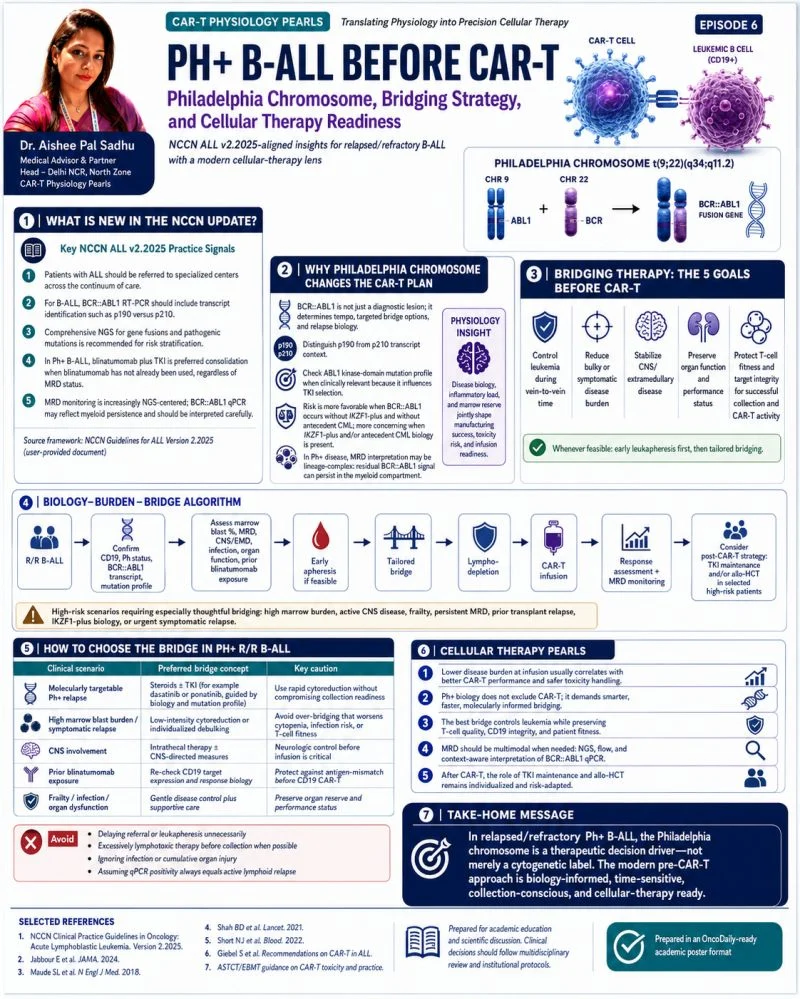
“Episode 6. Ph+ B-ALL BEFORE CAR-T. The Biology-Burden-Bridge Algorithm.
Translating molecular physiology into precision cellular therapy.
Philadelphia chromosome positivity should not be treated as a binary label before CAR-T.
In relapsed or refractory Ph+ B-ALL, the decisive question is not simply whether a patient is eligible for cellular therapy. The more relevant question is whether molecular biology, disease burden, antigen integrity, T-cell fitness and the manufacturing timeline have been aligned before leukapheresis and infusion.
In Episode 6 of CAR-T Physiology Pearls, I present a Biology-Burden-Bridge framework for Ph+ B-ALL before CAR-T, integrating National Comprehensive Cancer Network (NCCN) practice signals with a contemporary cellular-therapy perspective.
The framework prioritises:
- Identification of p190 versus p210 BCR::ABL1 transcripts; mutation-informed TKI selection;
- Differentiation of lymphoid MRD from multilineage BCR::ABL1 persistence;
- Early leukapheresis before potentially lymphotoxic bridging;
- Preservation of CD19 after prior antigen-directed therapy;
- CNS and extramedullary disease control; and
- Risk-adapted consideration of post-CAR-T TKI maintenance and allo-HCT.
My central proposition:
The optimal bridge is not necessarily the most intensive therapy. It is the least T-cell-compromising strategy that achieves sufficient disease control to deliver CAR-T safely and effectively.
For oncologists, hematologists, transplant physicians, cellular therapy colleagues:
Which variable most often changes your bridging decision in Ph+ B-ALL – BCR::ABL1 biology, marrow burden, CNS disease, previous CD19-directed therapy or the manufacturing interval?”
Other articles featuring Aishee Pal Sadhu on OncoDaily.