






Adrian Lee, Professor at University of Pittsburgh, shared on LinkedIn:
“Organoid biology and precision oncology – three companion papers just published together in Nature Portfolio, all validating patient-derived 3D cancer models as the next generation of preclinical tools.
Deep thanks to the Broad Institute team, including James N., Francisca Vazquez, and many others for leading ‘A dependency map enhanced with next-generation 3D cancer models,’ which Steffi Oesterreich, Daniel D. Brown, and I were proud to contribute to.
This is exactly the mission of the University of Pittsburgh School of Medicine Organoid Research Core within our Institute for Precision Medicine, so it’s gratifying to see it validated at this scale
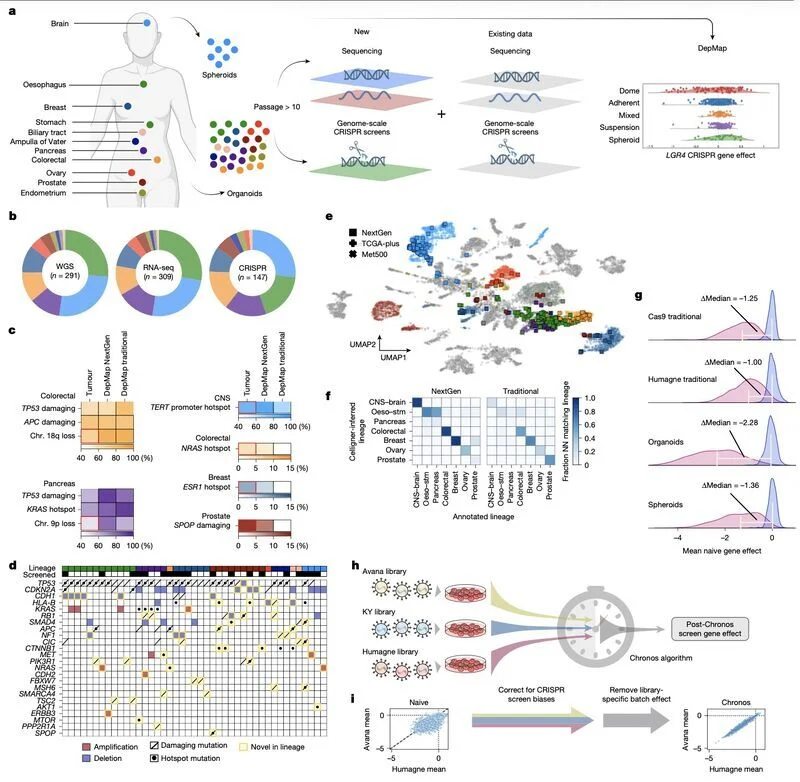
The Broad Institute of MIT and Harvard team ran genome-scale CRISPR screens across 147 organoid and spheroid models spanning 10 cancer types, expanding the Cancer Dependency Map (DepMap) into tumor subtypes traditional cell lines simply don’t capture.
These models preserve transcriptional programs that get silenced in 2D culture (like the PDAC-classical/MUC program in GI organoids), and oncogene dependency itself can be model-dependent. Model choice shapes the biology we’re able to see.
Our contribution to this work was supported in part by NIH R01CA252378 through the National Cancer Institute (NCI) Oncology Models Forum, grateful for that support in helping make this collaboration possible.
This seminal paper is published alongside two outstanding companion papers:
Herranz-Ors et al. (Welcome Sanger Institute), ‘A tumour-derived organoid biobank maps cancer gene dependencies‘ – 256 clinically annotated organoids across five GI/gynecologic cancers, with genome-wide CRISPR dependency screens on 162 of them.
ElHarouni et al., ‘A compendium of next-generation patient-derived models for diverse cancers‘ – the Human Cancer Models Initiative’s landmark 665-model resource across 25 cancer types.
Together, these three papers make a compelling, converging case that organoids and related New Approach Methodologies (NAMs) can faithfully recapitulate tumor biology at a scale sufficient for systematic target discovery, not just as a nice complement to cell lines, but as tools that reveal biology cell lines miss entirely.
That’s the bet we’ve made with the Organoid Research Core here at Pitt, and it’s exciting to see it borne out across multiple independent efforts at once.”
Title: A dependency map enhanced with next-generation 3D cancer models
Authors: James V. Neiswender, Samuel Maffa, Lisa Brenan, Dina ElHarouni, Yejie Yun, Isabella Boyle, Kirsty Wienand, Haider Inam, Tate Bertea, Ashley Anderson, Megan Wong, Matias Enriquez, Evan Lenz, Beatriz Villafranca, Nora Shanks, Mary Hager, Nia Lloyd, Hannah Shadmany, Sarah J. Wie, Harry Liang, Konnor Yunghans, Xiaomeng Zhang, Lauren Golden, Hannah Harris, Serena Day, Philip Montgomery, Samantha Stokes, Ross M. Giglio, Cynthia Hajal, James R. Whittle, Guadalupe Garcia, Caitlin E. Mills, Mehdi Touat, Kristine Pelton, Hongyu Li, Prem Sai Prabhakar, Sonja Herter, Zoe Hoffmann Kamrat, Dan Gui, Julien Dilly, Chen Khuan Wong, Jimmy A. Guo, Sangita Pal, Yossef Baidi, Ryan Johnston, Daniel D. Brown, Sonam Bhatia, Peter S. Winter, Srivatsan Raghavan, Rameen Beroukhim, Eva Colas, David L. Spector, Adam J. Bass, Peter K. Sorger, Yu Chen, Sarah J. Hill, Steffi Oesterreich, Adrian V. Lee, Himisha Beltran, Jesse S. Boehm, Yuen-Yi Tseng, David E. Root, William C. Hahn, Andrew J. Aguirre, Catarina D. Campbell, Keith L. Ligon, Joshua M. Dempster, Tsukasa Shibue Francisca Vazquez, Francisca Vazquez
Title: A tumour-derived organoid biobank maps cancer gene dependencies
Authors: C. Herranz-Ors, S. G. Bhosle, A. E. Beck, J. G. R. Gilbert, G. Picco, J. Espejo Valle-Inclan, F. Muyas, S. Valentini, A. E. Andres,
R. Ansari, S. Barthorpe, G. Battarbee, C. M. Beaver, S. Brocklesby, J. Cantwell, z. A. Collins, J. Davis, H. G. Dimitrova, J. Doran, E. Efendi,
K. Evans, M. Fekry, T. A. Fowler, M. Garcia-Casado, J. A. T. Griffiths, C. Hall, R. Hamer, C. Hardy, Z. Hewitson, E. Hitch, L. Holland, D. A. Jackson, N. Joshi, A. Kavasakali, L. Letchford, H. B. Lightfoot, H. Lingala, I. Mali, K. May, T. Mironenko, J. Morris, C. Pacini, S. Price, G. Robert-Tissot, H. A. Rogers, J. V. Smith, K. Smith, E. Souster, W. J. Spence, F. Thomas, S. F. Vieira, S. Walker, G. Alfonsin, H. Bermingham, H. Coles, D. P. Ennis, A. Freeman, G. Giannone, N. Grehan, E. A. Griffiths, J. Hall, S. L. Lee, E. Y. L. Leung, C. Loreno, C. Millington,
A. Mirnezami, B. Nutzinger, K. Orzechowska, C. M. A. Pinna, A. M. Redmond, K. Roberts, S. Roy, D. A. Sanders, P. Taniere, M. Vias, K. Wanigasooriya, OCCAMS Consortium, M. R. Stratton, L. M. Staudt, U. McDermott, J. D. Brenton, I. A. McNeish, A. Biankin, O. J. Sansom, I. Cortes-Ciriano, T. J. Underwood, R. C. Fitzgerald, A. D. Beggs, H. E. Francies & M. J. Garnet
Title: A compendium of next-generation patient-derived models for diverse cancers
Authors: Dina ElHarouni, Mushriq Al-Jazrawe, Seongmin Choi, Merve Dede, Toshinori Hinoue, Sean A. Misek, Heeju Noh, Luca Zanella, Yuen-Yi Tseng, Hayley E. Francies, Dennis Plenker, Cindy W. Kyi, Julyann Perez-Mayoral, Megan J. Stine, Eva Tonsing-Carter, Rachana Agarwal, Jean Claude Zenklusen, James M. Clinton, Jennifer M. Shelton, Timothy R. Chu, William F. Hooper, Xavi Loinaz, Paula Keskula, Jordan Tagle, Peyton C. Kuhlers, Bahar Tercan, Sylvia F. Boj, Alessandro Vasciaveo, Lorenzo Tomassoni, James M. Crawford, Shawna Walsh, Claire Sinai, Sonam Bhatia, Priya Sridevi, Hardik Patel, Maria Antonietta Cerone, The HCMI Network, Kyle Ellrott, Calvin J. Kuo, Olivier Elemento, Semir Beyaz, Vincenzo Corbo, David L. Spector, Rameen Beroukhim, Martin L. Ferguson, Andrew D. Cherniack, Peter W. Laird, Nicolas Robine, Andrew McPherson, Katherine A. Hoadley, Mathew J. Garnett, David A. Tuveson, Andrea Califano,Paul T. Spellman, Keith L. Ligon, Daniela S. Gerhard, Louis M. Staudt and Jesse S. Boehm
Other articles featuring Adrian Lee on OncoDaily.