Abdul Mannan, Founder of First AI-Based Haematology Education System at Blood Doctor, shared on LinkedIn:
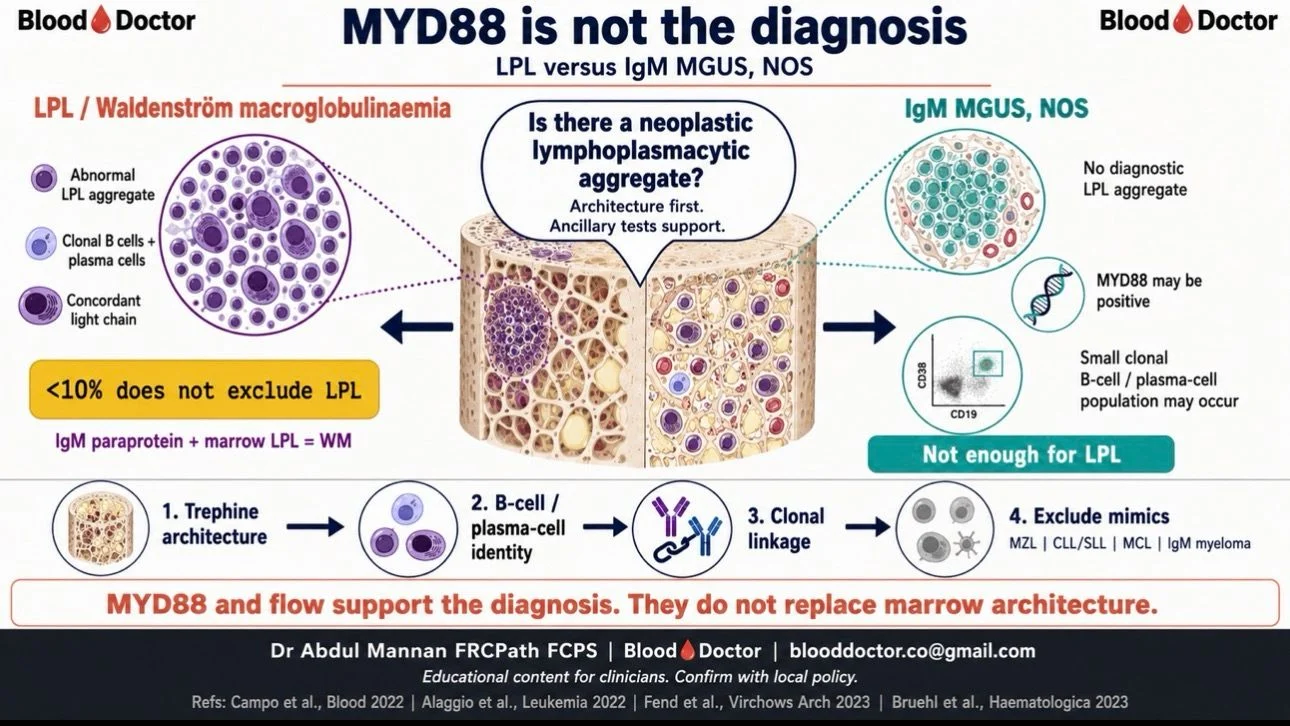
“MYD88 L265P is not a lymphoma diagnosis.
Neither is a tiny clonal B-cell population on flow cytometry.
This is where the old 10% marrow rule can mislead us.
In the ICC 2022 approach, lymphoplasmacytic lymphoma can be diagnosed below 10% marrow involvement. But only when the trephine shows an abnormal lymphoplasmacytic aggregate and the B-cell and plasma-cell components are clonally linked.
Here is the practical rule:
- Start with marrow architecture, not the mutation result
- Ask whether the aggregate is truly abnormal and B-cell rich, rather than reactive and T-cell rich
- Show linkage between the B-cell clone, plasma cells and serum IgM, usually through concordant light-chain restriction
- Use MYD88 and flow as supporting evidence, not as a shortcut around morphology
IgM MGUS, NOS can still be MYD88-mutated. It can still show a small clonal B-cell population. It can still show clonal plasma cells.
What it must not show is a diagnostic lymphoplasmacytic aggregate.
That is the line between a precursor state and low-volume LPL. If IgM is present with marrow LPL, the clinicopathological diagnosis is Waldenström macroglobulinaemia, whether or not treatment is needed today.
Fend et al. in Virchows Archiv (2023) and Bruehl et al. in Haematologica (2023) make this point clearly, alongside the ICC 2022 report in Blood.
How do you word the borderline report when flow is positive but the marrow architecture is not convincing?”