Aadil Najeed, Senior Resident at Government Medical College Srinagar, shared on LinkedIn:
“SBRT vs Prostatectomy in Localised Prostate Cancer: What do the 8-year PACE-A results tell us?
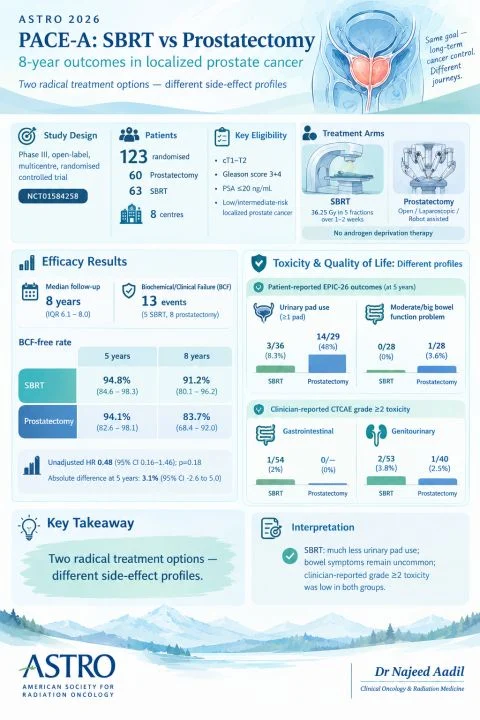
The long-term results from PACE-A (NCT01584258), a phase III randomised trial, provide important evidence for men with localised prostate cancer considering surgery or stereotactic body radiotherapy (SBRT).
Study design
PACE-A randomised 123 men across 8 centres:
- 63 → SBRT
- 60 → Prostatectomy
- Median age: 65.5 years
- Median PSA: 7.9 ng/mL
- 94.3% had intermediate-risk disease
- SBRT: 36.25 Gy in 5 fractions over 1–2 weeks
- No androgen deprivation therapy was permitted
The primary endpoint was freedom from biochemical/clinical failure (BCF).
Long-term cancer control
After a median follow-up of 8 years:
Only 13 BCF events occurred: 5 after SBRT and 8 after prostatectomy
8-year BCF-free rates: SBRT: 91.2%, Prostatectomy: 83.7%
5-year BCF-free rates were similarly high: SBRT: 94.8%, Prostatectomy: 94.1%
The unadjusted HR for BCF was 0.48 (95% CI 0.16–1.46; p=0.18).
Importantly, the study was not powered to demonstrate superiority of one treatment over the other.
But the most interesting part for me is what happens beyond cancer control: toxicity and quality of life.
Urinary outcomes at 5 years
Patient-reported use of ≥1 urinary pad: SBRT: 3/36 (8.3%) and Prostatectomy: 14/29 (48%)
That is a striking difference in urinary continence outcomes.
Bowel function
Moderate/big bowel function problems were uncommon: SBRT: 0/28 (0%) and Prostatectomy: 1/28 (3.6%)
Clinician-reported grade ≥2 toxicity
Gastrointestinal: SBRT: 1/54 (2%) and Prostatectomy: 0 patients
Genitourinary: SBRT: 2/53 (3.8%) and Prostatectomy: 1/40 (2.5%)
So, rather than simply saying that one treatment has ‘fewer side effects‘, the more accurate message is that the two approaches have different toxicity profiles.
SBRT avoids surgery and was associated with substantially less urinary pad use, while clinically significant GI/GU toxicity remained uncommon in both groups.
The bigger picture
PACE-A adds long-term randomised evidence to an increasingly important conversation: Can a 5-fraction, non-surgical treatment provide durable cancer control while preserving quality of life?
At 8 years, both prostatectomy and SBRT demonstrated excellent biochemical/clinical control.
And the patient-reported urinary outcomes highlight something extremely important in prostate cancer treatment: The decision is not only about controlling the cancer.
It is also about understanding what life may look like after treatment.
Different treatments can achieve excellent cancer control while producing very different experiences for patients.
For me, this is one of the most valuable messages from the PACE-A trial: modern prostate cancer treatment is increasingly about balancing oncological control with function, toxicity, convenience and the patient’s priorities.
PACE-A | NCT0158425.”
Other articles about ASTRO 2026 on OncoDaily.