
Roche has entered an exclusive global licensing and collaboration agreement with Nurix Therapeutics to co-develop and co-commercialize bexobrutideg, an investigational oral BTK degrader for B-cell malignancies, in a transaction valued at up to $2.3 billion. Under the terms of the agreement, Nurix will receive an upfront cash payment of $700 million and is eligible to receive development, regulatory and sales milestones for potential total payments of up to $2.3 billion. Roche announced the agreement from Basel on 8 June 2026, with Nurix issuing a parallel disclosure to investors. The Roche–Nurix collaboration centers on bexobrutideg (NX-5948), an oral BTK degrader being developed across B-cell malignancies, immunology and neurology.
The candidate sits within the established Bruton’s tyrosine kinase (BTK) treatment area but uses a distinct mechanism. Bexobrutideg is described as an investigational, oral, brain-penetrant, highly selective small molecule BTK targeted protein degrader; BTK is a central signaling node controlling B-cell growth, development and immunologic activity. Rather than inhibiting the protein, the oral degrader eliminates BTK from the cell, removing both its kinase activity and scaffolding function, an approach the developers state may help address the drug resistance seen with traditional BTK inhibitors.
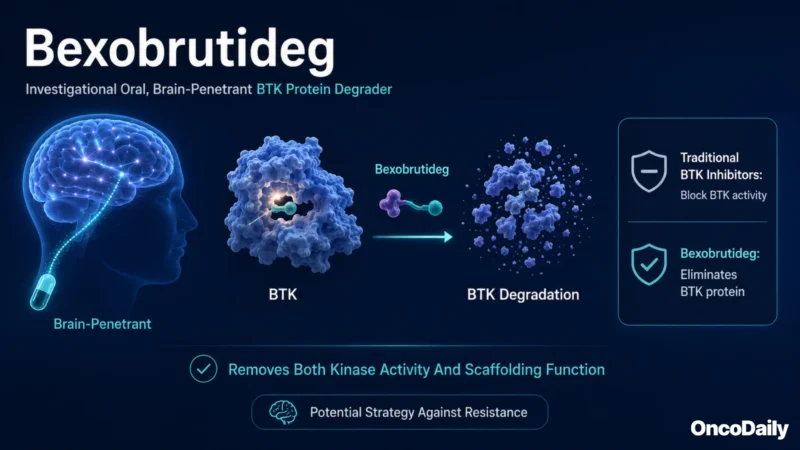
Bexobrutideg Development Stage and Phase III Timeline
Bexobrutideg is moving from early- and mid-stage testing toward registrational trials. In addition to ongoing pivotal Phase 2 and Phase 3 activity in chronic lymphocytic leukemia, the companies plan Phase 2 trials in multiple sclerosis and chronic spontaneous urticaria, and Phase 3 trial initiation in chronic lymphocytic leukemia is planned for this summer. The collaboration spans a clinical development plan across B-cell malignancies, immunology and neurology, complementing Roche’s established position in hematology while extending its pipeline into new therapeutic areas.
Earlier clinical data underpin the agreement. An 80.9% objective response rate was reported in heavily pre-treated relapsed or refractory CLL patients, including those previously exposed to BTK inhibitors and BCL-2 inhibitors, drawn from 47 response-evaluable patients as of a March 2025 data cut from the Phase 1a study. With Phase III initiation in chronic lymphocytic leukemia scheduled for this summer, market entry is projected around 2030, contingent on trial outcomes and regulatory review.
The candidate enters a competitive treatment area. Approved BTK inhibitors include AbbVie and Johnson & Johnson’s Imbruvica (ibrutinib), AstraZeneca’s Calquence (acalabrutinib), and BeOne Medicines’ Brukinsa (zanubrutinib), the last of which recorded roughly $3.9 billion in global sales in 2025.
Roche–Nurix Deal Terms: Cost Sharing, U.S. Co-Commercialization and Royalties
The deal allocates development funding and commercial responsibilities across both partners. Development costs will be shared 40% by Nurix and 60% by Roche, and the parties will equally split the profits and losses from U.S. commercialization. Nurix and Roche will co-commercialize bexobrutideg in the United States across all indications; outside the United States, Roche will be responsible for commercialization, with Nurix eligible to receive royalties ranging from the low- to high-teens.
The transaction remains subject to regulatory clearance before completion. The deal is subject to customary conditions, including Hart-Scott-Rodino clearance, and is expected to close in the third quarter of 2026. The cost-sharing arrangement places Nurix at 40% of development spending while it runs the Phase 3 program and concurrently funds immunology and neurology work, distributing both the financial commitment and the multi-indication clinical scope across the two organizations.
What the Bexobrutideg Deal Means for the Blood Cancer Market
The agreement adds a targeted protein degrader to Roche’s hematology portfolio at a point when the BTK treatment area is dominated by inhibitor-class agents. The collaboration brings together Nurix’s work in targeted protein degradation and Roche’s portfolio of B-cell targeted therapies alongside its global clinical and commercial infrastructure. The CLL market is projected to grow from $12 billion in 2024 to $16 billion by 2035.
The deal structure, combining shared development costs, equal U.S. profit and loss sharing, and ex-U.S. royalties, reflects a partnership model that retains commercial participation for the originating biotechnology company while drawing on a larger partner’s late-stage development and distribution capabilities. The clinical and regulatory path ahead, beginning with the planned Phase III CLL study, will determine whether the degrader approach can establish a differentiated position relative to the established inhibitor class.
Read more biotech insights on OncoDaily Biotech.
Written by: Semiramida Nina Markosyan, Editor, OncoDaily Canada