On June 22, China’s National Medical Products Administration approved satricabtagene autoleucel, known as satri-cel, for certain patients with advanced gastric and gastroesophageal junction cancer. The decision, granted to Shanghai-based CARsgen Therapeutics, is the first time any regulator anywhere has cleared a CAR-T cell therapy for a solid tumor. For a field that has delivered striking cures in blood cancers but repeatedly stalled against the tumors that account for the overwhelming majority of cancer deaths, it is a milestone the sector has chased for more than a decade. It is also, just as importantly, the opening of a commercial chapter whose outcome is far from settled.
What CAR-T is, and why solid tumors were so hard
CAR-T therapy works by drawing a patient’s own T cells, the immune system’s natural assassins, and genetically reprogramming them in a laboratory to recognize a specific protein on cancer cells. The engineered cells are multiplied and infused back, where they hunt and destroy tumor cells carrying that marker. In leukemias and lymphomas the approach has been transformative, because blood cancer cells circulate freely and tend to display clean, consistent targets.
Solid tumors are a different problem. Their cells hide inside dense tissue that engineered cells struggle to penetrate, they surround themselves with a microenvironment that actively suppresses immune attack, and they rarely carry a single uniform marker that is absent from healthy organs. Those biological barriers are why, until now, no solid-tumor CAR-T had reached the market.
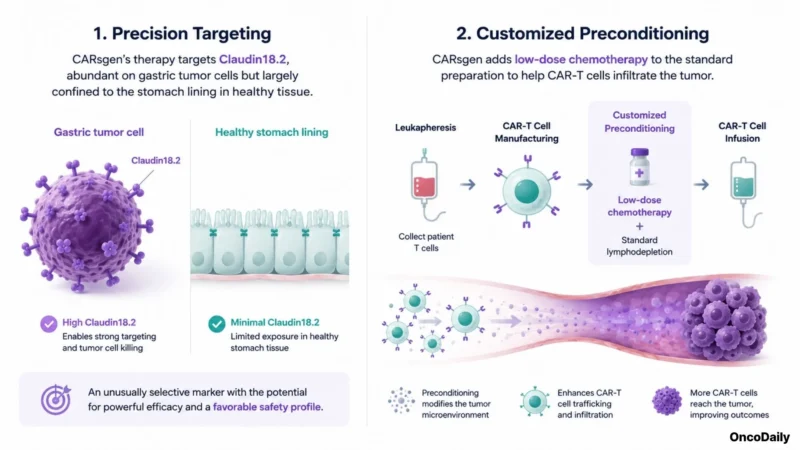
CARsgen’s therapy targets Claudin18.2, a protein abundant on gastric tumor cells but largely confined to the stomach lining in healthy tissue, making it an unusually selective marker. The company also developed a customized preconditioning regimen, adding low-dose chemotherapy to the standard preparation, intended to help the cells infiltrate the tumor. The approval rests on a randomized Phase 2 trial published in The Lancet, in which satri-cel extended median progression-free survival to 3.25 months versus 1.77 months for physician’s choice of treatment, with median overall survival of 7.92 months against 5.49 months in heavily pretreated patients who had largely run out of options (Qi et al., 2025).
The company and its strategy
CARsgen, listed in Hong Kong, has built end-to-end capabilities spanning target discovery, clinical development, and commercial-scale manufacturing, and it says it was first to validate Claudin18.2 as a CAR-T target. Its strategy is to treat this later-line gastric approval as a beachhead rather than a destination. The company is already testing satri-cel in earlier lines of gastric cancer, in perioperative and adjuvant settings, and in other Claudin18.2-positive cancers such as pancreatic and biliary tract tumors, where the same targeting rationale applies.
It is running a North American Phase 1b/2 study to position the program for filings in Western markets, and the therapy has already drawn regulatory attention abroad, with U.S. RMAT and orphan-drug designations and European PRIME and orphan status. The disease burden gives the strategy commercial logic: gastric cancer ranks fifth worldwide in both incidence and mortality, more than 70% of cases occur in Asia, and Chinese patients alone account for roughly 47% of the global total.
China’s rise in cell therapy
The approval is as much a statement about China as about CARsgen. Over the past several years the country has built one of the world’s most active cell-therapy ecosystems, running large numbers of CAR-T trials, nurturing a deep bench of domestic developers, and pairing them with regulators increasingly willing to grant priority review and breakthrough status to move novel therapies quickly. Shanghai authorities publicly pledged to accelerate satri-cel’s path to market.
That combination of clinical-trial volume, manufacturing investment, and regulatory speed means a Chinese company has now reached a scientific finish line ahead of long-established Western players, a marker of how far the country’s innovation capacity has matured and a signal global oncology firms cannot ignore. For investors, it validates Claudin18.2 as a commercial target and intensifies a race already crowded with competing CAR-T, antibody, and T-cell-engager programs from Chinese and U.S. biotechs alike.
The commercial barriers ahead
A first approval, however, is not the same as a solved problem. Autologous CAR-T remains expensive and logistically demanding: each dose is manufactured individually from a patient’s own cells, requiring specialized facilities, trained centers, and careful coordination. Hospital readiness varies widely, and the safety profile is real, the trial reported cytokine release syndrome in the great majority of treated patients and high rates of serious adverse events, complications that demand experienced teams to manage.
Reimbursement is an open question in a market where many patients pay substantial sums out of pocket, and several Chinese developers are openly racing to drive per-dose costs down. Patient access will depend on how quickly capacity, financing, and trained centers expand beyond a handful of leading hospitals.
A milestone, not a finish line
The honest reading is that satri-cel proves the concept without closing the case. The pivotal data come from a Phase 2 study with survival gains measured in months, not the durable remissions CAR-T can produce in blood cancers, and the field will be watching what longer follow-up, post-market safety monitoring, and broader real-world use reveal about durability of response and value in everyday practice.
Whether the approach extends to other solid tumors, and whether it can be delivered affordably at scale, will determine if this is the first crack in a long-standing barrier or a narrow win in one biomarker-defined niche. For now, the cell-therapy industry has crossed a threshold that eluded it for years, and inherited a fresh set of commercial and clinical questions that will take years more to answer.
Read more biotech insights on OncoDaily Biotech.
Written by: Semiramida Nina Markosyan, Editor, OncoDaily Canada