Big pharma has committed more than $13 billion to radioligand therapy since 2023. The science is no longer the risk. The atoms are.
In roughly two years, radioligand therapy has gone from a logistics-heavy backwater of nuclear medicine to the most actively traded modality in oncology dealmaking. Since late 2023, drugmakers have committed more than $13 billion across acquisitions and licensing deals, much of it for assets still in clinical trials, chasing a class of cancer drugs that suddenly looks like the next great targeted platform. The catalyst was simple: commercial proof.
How it works, and why the industry fell in love
A radioligand therapy is two parts bolted together. The first is a targeting molecule, an antibody, a peptide, or a small molecule, engineered to seek out a protein that sits on the surface of cancer cells but not healthy ones. The second is a radioactive payload: an isotope that rides the targeting molecule to the tumor and irradiates it from a few cell-widths away. The pitch is precision. Rather than blasting a region with external-beam radiation or flooding the body with chemotherapy, the drug delivers its dose directly to the malignant cell and largely spares the tissue around it. It can also reach micro-metastases that a surgeon’s knife or a radiation beam never will.
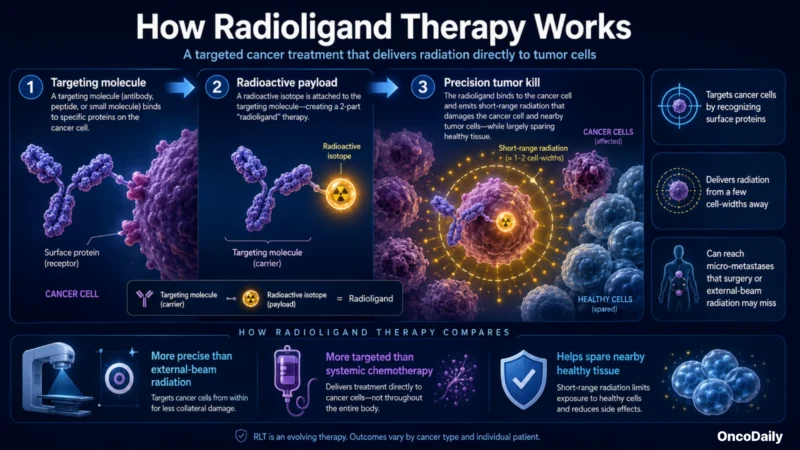
Two isotopes anchor the field. Lutetium-177, a beta emitter, has defined the commercial era: its particles travel a relatively long distance and kill with moderate force. Actinium-225, an alpha emitter, is the coming thing, its radiation is far more potent over a much shorter range, snapping both strands of a cancer cell’s DNA. That potency is exactly why demand for it has outrun supply.
The commercial proof, and the buying spree it triggered
The asset that silenced the skeptics is Novartis‘s Pluvicto, a lutetium-177 therapy targeting PSMA in metastatic prostate cancer. It reached roughly $2.0 billion in sales in 2025, up 42% year over year, after regulators cleared it for use earlier in the treatment pathway. Lutathera, Novartis’s second approved radioligand anchor, lifted the company’s combined radiotherapy sales to about $2.8 billion. Once a radioligand crossed the blockbuster line, the rest of the industry decided the model worked, and moved.
The result was a land grab. Bristol Myers Squibb bought RayzeBio for roughly $4.1 billion. AstraZeneca acquired Fusion Pharmaceuticals in a deal worth up to about $2.4 billion. Eli Lilly took out Point Biopharma for roughly $1.4 billion, and Novartis added Mariana Oncology for about $1 billion. Layer in licensing pacts, Novartis with PeptiDream, Lilly with Aktis, Bayer with Bicycle, and the total committed since 2023 clears $13 billion. Tellingly, three of the four big acquisitions were built around actinium-225.
The bottleneck no one’s pricing in
Here is the contrarian core of the story: the binding constraint on this field is not the biology. It is the atoms. And nowhere is that clearer than with actinium-225.
Ac-225 is genuinely rare. For nearly three decades it has been produced mainly at the Department of Energy’s Oak Ridge National Laboratory, milked in minute quantities from a dwindling stock of thorium-229 left over from Cold War–era nuclear programs. That legacy route is exquisitely pure but finite, historically only a handful of these “generators” existed worldwide, together yielding, by common industry estimates, enough material for only one to two thousand patient treatments a year. Against a pipeline of dozens of trials, that is nothing.
The alternatives are hard. Firing protons at radium-226 in a cyclotron works, but radium targets are hazardous and suitable machines are scarce. Blasting thorium-232 with high-energy protons produces actinium in volume, but it co-generates actinium-227, a contaminant with a roughly 22-year half-life that cannot be chemically separated out in any useful timeframe. Electron-accelerator and photonuclear routes sidestep that problem but are still being scaled. Compounding everything, these isotopes decay in days, lutetium-177 in about a week, actinium-225 in roughly ten, so nothing can be stockpiled. A dose that misses its shipping window is simply gone.
The consequences are not hypothetical. In 2024, BMS’s RayzeBio paused new-patient enrollment in ACTION-1, the Phase III trial of its lead actinium candidate RYZ101, because it could not secure enough Ac-225, a year after BMS paid $4.1 billion for the company. Novartis, for its part, watched Pluvicto land on the FDA shortage list in 2023 when a single Italian manufacturing site couldn’t keep up with demand. For investors, the lesson is uncomfortable: a late-stage radioligand asset with no locked-in isotope supply is a stranded asset, and the trial timelines that drive biotech valuations now hinge on a nuclear supply chain most analysts have never modeled.
Where the smart money is going next
Which is why the next wave of capital is flowing not into molecules but into atoms. In 2026, TerraPower Isotopes, the Bill Gates–backed nuclear venture, broke ground on a $450 million actinium-225 plant in Philadelphia that, with its Washington-state site, aims to lift capacity roughly twentyfold by the end of the decade. NorthStar Medical Radioisotopes is scaling an accelerator-based route to a purer, non-carrier-added product. Producers from Belgium’s PanTera to Canadian Nuclear Laboratories are racing to add reactors, cyclotrons, and generators, while drugmakers including Novartis and AstraZeneca sign multiyear supply deals to guarantee their share.
The strategic reality is now plain to anyone underwriting this boom. The drug candidates are abundant and the science is increasingly derisked; the scarce, supply-constrained input, the thing worth owning, is the isotope. In radiopharmaceuticals, the molecule isn’t the bottleneck. The isotope is.
Read more biotech insights on OncoDaily Biotech.
Written by: Semiramida Nina Markosyan, Editor, OncoDaily Canada