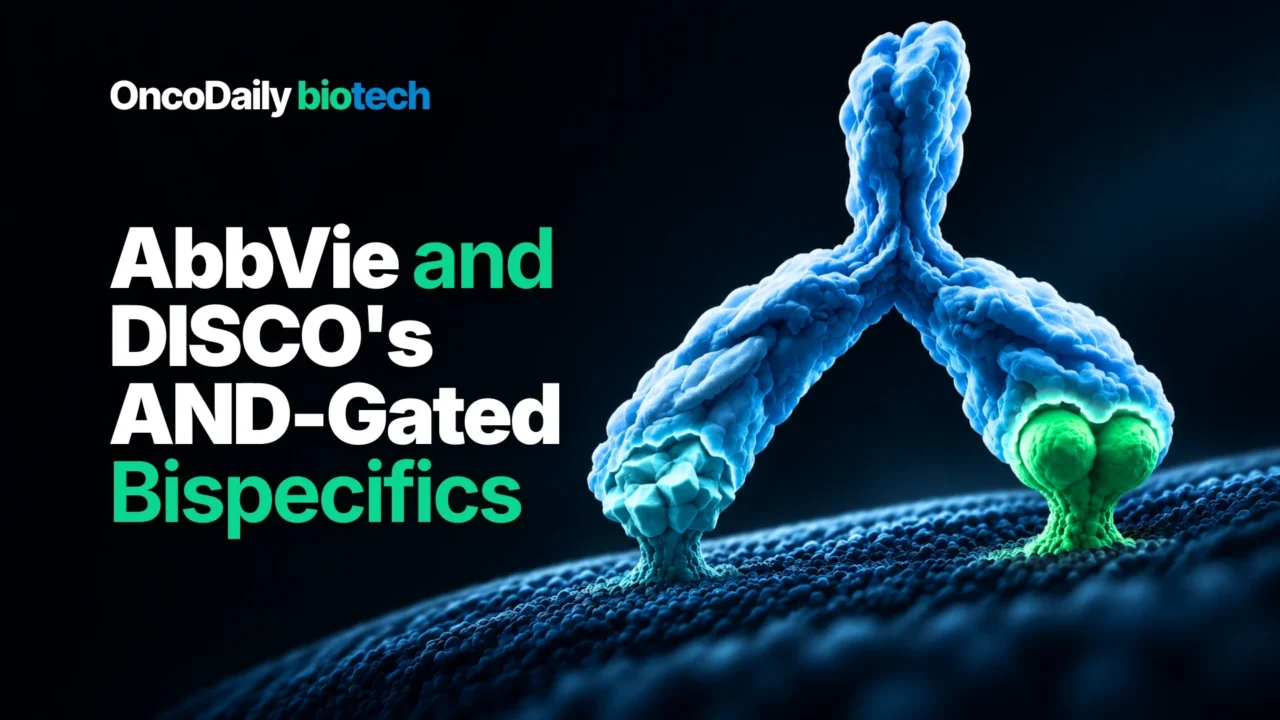
Your bank won’t let you in on a password alone, and DISCO Pharmaceuticals wants cancer drugs to work the same way. On November 19, the Cologne biotech signed a collaboration and option-to-license agreement with AbbVie to discover AND-gated bispecifics for solid tumors. These are antibody-drug conjugates (ADCs) and T-cell engagers built to engage two cell-surface targets at once. DISCO receives $40 million upfront and is eligible for up to $2.5 billion in option, development and other milestones, plus tiered royalties on worldwide net sales.
What is an AND-gated bispecific?
In digital logic, an AND gate fires only when both inputs are on. Applied to drugs, the molecule should act only on cells displaying both of its targets. The need is real: most cell types, Lajoie et al. (2020) noted, “lack a single surface marker that distinguishes them.”
Researchers have shown the idea can work in the lab:
- Lajoie et al. (2020) designed protein switches that perform AND, OR and NOT logic on cell surfaces and used them to steer CAR-T cells.
- Banaszek et al. (2019) split a T-cell engager into two halves that reassemble only when both bind the same cell. In preclinical leukemia and breast cancer models, “T lymphocytes exclusively eliminate dual antigen-positive cells while sparing single positive bystanders.”
- Oostindie et al. (2022) engineered antibody pairs that act as Boolean AND gates, activating only on cells co-expressing both targets.
DISCO argues that requiring both targets could expand the pool of usable targets and reduce on-target, off-tumor toxicity, which it identifies as a major limitation of solid tumor therapies.
Where DISCO’s target pairs come from
DISCO’s DISCOtech platform maps cancer-specific cell-surface expression and identifies target pairs that flag tumor cells. It combines cell-surface proteomics with protein community mapping.
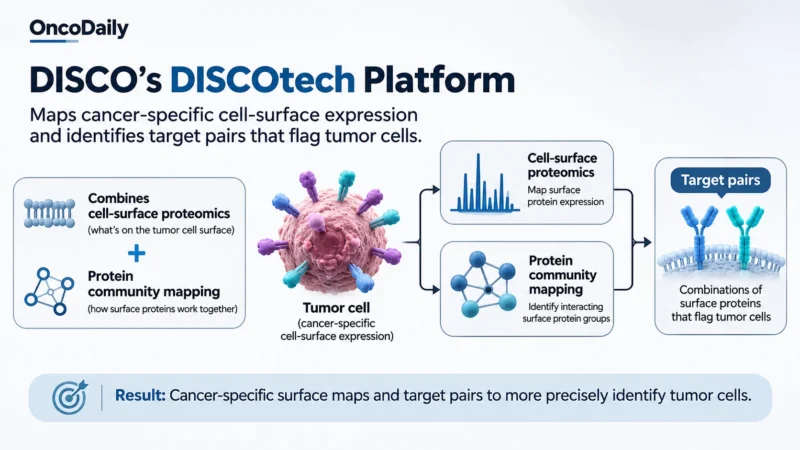
The company’s surface proteomics roots are at ETH Zurich. Co-founder Bernd Wollscheid was first author of the 2009 paper describing cell surface capture, a mass-spectrometry method that identifies hundreds of cell-surface glycosylation sites without antibodies (Wollscheid et al., 2009). At its 2024 launch, DISCO said it had completed the first surfaceome map of a cancer type, small cell lung cancer. It also said fewer than 30 molecular targets underpin all antibody-based therapies.
AbbVie–DISCO deal terms
DISCO will carry out specified research; if it succeeds, AbbVie can exclusively license selected programs. The targets, tumor types and number of programs were not disclosed. CEO Mark Manfredi said the approach is “designed to selectively target tumor cells while sparing healthy tissue.”
AbbVie is not new to the company. AbbVie Ventures was in DISCO’s launch syndicate and took part in the €36 million seed close in December 2025. In January, Amgen took exclusive global rights to programs against a target DISCO’s platform mapped, in a deal worth up to $618 million plus royalties.
Why it matters for solid tumors
For ADCs and T-cell engagers, the target often defines the toxicity. Most targets of current T-cell-redirecting therapies are differentiation antigens shared with normal tissue, and engaging them can cause serious adverse events, Banaszek et al. (2019) noted. Logic-gating offers a route to shared targets when only the combination is tumor-specific. The same week, Lilly bet on a related idea, tumor-specific epitopes, with Stipple Bio.
For AbbVie, the deal adds early discovery behind a clinical solid tumor portfolio. In January it licensed RC148, a PD-1/VEGF bispecific, from RemeGen for $650 million upfront and up to $4.95 billion in milestones, partly to combine with ADCs such as telisotuzumab adizutecan. DISCO’s own lead ADC programs target small cell lung cancer and microsatellite-stable colorectal cancer.
What’s next
AbbVie’s option applies only after DISCO completes the agreed research, and no clinical timelines were given. DISCO’s own lead programs are progressing toward the clinic. The key test is whether the dual-antigen selectivity seen in preclinical models (Banaszek et al., 2019; Oostindie et al., 2022) holds in patients.
About the companies
AbbVie is a North Chicago, Illinois, biopharmaceutical company. As of January it was evaluating more than 35 investigational cancer medicines in clinical trials across small molecules, ADCs, multispecific antibodies and CAR-T platforms.
DISCO Pharmaceuticals is a Cologne-based ETH Zurich spin-out founded in May 2022 by Roman Thomas, Johannes Heuckmann, Bernd Wollscheid and Julien Sage. CEO Mark Manfredi previously led Ikena Oncology.
FAQ
What does “AND-gated” mean for a cancer drug? The molecule is designed to engage two surface proteins at once, aiming to act on tumor cells while sparing healthy tissue.
What is AbbVie paying DISCO? $40 million upfront, up to $2.5 billion in option, development and other milestones, and tiered royalties.
Read further insights on OncoDaily Biotech.