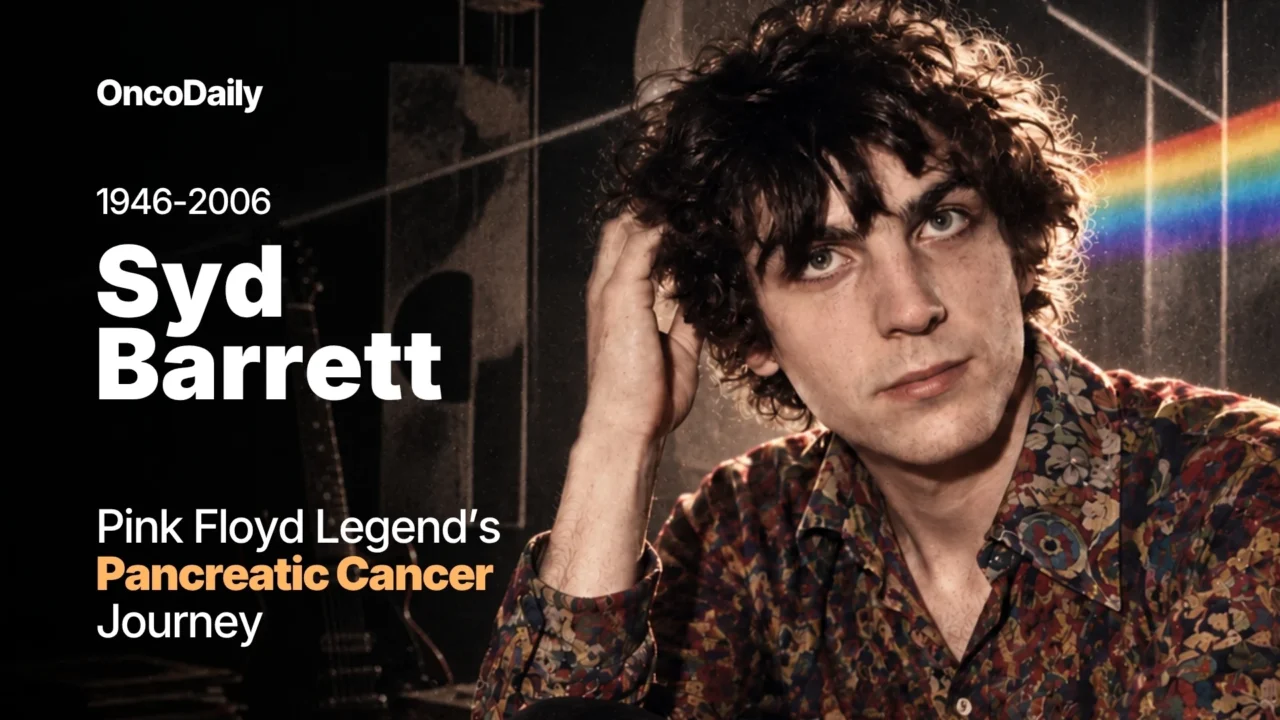
Syd Barrett, co-founder, original lead singer, guitarist, and principal songwriter of early Pink Floyd, died at his home in Cambridge, England, on July 7, 2006, at age 60. Pink Floyd’s official history records pancreatic cancer as the cause of death. Barrett’s public career was remarkably brief. Yet the music he created during Pink Floyd’s formative years helped establish the band’s psychedelic identity and influenced the direction of progressive rock that followed.
His story is therefore unusual in two ways: a musician whose creative influence vastly outlived his active career, and a private individual whose death from pancreatic cancer brought renewed attention to a disease that remains difficult to detect and treat.
Syd Barrett: The Visionary Behind Early Pink Floyd
Born Roger Keith Barrett on January 6, 1946, in Cambridge, Barrett co-founded Pink Floyd in 1965 alongside Roger Waters, Richard Wright, and Nick Mason. He became the band’s original frontman and principal creative force during its early years. Barrett wrote much of Pink Floyd’s first recorded material, including “Arnold Layne” and “See Emily Play,” and led the band through its landmark debut album, The Piper at the Gates of Dawn, released in 1967.
His approach to songwriting and performance was unconventional. Barrett combined surreal imagery, unusual song structures, experimental guitar techniques, and studio effects, helping create the distinctive psychedelic sound that initially defined Pink Floyd. The band’s first major successes came quickly. “Arnold Layne” became Pink Floyd’s first single, followed by “See Emily Play,” which became an even bigger British hit. The Piper at the Gates of Dawn subsequently reached the UK Top 10.
The Rise and Success of Pink Floyd
Although Barrett left Pink Floyd early in the band’s history, his creative influence remained embedded in the group’s musical identity. After Barrett’s departure in 1968, David Gilmour joined the band, while Roger Waters increasingly became its principal lyricist and conceptual leader. Pink Floyd subsequently developed from a psychedelic rock group into one of the most commercially successful and influential bands in music history.
Their later albums achieved extraordinary global success. The Dark Side of the Moon, released in 1973, has sold more than 50 million copies worldwide and remains one of the best-selling albums in music history. Wish You Were Here, released in 1975, was also a major international success. The album became Pink Floyd’s first record to reach No. 1 in both the United Kingdom and United States, and its central song cycle included “Shine On You Crazy Diamond,” widely understood as a tribute to Barrett.
The band’s 1979 album The Wall became another landmark, reinforcing Pink Floyd’s status as one of rock’s defining acts. The Rock & Roll Hall of Fame describes The Dark Side of the Moon and The Wall as two of the most ambitious and best-selling albums ever made. Pink Floyd was inducted into the Hall of Fame in 1996. Barrett therefore remained connected to Pink Floyd’s legacy even after his departure. His experimental approach helped establish the creative foundation from which the band’s later sound evolved.
Barrett’s Departure From Music
By 1967 and 1968, Barrett’s behavior had become increasingly unpredictable, and his ability to continue functioning within Pink Floyd deteriorated. David Gilmour eventually joined the band, initially helping to supplement Barrett before becoming his replacement. Barrett formally left Pink Floyd in 1968. He later released two solo albums, The Madcap Laughs and Barrett, both in 1970. Neither marked the beginning of a sustained return to music.
Barrett gradually withdrew from professional life and eventually abandoned the music industry altogether. His disappearance from public life contributed to the mythology surrounding him, but it is important not to reduce his later years to a simple narrative of “genius and collapse.” His personal circumstances were complex, and many details of his health remain uncertain.
Years of Reclusion and Declining Health
After leaving the music industry, Barrett returned to Cambridge and lived a highly private life. He spent much of his later years away from the media and rarely discussed his former band or career. Accounts describe him pursuing private interests including painting and gardening rather than returning to music or public performance. There has also been extensive discussion of Barrett’s mental health and his use of psychedelic drugs during the 1960s. However, retrospective accounts often disagree about his diagnosis, and it is important not to present an unconfirmed psychiatric diagnosis as established medical fact. Likewise, while his historical drug use has been extensively documented, there is no established evidence that his psychedelic drug use caused his pancreatic cancer.
Pancreatic Cancer Diagnosis
Barrett died on July 7, 2006, at his home in Cambridge, England, aged 60. Pink Floyd’s official website identifies pancreatic cancer as the cause of death. Public information about his cancer is extremely limited. The exact date of his diagnosis, stage at diagnosis, histologic subtype, treatment regimen, response to treatment, and whether he underwent surgery or systemic therapy have not been publicly documented in reliable medical sources. That distinction matters. Barrett’s death can be accurately described as being caused by pancreatic cancer, but his individual clinical course should not be reconstructed from speculation.
Pancreatic Cancer: Why It Remains So Difficult
Pancreatic cancer develops in the pancreas, an organ located deep within the abdomen that plays important roles in digestion and blood-glucose regulation. Most pancreatic cancers arise from exocrine cells, with pancreatic ductal adenocarcinoma (PDAC) being the dominant histologic type. Pancreatic neuroendocrine tumors (pNETs) are much less common and generally have a different biological behavior and prognosis.
One of the major challenges is that pancreatic cancer can produce few or nonspecific symptoms during its early stages. As a result, many patients are diagnosed only after the disease has progressed. The International Agency for Research on Cancer (IARC), part of the World Health Organization, estimates that pancreatic cancer was responsible for approximately 510,992 new cases and 467,409 deaths worldwide in 2022. It ranked 12th for incidence but 6th for cancer mortality, illustrating its disproportionately high mortality burden. IARC describes pancreatic cancer as one of the cancers with the least favorable prognosis.
What Are the Symptoms of Pancreatic Cancer?
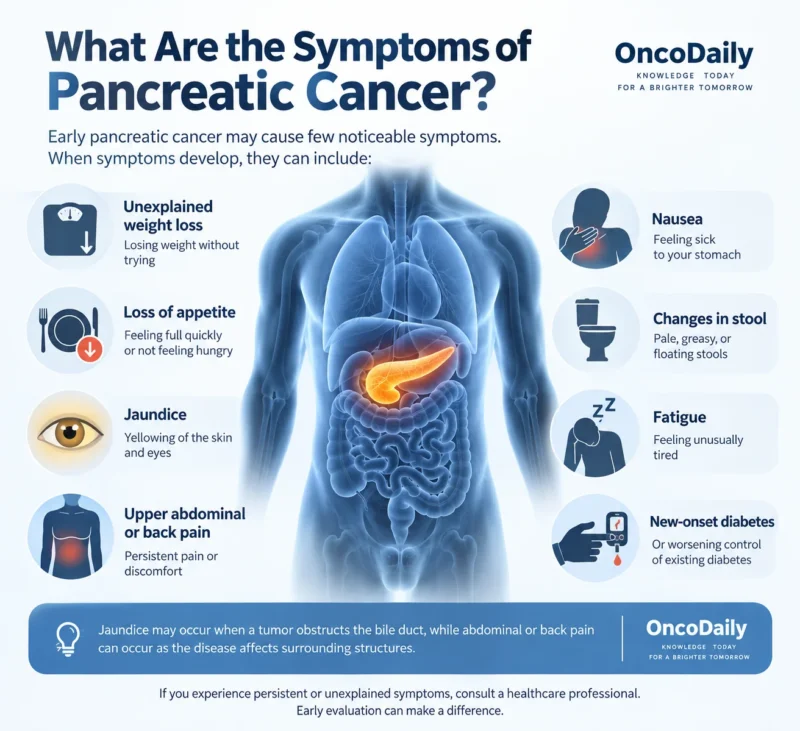
Early pancreatic cancer may cause few noticeable symptoms, but as the disease develops, symptoms can include unexplained weight loss, loss of appetite, jaundice, upper abdominal or back pain, nausea, changes in stool, fatigue, and new-onset diabetes or worsening control of existing diabetes. Jaundice may occur when a tumor obstructs the bile duct, while abdominal or back pain can develop as the disease affects surrounding structures. These symptoms are not specific to pancreatic cancer and can have many other causes, but persistent or unexplained symptoms should be evaluated by a healthcare professional.
What Increases the Risk of Pancreatic Cancer?
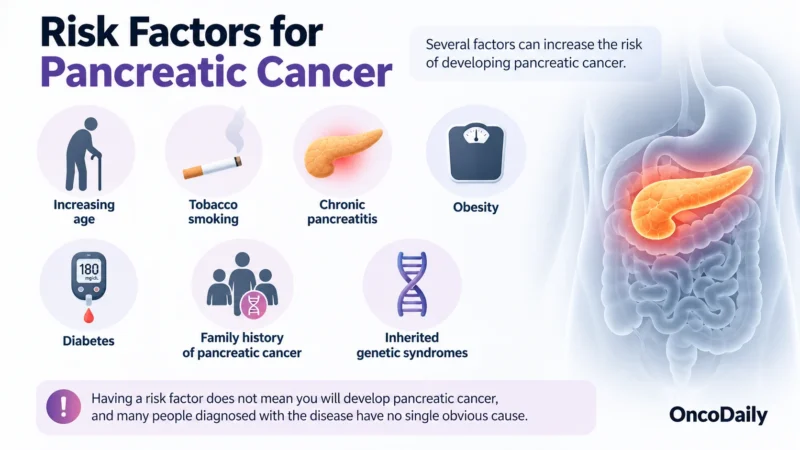
Risk factors for pancreatic cancer include increasing age, tobacco smoking, chronic pancreatitis, obesity, diabetes, a family history of pancreatic cancer, and certain inherited genetic syndromes. Smoking is one of the most established modifiable risk factors, while chronic pancreatitis and some inherited conditions can also increase risk. However, having a risk factor does not mean that someone will develop pancreatic cancer, and many people diagnosed with the disease have no single obvious cause.
How Is Pancreatic Cancer Diagnosed?
Diagnosis generally involves a combination of imaging, laboratory evaluation, and, when appropriate, tissue sampling. Doctors may use:
- CT scans
- MRI or MRCP
- Endoscopic ultrasound
- Endoscopic procedures such as ERCP in selected cases
- Blood tests
- CA 19-9, primarily as a disease-monitoring marker rather than a stand-alone diagnostic test
- Biopsy, when tissue confirmation is needed
The cancer’s stage and whether it can be completely removed surgically are among the most important factors in determining treatment.
Pancreatic Cancer Treatment
Treatment depends heavily on whether the tumor is resectable, borderline resectable, locally advanced, or metastatic. For patients with localized, resectable disease, surgery offers the possibility of long-term survival and may include procedures such as the Whipple procedure for tumors involving the pancreatic head. Systemic chemotherapy is also an important component of treatment. Depending on the clinical setting, regimens may include FOLFIRINOX or gemcitabine-based combinations.
Radiation therapy may be considered in selected patients, while targeted therapy or immunotherapy can be appropriate for specific molecular subgroups. For advanced disease, treatment generally focuses on controlling the cancer, extending survival, managing symptoms, and maintaining quality of life. Clinical trials remain particularly important because pancreatic cancer continues to have a poor overall prognosis and researchers are actively investigating new targeted therapies, immunotherapies, vaccines, cellular therapies, and approaches to earlier detection.
Pancreatic Cancer Survival Rates
Survival statistics illustrate why early detection and effective treatment remain major priorities. According to the U.S. National Cancer Institute’s SEER data, the 5-year relative survival for pancreatic cancer is 13.7% for patients diagnosed during 2016–2022. But the overall figure does not tell the whole story. Survival varies substantially according to how far the cancer has spread at diagnosis:
For pancreatic cancer, the 5-year relative survival varies substantially by stage at diagnosis: 43.6% for localized disease, 17.0% for regional disease, 3.4% for distant or metastatic disease, and 13.7% across all stages combined. Only about 15% of pancreatic cancers are diagnosed while localized, while approximately 51% are diagnosed after distant spread in the SEER dataset. These numbers demonstrate why stage at diagnosis is so important. They are population-level statistics, however, and cannot predict what will happen to an individual patient.
Why Early Detection Matters
Pancreatic cancer remains difficult to detect early because its symptoms can be vague and there is currently no recommended population-wide screening program for people at average risk. The NCI notes that evidence-based screening information is not currently available for pancreatic cancer in the general population. For people with strong family histories or certain inherited genetic syndromes, however, specialized surveillance may be considered through high-risk programs. Earlier diagnosis can make a major difference because localized tumors are more likely to be considered for potentially curative surgery. The current SEER data show a substantial difference between the 43.6% 5-year relative survival for localized disease and 3.4% for distant disease.
Why Syd Barrett’s Story Resonates
Barrett’s story is often remembered through the lens of his extraordinary creative output and his subsequent disappearance from public life. But his legacy should not be reduced to his mental health, drug use, or illness.
Within only a few years, Barrett helped create the musical identity of early Pink Floyd. His songwriting and experimentation influenced the band that would eventually produce The Dark Side of the Moon, Wish You Were Here, and The Wall—albums that transformed Pink Floyd into one of the most successful groups in rock history. His death from pancreatic cancer adds another dimension to his story, but the limited public medical information means there is no basis for making assumptions about his diagnosis, treatment, or disease progression.
A Legacy That Outlived His Career
Syd Barrett’s active career lasted only a few years, but his influence lasted decades. He helped establish Pink Floyd’s earliest sound and aesthetic before leaving the band at the beginning of its transformation into a global rock phenomenon. The group’s later success became enormous, but Barrett remained an important part of its history and mythology.
His death in 2006 closed a life that had moved from intense public attention to extraordinary privacy. Pancreatic cancer was the final medical diagnosis publicly associated with him, but it was only one part of a much larger story. Barrett is ultimately remembered for what he created: songs, sounds, ideas, and an approach to music that helped push rock beyond conventional boundaries.
You Can Also Read Tony Iommi Lymphoma Battle: How the Black Sabbath Legend Beat Cancer by OncoDaily

Written by Aharon Tsaturyan, MD, Editor at OncoDaily Intelligence Unit
FAQ
Who was Syd Barrett?
Syd Barrett was a founding member, vocalist, guitarist, and principal songwriter of Pink Floyd who helped establish the band's early psychedelic sound.
When did Syd Barrett die?
Syd Barrett died on July 7, 2006, in Cambridge, England, at the age of 60.
What type of cancer did Syd Barrett have?
Syd Barrett died from pancreatic cancer. Publicly available sources do not provide detailed information about his specific tumor subtype or stage.
What was Syd Barrett’s cause of death?
His cause of death was pancreatic cancer.
How successful was Pink Floyd?
Pink Floyd became one of the most commercially successful and influential rock bands in history, with landmark albums including The Dark Side of the Moon, Wish You Were Here, and The Wall.
Did Syd Barrett write songs for Pink Floyd?
Yes. Barrett was the principal songwriter during Pink Floyd's earliest period and wrote or co-wrote many of the band's first songs.
What are the early symptoms of pancreatic cancer?
Possible symptoms include unexplained weight loss, jaundice, abdominal or back pain, appetite loss, fatigue, digestive changes, and new-onset or worsening diabetes.
What is the survival rate for pancreatic cancer?
The overall 5-year relative survival for pancreatic cancer in the United States is about 13.7%, although survival varies considerably by stage.
Can pancreatic cancer be detected early?
Early detection can be difficult because pancreatic cancer may cause few or nonspecific symptoms. There is currently no recommended routine screening program for people at average risk.
What are the main risk factors for pancreatic cancer?
Important risk factors include increasing age, smoking, chronic pancreatitis, obesity, diabetes, family history, and certain inherited genetic syndromes.
Who founded Pink Floyd?
Pink Floyd was formed in London in 1965 by Syd Barrett, Roger Waters, Richard Wright, and Nick Mason. Barrett served as the band's original frontman and principal songwriter during its early years.
What was Pink Floyd’s most successful album?
The Dark Side of the Moon is one of Pink Floyd’s most successful and influential albums. Released in 1973, it became one of the best-selling albums in music history and helped establish the band as a global rock phenomenon.
Did Pink Floyd remain successful after Syd Barrett left?
Yes. Although Barrett's departure in 1968 marked the end of his active role in the band, Pink Floyd went on to achieve enormous international success. Albums such as The Dark Side of the Moon, Wish You Were Here, and The Wall became landmark records in rock music, while Barrett remained an important influence on the band's early identity.