
Nicole “Snooki” Polizzi has shared an encouraging update after treatment for stage 1 cervical adenocarcinoma: she currently has no evidence of cervical cancer after undergoing a hysterectomy in July 2026. The Jersey Shore star said in September that doctors had removed the cancer. However, she has also acknowledged that recurrence remains possible and that continued medical surveillance will be part of her care.
Her update comes approximately seven months after she publicly disclosed her cervical cancer diagnosis following years of abnormal Pap-smear results. Her experience highlights not only the treatment of early cervical cancer, but also one of the most important opportunities in modern oncology: cervical cancer is one of the cancers for which vaccination, screening and treatment of precancer can prevent a substantial proportion of cases.
From Abnormal Pap Tests to Cervical Cancer
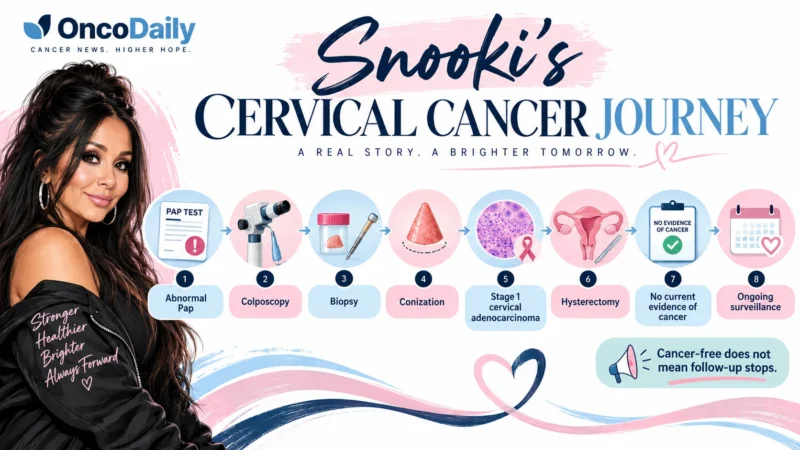
Snooki has said that abnormalities involving her cervix had been monitored for several years before doctors eventually identified adenocarcinoma. Her diagnostic journey included colposcopy, biopsy, conization and ultimately hysterectomy. A colposcopy allows clinicians to examine the cervix under magnification and obtain targeted biopsies from abnormal areas. A cone biopsy, or conization, removes a cone-shaped section of cervical tissue that can then be examined by a pathologist. Conization may help determine whether abnormal cells remain precancerous or whether malignant cells have invaded deeper cervical tissue.
Importantly, an abnormal Pap test does not mean that a patient has cervical cancer. Abnormal cervical cells are relatively common and can have different causes and levels of severity. Some abnormalities disappear spontaneously, while persistent high-grade lesions may require additional investigation or treatment. Snooki’s experience illustrates why the follow-up after an abnormal screening result can be just as important as the initial screening test itself.
What Type of Cervical Cancer Did Snooki Have?
Snooki has described her diagnosis as stage 1 cervical adenocarcinoma. Cervical cancer is broadly divided into different histologic types. Squamous cell carcinoma is the most common, while adenocarcinoma develops from glandular cells of the cervix. Stage I generally means that the cancer remains confined to the cervix, but stage I includes several substages based on factors such as the depth of invasion and tumor size.
Those details are important because treatment can differ substantially between a very small microscopic stage IA tumor and a larger stage IB cancer. Snooki has not publicly disclosed enough pathology information to determine her precise substage, tumor dimensions, lymphovascular invasion, lymph-node findings, surgical-margin status or other prognostic factors.

You Can Also Read Snooki Reveals Stage 1 Cervical Cancer Diagnosis After Abnormal Pap Smears by OncoDaily
What Does “Cancer-Free” Mean?
In discussing her recovery, Snooki said:
“As of right now, I am cancer-free.”
That is encouraging, but in oncology the phrase “cancer-free” does not necessarily mean that recurrence is impossible. A patient may have no current evidence of disease after treatment while still requiring follow-up because cancer can sometimes recur months or years later. Snooki has said that her doctors warned her that recurrence remains possible, which is why surveillance will continue. The most medically precise description is therefore that Snooki has reported no current evidence of cervical cancer after surgery and remains under surveillance. That should not automatically be interpreted as permanent cure.
Why Follow-Up After Cervical Cancer Matters
Cervical cancer recurrence is more likely during the earlier years after treatment, making structured follow-up important. The National Cancer Institute notes that many guidelines recommend follow-up approximately every three to four months during the first two years, followed by evaluations roughly every six months, although the optimal schedule has not been established by high-quality trials and care should be individualized. Follow-up focuses particularly on medical history, physical examination and new symptoms. Imaging and other tests may be used when clinical findings raise concern.
Snooki has discussed continued Pap- or HPV-related monitoring, but her exact surveillance plan should not be generalized to every cervical cancer survivor. Follow-up after hysterectomy depends on the original pathology, previous precancer, surgical margins, type of surgery, treatment history and the recommendations of the treating oncology team.
Why Did Snooki Have a Hysterectomy?
A hysterectomy removes the uterus and cervix. Depending on the type of procedure, additional surrounding tissues may also be removed. Surgery can be used with curative intent in selected patients with early-stage cervical cancer. The appropriate procedure depends on factors including tumor size, depth of stromal invasion, histologic subtype, lymphovascular space invasion, lymph-node status, margins and fertility preferences. For example, NCI treatment guidance includes conization or hysterectomy for selected stage IA1 cancers, while stage IA2 disease may be managed with modified radical hysterectomy and lymph-node assessment or, in selected patients seeking fertility preservation, radical trachelectomy.
Treatment is also becoming less extensive for carefully selected low-risk patients. In the SHAPE trial involving about 700 people with low-risk early cervical cancer, three-year pelvic recurrence was 2.52% after simple hysterectomy versus 2.17% after radical hysterectomy, while the less extensive procedure produced fewer urinary complications. Snooki has confirmed that she underwent a hysterectomy, but she has not publicly identified its exact extent. It would therefore be inappropriate to describe her surgery specifically as a radical hysterectomy unless that is confirmed.
Did Snooki Need Chemotherapy or Radiotherapy?
Based on the information she has publicly shared, surgery was the central treatment in Snooki’s cancer journey. She has not provided enough information to confirm a complete chemotherapy or radiotherapy regimen. Whether additional treatment is needed after surgery depends on the final pathology. Features such as positive lymph nodes, positive surgical margins, parametrial involvement or combinations of other adverse pathological factors can increase recurrence risk and influence decisions about radiation or concurrent chemoradiotherapy.
For some stage IB and IIA cervical cancers, treatment options can include radical hysterectomy with lymph-node assessment or radiation therapy given with chemotherapy. These general treatment principles should not be used to infer Snooki’s individual pathology or treatment plan.
Recovery After Hysterectomy
Snooki has said that she has gradually begun feeling more like herself after treatment. Recovery after hysterectomy varies substantially. Short-term effects may include pelvic discomfort, fatigue, bleeding or discharge, temporary limitations on exercise or lifting and emotional distress. Longer-term effects depend on the exact procedure and whether additional therapy was required.
Whether the ovaries were preserved is particularly important. Removal of both ovaries in a premenopausal patient results in surgical menopause, whereas hysterectomy alone does not necessarily cause immediate menopause. Snooki has not provided enough information to establish whether her ovaries were removed, so menopause should not be assumed.
The Emotional Impact of Cervical Cancer
Cancer treatment extends beyond surgery and pathology. Snooki has spoken about the fear surrounding the possibility of hysterectomy and how her diagnosis affected life as a mother of three while balancing family, work and recovery. Patients treated for cervical cancer may experience fear of recurrence, anxiety while awaiting scans or pathology, fertility concerns, changes in body image, sexual-health concerns and difficulty returning to normal routines. Feeling relieved that treatment has been completed and simultaneously fearful that cancer could return are not contradictory reactions.
Snooki’s Message to Women: Do Not Ignore Screening
One of Snooki’s clearest messages since her diagnosis has been to encourage women to undergo cervical screening and, critically, to follow up abnormal results.
She said:
“Get your Paps done.”
Her experience emphasizes an important point: the effectiveness of screening does not end when the laboratory reports an abnormal result. Pap tests and HPV testing identify people who may need repeat testing, colposcopy, biopsy or treatment of cervical precancer. Screening only reaches its full preventive potential when abnormal findings receive appropriate follow-up.
Cervical Cancer and HPV: How Strong Is the Link?
The relationship between cervical cancer and human papillomavirus is one of the strongest established infectious causes of cancer. WHO states that approximately 99% of cervical cancer cases are linked to high-risk HPV infection. Most HPV infections resolve spontaneously, but persistent infection with oncogenic HPV types can eventually lead to cervical precancer and invasive cancer. HPV itself is extremely common. WHO estimates that around 90% of people control HPV infection naturally, without developing persistent disease. Cancer usually develops only after persistent high-risk infection and a sequence of cellular changes that can occur over many years.
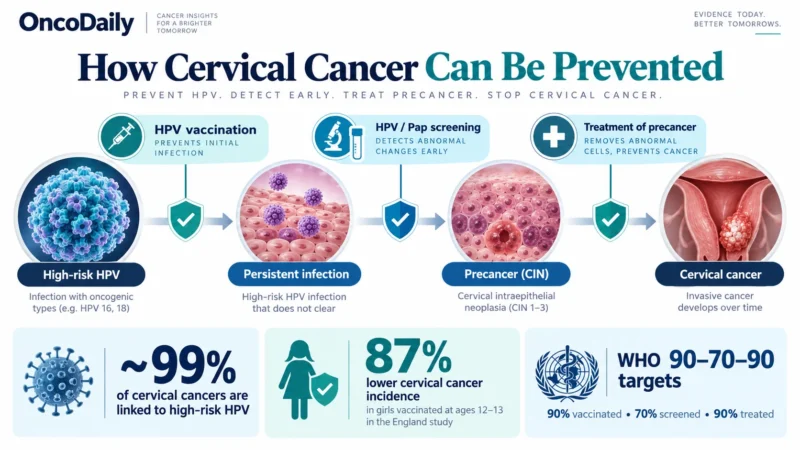
That relatively long precancerous period creates an opportunity for screening to identify abnormalities before invasive cancer develops. Yet cervical cancer remains a major global health problem. In 2022, approximately 660,000 women developed cervical cancer worldwide and around 350,000 died from the disease. Those numbers are especially striking because cervical cancer is one of the malignancies for which highly effective primary and secondary prevention strategies already exist.
How Effective Is HPV Vaccination?
HPV vaccination is fundamentally a form of cancer prevention. CDC estimates that HPV vaccination has the potential to prevent more than 90% of cancers caused by HPV. Population-level studies are now demonstrating reductions not merely in HPV infection, but in serious cervical precancers and cervical cancer itself. One of the strongest examples comes from England.
A large population study published in The Lancet compared vaccinated cohorts with an earlier unvaccinated population. Among girls offered HPV vaccination at ages 12–13, cervical cancer incidence was 87% lower, while incidence of CIN3—the most severe grade of cervical precancer was 97% lower. Researchers estimated that by June 2019, England’s vaccination programme had already prevented approximately 448 cervical cancers and 17,235 cases of CIN3 in the studied cohorts.
The age at vaccination mattered. Cervical cancer reductions were approximately 34% when vaccination was offered at ages 16–18, 62% at ages 14–16 and 87% at ages 12–13. This supports the principle that HPV vaccination works best when administered before exposure to HPV.
What Is Happening in the United States?
U.S. surveillance is showing a similar pattern. CDC researchers examining cervical precancer between 2008 and 2022 found that among screened women aged 20–24—the population most likely to have benefited from adolescent HPV vaccination the incidence of CIN2 or worse fell by approximately 79%, while CIN3 or worse fell by approximately 80%.
Among screened women aged 25–29, CIN3-or-worse incidence decreased by approximately 37%. Earlier U.S. data also showed dramatic declines in infection with vaccine-targeted HPV types. Compared with the prevaccine era, prevalence fell by 88% among females aged 14–19 and 81% among those aged 20–24. Together, these data provide real-world evidence that vaccination can interrupt the biological pathway that leads from HPV infection to cervical precancer and eventually cancer.
Why Screening Is Still Necessary After HPV Vaccination
HPV vaccination does not eliminate the need for cervical screening. Vaccines protect against the major cancer-associated HPV types, but they do not prevent every oncogenic HPV infection. Some individuals may also have been exposed to HPV before vaccination. Screening therefore provides a second layer of protection. Traditionally, cervical screening relied heavily on the Pap test, which identifies abnormal cervical cells under a microscope.
Modern screening increasingly uses high-risk HPV testing, which detects the carcinogenic viral infection that drives most cervical cancers. Evidence suggests that HPV-based screening can provide stronger protection against invasive disease.
A pooled analysis of four randomized European trials involving 176,464 women found that HPV-based screening provided approximately 60–70% greater protection against invasive cervical cancer than cytology-based screening during follow-up. The difference was particularly relevant after an initially negative screening result: women testing negative with HPV-based screening had substantially lower subsequent invasive cancer incidence than those screened with cytology.
HPV Testing vs. Pap Cytology: What Does the Research Show?
The ESTAMPA study provides another illustration. Researchers evaluated cervical screening performance across Latin America and identified 470 cases of significant cervical disease. Cytology missed 52%—242 of 470 cases whereas HPV testing missed only 2%, or 9 of 470 cases. The sensitivity of HPV testing remained above 96%, compared with a much wider range for cytology. This does not mean that cytology is obsolete. Rather, cervical screening is increasingly moving toward HPV-based primary testing, with cytology, HPV genotyping, dual-stain testing, colposcopy and biopsy used to determine what should happen after a positive test. A positive HPV test also does not mean that a patient has cancer. Most HPV infections will never progress to invasive malignancy.
Can Cervical Cancer Actually Be Prevented?
A substantial proportion can. Cervical cancer prevention works at several stages of the disease pathway. Primary prevention aims to prevent high-risk HPV infection through vaccination. Secondary prevention uses screening to identify persistent high-risk HPV infection or precancerous cervical lesions. Treatment of precancer can then interrupt progression before invasive cervical cancer develops. This combination has led WHO to pursue something unusual in cancer control: global elimination of cervical cancer as a public-health problem. WHO defines elimination as reducing incidence below 4 cases per 100,000 women-years.
The WHO 90–70–90 Cervical Cancer Elimination Strategy
WHO has established three global targets to be achieved by 2030:
- 90% of girls fully vaccinated against HPV by age 15.
- 70% of women screened using a high-performance test by age 35 and again by age 45.
- 90% of women identified with cervical disease receiving treatment, including treatment of precancer and management of invasive cancer.
The potential impact is enormous. WHO modelling estimates that reaching and maintaining these targets could reduce median cervical cancer incidence by approximately 42% by 2045 and 97% by 2120, potentially preventing more than 74 million cervical cancer cases and more than 62 million deaths over the coming century. Few cancers currently offer such a clear pathway from known cause to vaccination, molecular screening, precancer treatment and potential population-level elimination.
What Else Can Reduce Cervical Cancer Risk?
The strongest evidence supports three interventions: HPV vaccination, appropriate cervical screening and timely treatment of precancerous lesions. Avoiding tobacco exposure is also relevant because smoking can contribute to cervical carcinogenesis, particularly in the presence of persistent high-risk HPV infection. People should also seek medical evaluation for concerning symptoms rather than waiting for their next scheduled screening test. Importantly, HPV vaccination and cervical screening are not competing strategies.
They work at different stages: Vaccination reduces the chance that cancer-causing HPV infection occurs in the first place. Screening identifies persistent HPV infection or abnormal cells before they progress to invasive cancer. Used together, they provide substantially stronger protection than either strategy alone.
What Are the Warning Signs of Cervical Cancer?
Early cervical cancer may cause few or no obvious symptoms. When symptoms do occur, they can include bleeding after sex, bleeding between menstrual periods, bleeding after menopause, unusual or persistent vaginal discharge, pelvic pain, or pain during sex. These symptoms are not specific to cervical cancer and may be caused by many benign conditions, but persistent or unexplained changes should still be medically evaluated. An abnormal HPV or Pap result also requires appropriate follow-up, even when a person feels completely well.
Has Snooki Encouraged Other Women to Seek Care?
Snooki has said that women contacted her after hearing about her diagnosis and told her that her story encouraged them to schedule medical appointments or follow up health concerns. Celebrity cancer disclosures can increase public discussion about screening and symptoms. However, it would be inappropriate to assign a specific percentage increase in screening to Snooki’s disclosure without population-level research demonstrating such an effect. The more defensible conclusion is that stories like hers can remind people that screening only works when abnormal results receive appropriate follow-up.
Written by Aharon Tsaturyan, MD, Editor at OncoDaily Intelligence Unit
FAQ
What Type of Cancer Did Snooki Have?
Snooki has said that she was diagnosed with stage 1 cervical adenocarcinoma, a form of cervical cancer that develops from glandular cells.
Is Snooki Cancer-Free?
Snooki has said that she is currently cancer-free following surgery. A more medically precise description is that she has reported no current evidence of cervical cancer. Continued surveillance remains important because recurrence can occur.
What Surgery Did Snooki Have?
She has publicly confirmed undergoing a hysterectomy in July 2026. The exact extent of the procedure has not been publicly established, so it should not automatically be described as a radical hysterectomy.
Did Snooki Have Chemotherapy?
She has not publicly provided enough information to confirm a complete chemotherapy regimen. Based on the information available, surgery has been the central treatment she has described.
Did Snooki Have Radiation Therapy?
Her public account has not clearly established a radiation treatment regimen. Whether radiation or chemoradiotherapy is required after cervical cancer surgery depends on stage, lymph-node status, margins, parametrial involvement and other pathological risk factors.
Can Cervical Cancer Return After a Hysterectomy?
Yes. Surgery can successfully treat localized cervical cancer, but recurrence remains possible depending on the stage, pathology and other clinical characteristics. This is why continued surveillance after treatment remains important.
Does an Abnormal Pap Test Mean Cervical Cancer?
No. An abnormal Pap result usually means abnormal cervical cells have been detected and additional evaluation may be needed. Many abnormal results reflect HPV-associated changes or precancer rather than invasive cervical cancer.
Is HPV Responsible for Cervical Cancer?
Persistent infection with high-risk HPV causes nearly all cervical cancers. WHO estimates that approximately 99% of cervical cancer cases are associated with high-risk HPV infection.
How Effective Is the HPV Vaccine Against Cervical Cancer?
Real-world evidence shows substantial protection. In England, cervical cancer incidence was 87% lower among women offered vaccination at ages 12–13 compared with an unvaccinated reference cohort, while CIN3 incidence was reduced by 97%.
Do Vaccinated Women Still Need Cervical Screening?
Yes. HPV vaccination dramatically reduces risk but does not protect against every cancer-causing HPV type. Vaccination and cervical screening should therefore be viewed as complementary cancer-prevention strategies.