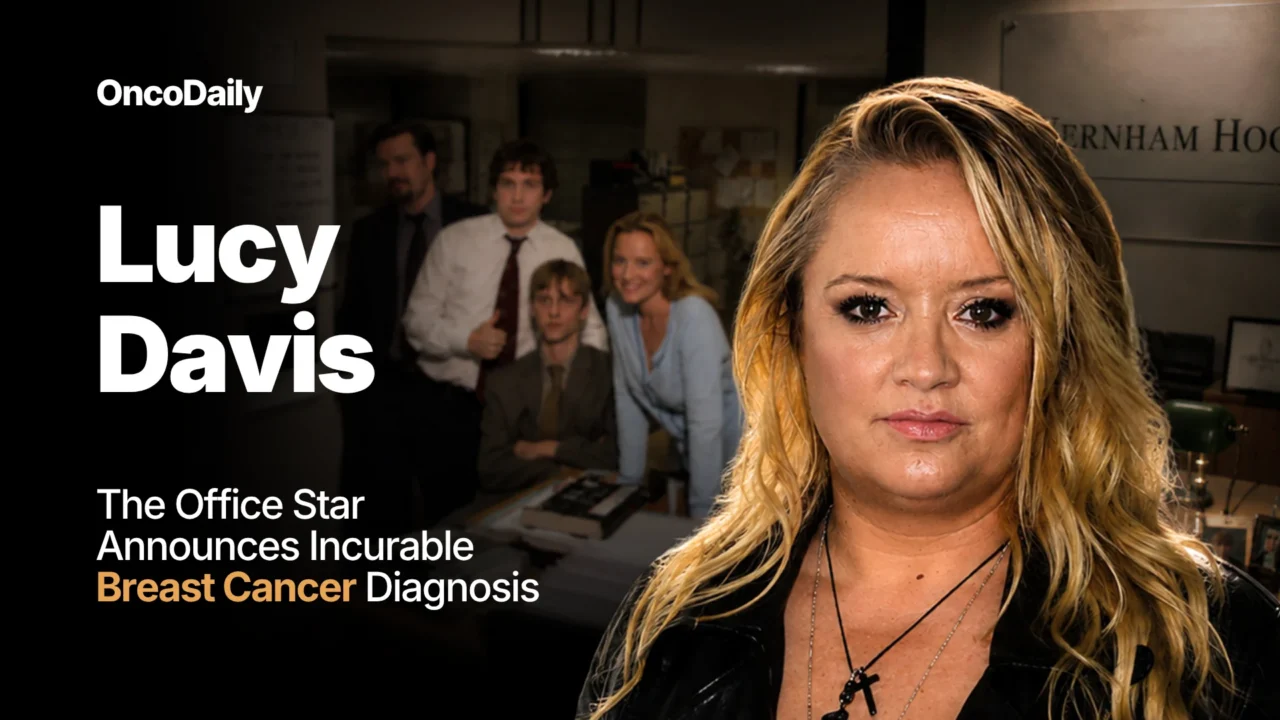
British actress Lucy Davis, best known for playing Dawn Tinsley in the original UK version of The Office, has revealed that she has been living with stage 4 breast cancer for approximately 18 months. In an emotional public announcement on August 11, 2026, the 53-year-old actress said the cancer has metastasized to her bones, specifically her spine, right hip, and ribs. Davis described her cancer as “incurable” and said it was “too late for chemo.” She also revealed that pain can make prolonged standing and walking difficult and that she sometimes uses a wheelchair.
Her story brings renewed attention to metastatic breast cancer, a disease that remains incurable in most cases but is not necessarily untreatable. In the United States, approximately 5%–6% of women with newly diagnosed breast cancer already have metastatic disease at diagnosis, according to the National Cancer Institute (NCI). For Davis, however, the announcement was about more than statistics. She spoke about continuing to work, finding humor despite pain, and trying to live whatever time remains as joyfully as possible.
Who Is Lucy Davis?
Lucy Davis is a British actress and comedian whose career spans more than three decades. She became internationally recognized as Dawn Tinsley, the receptionist at Wernham Hogg in Ricky Gervais and Stephen Merchant’s original British version of The Office. The series ran from 2001 to 2003 and became one of the defining British comedies of its era. Davis later appeared as Dianne in Shaun of the Dead and Etta Candy in Wonder Woman. A younger generation of viewers may also recognize her as Hilda Spellman in Chilling Adventures of Sabrina. Despite decades in the public eye, Davis had largely kept her cancer diagnosis private for approximately a year and a half before deciding to share it publicly.
How Did Lucy Davis Become a Star on The Office?
Lucy Davis became internationally recognized through her role as Dawn Tinsley in the original British version of The Office, created by Ricky Gervais and Stephen Merchant. The series, which aired from 2001 to 2003, followed the painfully ordinary—and often painfully awkward working lives of employees at the fictional Wernham Hogg paper company. Dawn was the office receptionist and one of the show’s emotional centers. Much of her storyline revolved around her friendship and growing romantic connection with Tim Canterbury, played by Martin Freeman, while she remained engaged to warehouse worker Lee. Their understated relationship became one of the series’ most memorable storylines and provided a warmer counterpoint to the show’s famously uncomfortable workplace comedy.
The success of The Office helped introduce Davis to an international audience and preceded roles in productions including Shaun of the Dead, Wonder Woman, and Chilling Adventures of Sabrina. The British series also inspired the hugely successful American adaptation, where Jenna Fischer’s Pam Beesly was the character most directly based on Dawn.More than two decades later, Dawn Tinsley remains one of Davis’s best-known roles, making news of her stage 4 breast cancer diagnosis particularly poignant for generations of viewers who first came to know her through The Office.
How Did Lucy Davis Discover Her Breast Cancer?
One detail of Davis’s announcement carries an important awareness message. She explained that she did not initially feel what she considered a conventional breast “lump.” Instead, she noticed a very small hard area and almost did not seek medical attention for it. She later learned that she had stage 4 breast cancer. In sharing this detail, Davis encouraged others not to ignore unusual changes and to have concerning findings evaluated. Her experience is a reminder that breast cancer does not always present as an obvious large lump. New or persistent changes in the breast deserve medical assessment, particularly when they feel different from the surrounding tissue.
What Did Lucy Davis Reveal About Her Diagnosis?
Davis said she was diagnosed with stage 4 breast cancer approximately 18 months before her August 2026 announcement. She revealed that the disease had metastasized to her bones, including her:
- Spine
- Right hip
- Ribs
She described her cancer as incurable and said chemotherapy was no longer an option. However, Davis has not publicly disclosed several clinical details that would be essential for understanding her individual disease and treatment, including her estrogen receptor (ER), progesterone receptor (PR), and HER2 status, genomic findings, complete treatment history, or the reasons chemotherapy is no longer being considered. It would therefore be inappropriate to speculate about her breast cancer subtype, previous therapies, or what additional anticancer treatments could be suitable for her.
What Does Stage 4 Breast Cancer Mean?
Stage 4 breast cancer, also called metastatic breast cancer, means that cancer cells have spread beyond the breast and nearby lymph nodes to distant parts of the body. Under the TNM system, this is classified as M1 disease, regardless of the original tumor size or nodal status. Common sites of spread include the bones, liver, lungs, and brain. According to the National Cancer Institute (NCI), approximately 5%–6% of women with newly diagnosed breast cancer in the United States have de novo metastatic disease, meaning the cancer has already spread when it is first detected.
Stage 4 breast cancer is generally considered not curable, but it is treatable. The goal is usually to control the disease for as long as possible, relieve symptoms, preserve quality of life, and extend survival. Treatment can continue for months or years, and the disease course varies substantially from one patient to another. Survival statistics also show why metastatic breast cancer should not be described as immediately terminal. The most recent American Cancer Society data, based on women diagnosed from 2015 to 2021, report a 33% 5-year relative survival rate for distant-stage breast cancer, compared with more than 99% for localized disease and 87% for regional disease. These figures are population averages and cannot predict an individual patient’s outcome.
The prognosis also differs markedly by tumor biology. NCI data show that among women with distant disease, 5-year relative survival has varied by subtype; for example, historical SEER estimates were approximately 34% for HR-positive/HER2-negative disease and 45.6% for HR-positive/HER2-positive disease. Newer treatments continue to improve outcomes, so current patients may do better than older survival datasets suggest.
ASCO also emphasizes that people living with advanced or metastatic cancer may require long-term survivorship, supportive, and palliative care, reflecting the fact that metastatic cancer can sometimes be managed over an extended period rather than representing only the final weeks or months of life. For Lucy Davis, the cancer has reportedly spread to the spine, right hip, and ribs, making her disease metastatic. However, because she has not publicly disclosed her hormone-receptor status, HER2 status, genomic profile, complete treatment history, or other clinical details, population survival figures should not be used to estimate her individual prognosis.
What Happens When Breast Cancer Spreads to the Bones?
Bone is one of the most common destinations for metastatic breast cancer cells. In Davis’s case, she has publicly identified involvement of her spine, right hip, and ribs. Bone metastases can cause pain and fractures, and depending on their location and extent, they can lead to significant limitations in mobility. NCI guidance also recognizes pathological or impending fractures and vertebral metastases associated with spinal cord compression as complications that can require specific intervention.
Davis has spoken openly about this physical reality. She said that standing or walking for prolonged periods can become extremely painful and that she sometimes needs a wheelchair. Her experience highlights an important aspect of advanced cancer care: controlling the tumor is only one objective. Maintaining mobility, controlling pain, preserving independence, and protecting quality of life can be equally important.
How Is Metastatic Breast Cancer Treated?
There is no single treatment regimen for every person with stage 4 breast cancer. Treatment is determined by several factors, particularly hormone-receptor and HER2 status, molecular characteristics, sites of metastasis, previous treatments, treatment response, general health, and the patient’s goals and preferences. NCI lists treatment options for metastatic breast cancer that can include endocrine therapy, HER2-targeted therapy, CDK4/6 inhibitors, other molecularly targeted treatments, chemotherapy, immunotherapy, radiation therapy, selected surgical interventions, and bone-modifying therapies. Treatments are frequently given sequentially or in different combinations as the disease changes over time.
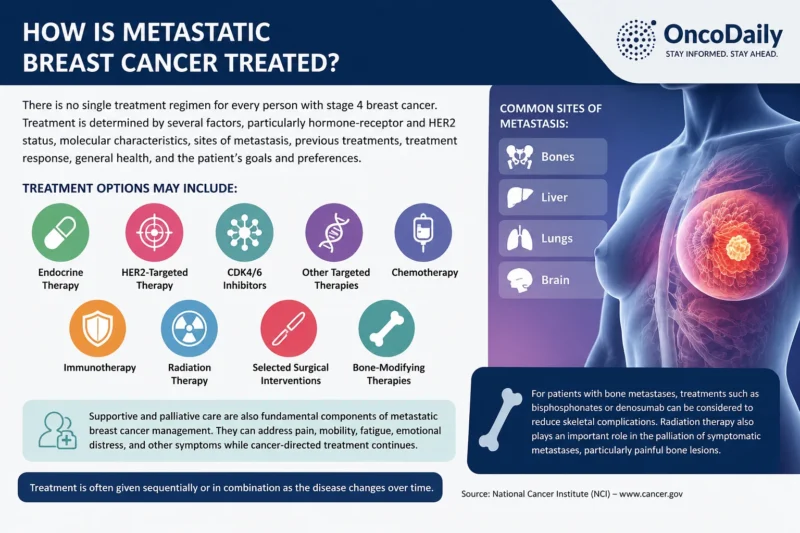
For patients with bone metastases, treatments such as bisphosphonates or denosumab can be considered to reduce skeletal complications. Radiation therapy also has an important role in the palliation of symptomatic metastases, particularly painful bone lesions. Supportive and palliative care are also fundamental components of metastatic breast cancer management. They can address pain, mobility, fatigue, emotional distress, and other symptoms while cancer-directed treatment continues.
Davis’s statement that chemotherapy is no longer an option should therefore be understood specifically in the context of her individual medical situation. Without further information from Davis or her medical team, the reason should not be assumed.
How Is Lucy Davis Living With Breast Cancer?
Perhaps the most powerful part of Davis’s announcement was not the medical terminology but how she described the life she wants to continue living. She said she is trying to spend whatever time remains as joyfully as possible and emphasized the importance of humor during her cancer experience. She also asked those around her not to treat her solely as someone who is ill. Despite the pain and mobility difficulties associated with her disease, Davis said she intends to continue acting and her animal-rights advocacy. Her message highlights something that can disappear from discussions about advanced cancer: a person with metastatic disease remains much more than a diagnosis. Careers, relationships, humor, causes, ambitions, and everyday experiences continue to matter.
Why Does Lucy Davis’s Story Matter for Breast Cancer Awareness?
Davis almost dismissed the tiny hard area that ultimately led her to seek medical evaluation. That makes her story particularly relevant to breast awareness. Breast cancer does not always announce itself through a large or obvious lump. Persistent or unexplained changes deserve attention, and Davis herself used her announcement to encourage people to have unusual findings checked. Her disclosure also creates an opportunity to challenge another misconception: “incurable” and “untreatable” are not synonymous.
For many patients, metastatic breast cancer is treated through multiple successive lines of therapy. Some live with controlled disease for years, while others experience cancers that progress more rapidly despite treatment. There is no single stage 4 breast cancer experience.
What Can We Learn From Lucy Davis’s Story?
Lucy Davis spent much of her career making audiences laugh. Now, her decision to speak publicly about metastatic breast cancer is bringing attention to a very different part of her life. Her story reinforces the importance of not ignoring unusual breast changes, seeking timely medical assessment, understanding metastatic breast cancer, and recognizing the importance of symptom control and quality of life in advanced disease.
It also demonstrates why celebrity cancer stories require careful medical context. Davis’s experience can raise awareness, but it cannot predict another patient’s treatment options or prognosis. For Davis herself, the focus now appears to be intensely personal: continuing to act, remaining committed to animal-rights advocacy, preserving humor, and finding as much joy as possible while living with an incurable disease. Her cancer may be part of her story, but as her announcement makes clear it is not the entirety of who she is.
You Can Also Read Sara Gore Cancer Free After Breast Cancer Diagnosis and Surgery by OncoDaily

Written by Aharon Tsaturyan, MD, Editor at OncoDaily Intelligence Unit
FAQ
Is Lucy Davis’s breast cancer stage 4?
Yes. Davis said she was diagnosed with stage 4 breast cancer approximately 18 months before her public announcement.
Is Lucy Davis’s cancer incurable?
Davis has described her cancer as incurable. In general, stage 4 breast cancer is usually considered incurable, although treatment can sometimes control the disease and relieve symptoms for prolonged periods.
Where has Lucy Davis’s breast cancer spread?
Davis said the cancer has spread to her bones, including her spine, right hip, and ribs.
What were Lucy Davis’s first breast cancer symptoms?
She said she noticed a very small hard area in her breast and initially almost dismissed it because it did not feel like a typical lump.
Why can’t Lucy Davis have chemotherapy?
Davis said chemotherapy is no longer an option for her, but she has not publicly explained why. Without details about her tumor subtype, previous treatments, organ function, or overall health, the reason should not be speculated about.
What does stage 4 metastatic breast cancer mean?
Stage 4 breast cancer means the disease has spread from the breast to distant parts of the body, such as the bones, liver, lungs, or brain.
Can stage 4 breast cancer be cured?
Stage 4 breast cancer is generally considered not curable, but it is treatable. Therapy can sometimes slow cancer growth, reduce symptoms, preserve quality of life, and extend survival.
How long can someone live with stage 4 breast cancer?
Survival varies widely depending on tumor subtype, sites of metastasis, response to treatment, overall health, and access to newer therapies. Population statistics cannot predict how long an individual patient will live.
How long can someone live with stage 4 breast cancer?
Survival varies widely depending on tumor subtype, sites of metastasis, response to treatment, overall health, and access to newer therapies. Population statistics cannot predict how long an individual patient will live.
What type of cancer does Lucy Davis have?
Lucy Davis has revealed that she is living with stage 4 breast cancer, also known as metastatic breast cancer.
Who did Lucy Davis play in The Office?
Lucy Davis played Dawn Tinsley, the receptionist at the fictional Wernham Hogg paper company in the original British version of The Office. Dawn became one of the show's central characters, particularly through her complicated relationship with Tim Canterbury, played by Martin Freeman. Davis appeared throughout the BBC series and its Christmas specials, and the role became the breakthrough that brought her international recognition.
Is Dawn Tinsley the British version of Pam Beesly?
Yes. Dawn Tinsley is the original UK character who served as the counterpart and inspiration for Pam Beesly, played by Jenna Fischer in the American adaptation of The Office. Both begin as receptionists and have major romantic storylines with male colleagues—Dawn with Tim Canterbury and Pam with Jim Halpert. Interestingly, Fischer publicly supported Davis following the actress's 2026 breast cancer announcement.
Who does Dawn Tinsley end up with in The Office?
Dawn Tinsley ultimately chooses Tim Canterbury. Throughout the series, Dawn is engaged to Lee despite her growing feelings for Tim. Their relationship reaches its emotional conclusion in the 2003 Christmas special, when a gift from Tim encouraging Dawn to pursue her passion for art prompts her to reconsider her life. She returns to the office, and the long-running romantic storyline finally culminates with Dawn and Tim together.
Why did Lucy Davis leave The Office?
Lucy Davis did not leave The Office because of a widely reported behind-the-scenes dispute. The original British series was intentionally short-lived, ending after two seasons and a two-part Christmas special. Davis completed Dawn Tinsley’s storyline alongside Martin Freeman’s Tim Canterbury, with their relationship reaching its memorable conclusion in the 2003 Christmas special. Davis subsequently expanded her career into British and American film and television.