


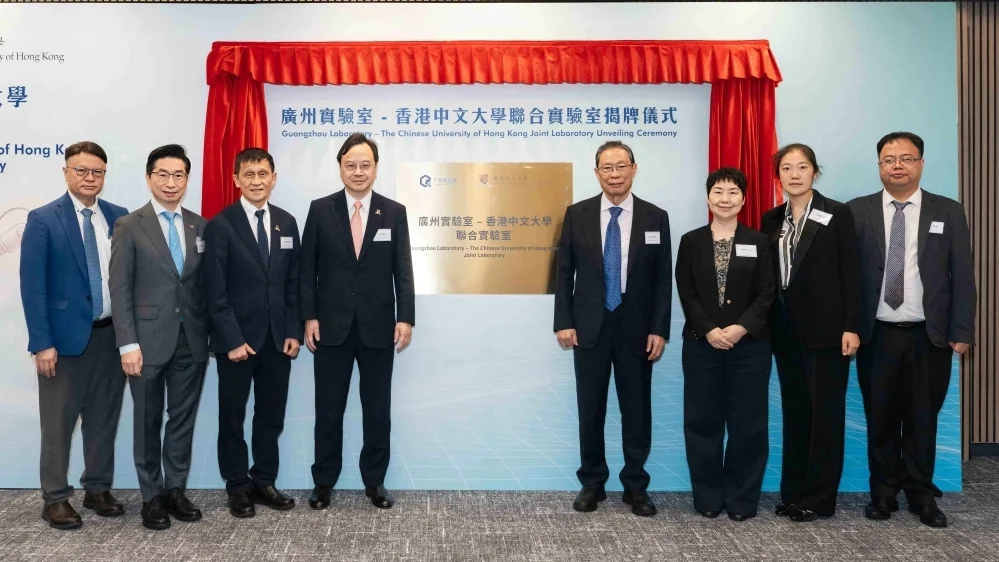
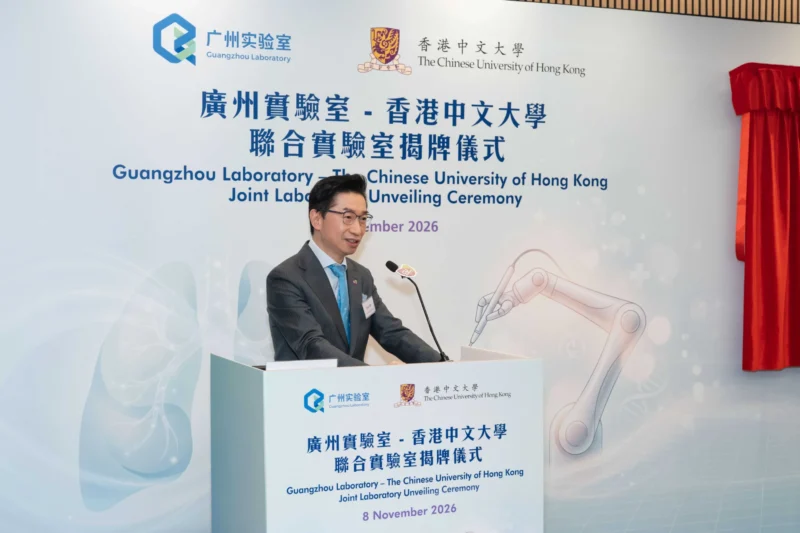
The Chinese University of Hong Kong (CUHK) and the Guangzhou Laboratory held the unveiling ceremonies for the “Guangzhou Laboratory–CUHK Joint Laboratory” (Joint Laboratory) on 8 November, and announced the launch of the “Guangdong–Hong Kong Joint Laboratory for Testing and Evaluation of Biological Products and Medical Devices”. This initiative marks the first Guangdong Science and Technology Programme project focused on bioproduct and medical device testing and evaluation. The establishment of the Joint Laboratory represents a major milestone in the collaboration between the two sides, bringing together research expertise from Hong Kong and the Chinese Mainland to advance innovation, translational research and talent development in key areas including respiratory diseases, emerging infectious diseases, computational biology, vaccine development and robotic surgery, contributing to national advancement in life and health sciences.
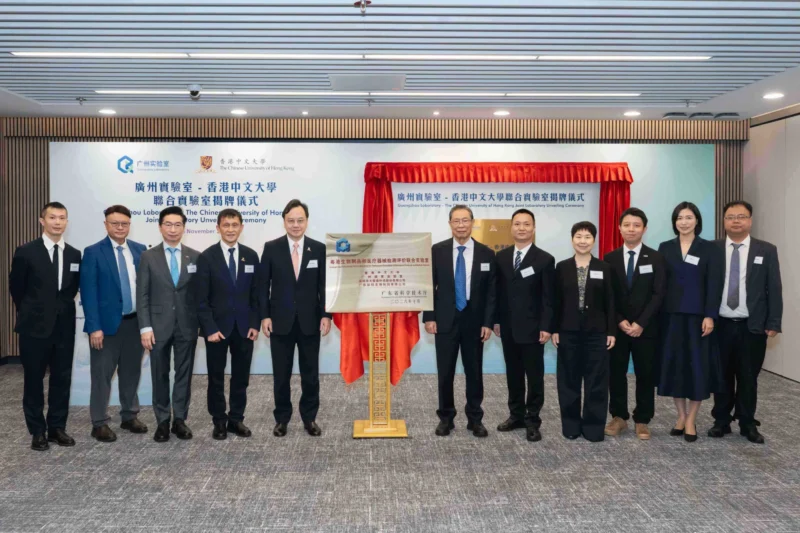
The unveiling ceremony took place at the Lui Che Woo Clinical Sciences Building, Prince of Wales Hospital, attended by leaders and experts from the scientific and medical communities in Hong Kong and the Chinese Mainland. Distinguished guests included Professor Zhong Nanshan, Academician of the Chinese Academy of Engineering and Director of the Guangzhou Laboratory; Professor Dennis Lo Yuk-ming, Vice-Chancellor and President of CUHK; Professor Jiang Liwen, Pro-Vice-Chancellor and Vice-President (Research & External Affairs) of CUHK; Professor Philip Chiu Wai-yan, Dean of CUHK’s Faculty of Medicine (CU Medicine); Mr Zhang Zhansheng, Deputy Director-General of the Department of Science and Technology of Guangdong Province; Mr Luo Xiaopeng, Deputy Director of the Laboratory and Infrastructure Division of the Department of Science and Technology of Guangdong Province; Professor Wang Zhongfang, Vice President and Researcher at the Shenzhen Hetao Institute; Professor David Hui Shu-cheong, Stanley Ho Professor of Respiratory Medicine and Professor of the Department of Medicine and Therapeutics at CU Medicine ; as well as representatives of biotechnology companies participating in the Guangdong Science and Technology Programme.
While CU Medicine possesses a strong foundation in clinical research, biomedical innovation and international collaboration, the Guangzhou Laboratory, as an important component of the nation’s strategic scientific and technological capabilities, brings established leadership in respiratory disease research and related prevention and control technologies. Building on years of close collaboration, the Joint Laboratory aims to further integrate research resources and platform strengths from both sides to accelerate advances in cutting-edge medical research and key technological breakthroughs.
Addressing national strategic priorities and advancing innovation in health technology
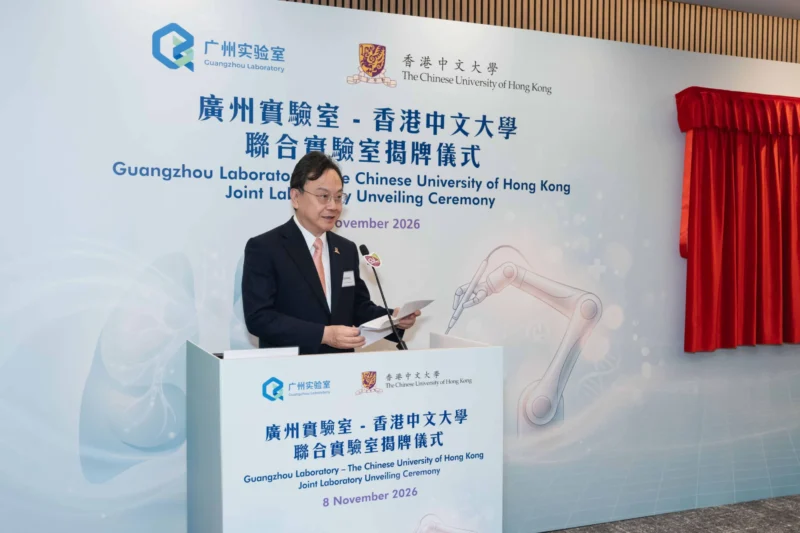
Professor Lo remarked at the ceremony, “Life and health technologies are advancing rapidly, yet we continue to face challenges posed by respiratory diseases and emerging infectious diseases. These challenges transcend geographical boundaries and cannot be addressed by a single university or research team alone. They remind us of the importance of cross-regional, interdisciplinary and inter-institutional collaboration in driving medical innovation and scientific breakthroughs. The need for collaboration has never been greater.
The establishment of the Joint Laboratory is not only a significant milestone in our partnership but also opens a new chapter for collaborative scientific innovation between Guangdong and Hong Kong. It strengthens our ability to tackle major health challenges while taking an important step towards changing the world.”
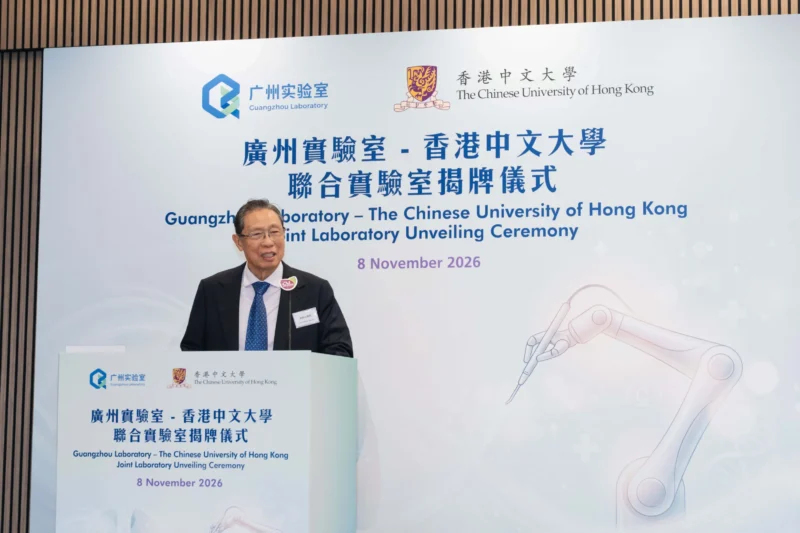
Professor Zhong said, “This latest deepening of cooperation marks an important achievement in the long-standing, pragmatic partnership between the Guangzhou Laboratory and CUHK, and represents a new starting point for substantive implementation of Guangdong–Hong Kong cooperation in biomedical testing and evaluation.
In light of current challenges, such as the lack of unified pharmaceutical and medical device standards between Guangdong and Hong Kong, and the absence of a mutual recognition evaluation system for cutting-edge products, we hope both sides will build on their complementary strengths, focus on common technologies and mutual recognition of standards, and deepen collaboration on talent development, platforms and data sharing. By integrating research, regulation, and industry, the goal is to develop a series of landmark achievements that can withstand regulatory review, industry validation and international peer assessment. This will make greater contributions to the national regulatory science for drugs and medical device, the Guangdong–Hong Kong–Macao Greater Bay Area international science and technology innovation centre, and the Healthy China initiative.”
Professor Chiu added, “Today’s unveiling marks a new beginning. I look forward to seeing more interdisciplinary collaborations emerge here, more impactful research outcomes reach the global stage, and the Joint Laboratory becoming an important platform for advancing medical innovation and disease prevention and control. Together, we can make meaningful contributions to national scientific and technological innovation and the Healthy China initiative.”
The Joint Laboratory will focus on major national needs in the field of life and health science and technology, promoting interdisciplinary and cross-regional collaboration and pursuing impactful research programmes. Research on respiratory diseases and emerging infectious diseases will be a key development direction. Combining the strengths of national-level research platforms with CUHK’s international collaboration network, the two sides will strengthen disease surveillance, mechanistic research and medical technology development, enhancing regional capacity to respond to emerging infectious diseases and major public health events.
Robotic surgery and innovative medical technology constitute another key focus. Combining strengths in engineering and clinical medicine, the laboratory will address clinical needs and technological challenges in existing robotic surgical systems in fields such as thoracic surgery, and drive the development of next-generation surgical robots. It will also advance research on robotic bronchoscopy and related minimally invasive medical technologies, improving the precision and safety in diagnosing and treating pulmonary diseases.
Launch of the Guangdong–Hong Kong Joint Laboratory for Testing and Evaluation of Biological Products and Medical Devices
The “Guangdong-Hong Kong Joint Laboratory for Testing and Evaluation of Biological Products and Medical Devices” is a Hong Kong-led project under the Guangdong Science and Technology Programme, and the programme’s first project focused on bioproduct and medical device testing and evaluation. It aims to address key bottlenecks such as the mutual recognition of standards between Guangdong and Hong Kong and the evaluation of cutting-edge products, thereby promoting the high-quality development of the biomedicine industry in the Greater Bay Area (GBA).
The project will focus on three major areas: standardised evaluation of biologics, integrated assessment of advanced medical devices, and clinical validation and translation of innovative healthcare products. Leveraging the resources of the cross-border rapid testing centre for biological samples in the GBA and the research capabilities across Guangdong and Hong Kong, the project aims to accelerate the translation of scientific discoveries, support precision medicine innovation, and promote high-quality development in public health and the biopharmaceutical industry.
The project will be carried out in collaboration with the Guangzhou Laboratory and two biotechnology companies from the Chinese Mainland, bringing together government, academia and industry partners to establish a collaborative testing and evaluation framework for biologics and medical devices, while facilitating clinical validation and translation of innovative products.
In addition to advancing scientific innovation, the Guangdong–Hong Kong Joint Laboratory for Testing and Evaluation of Biological Products and Medical Devices plans to train no fewer than 20 postgraduate students and postdoctoral researchers over the next three years through this collaborative research initiative, injecting new momentum into national scientific innovation, the advancement of health and life sciences, and the cultivation of high-calibre talent.
Other articles from The Chinese University of Hong Kong on OncoDaily.