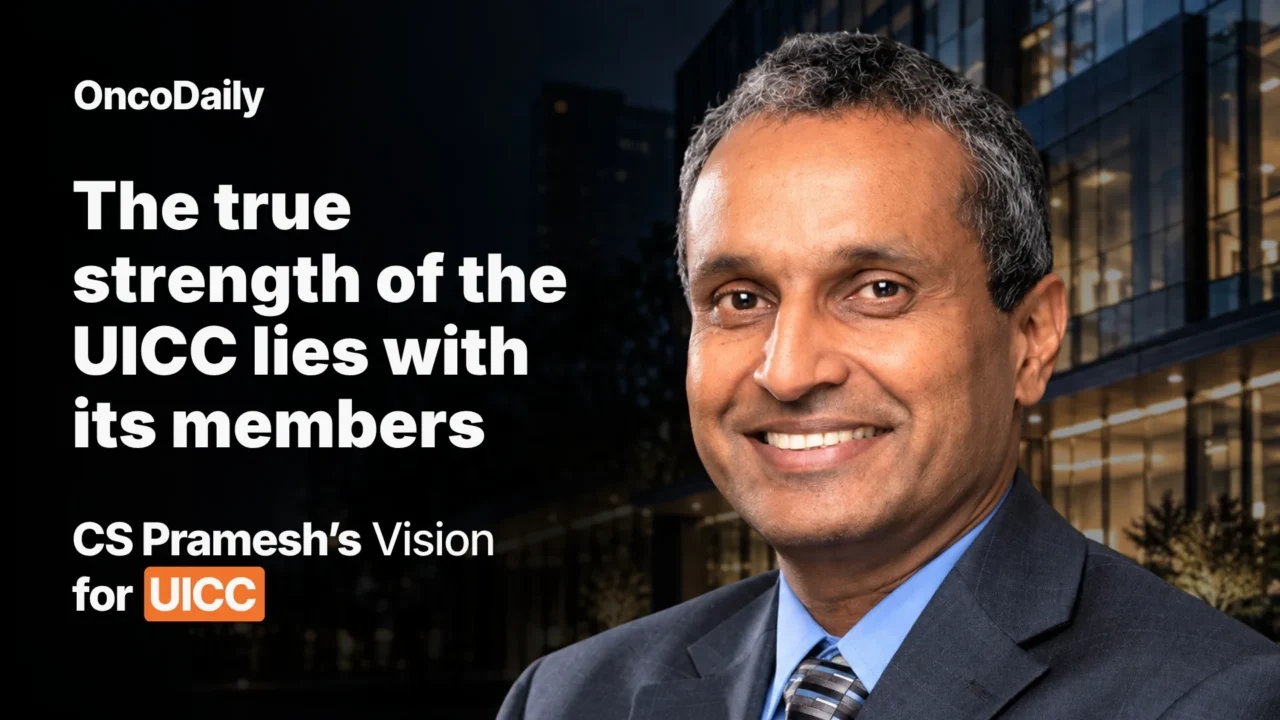
C S Pramesh, Director of Tata Memorial Hospital in Mumbai and Convener of India’s National Cancer Grid, is among the three candidates for President-elect of the Union for International Cancer Control (UICC) for the 2026–2028 term.
A surgical oncologist, researcher, and global cancer health leader, Dr Pramesh currently serves on the Boards of Directors of UICC and ASCO. His candidacy focuses on reducing inequalities in cancer care, strengthening health systems and ensuring that advances in oncology translate into meaningful improvements for patients worldwide.
Speaking at the World Cancer Congress 2026 in Hong Kong, Pramesh outlined his vision for UICC’s future, raising a fundamental question for global oncology: as cancer science advances, why are so many patients still unable to access the care they need?
To illustrate this divide, he presented two contrasting stories.
One concerned a major therapeutic breakthrough in pancreatic cancer, a development that received a standing ovation at an ASCO plenary session. The other was the story of a 49-year-old woman with potentially curable breast cancer in rural Kenya who experienced months of delays before receiving a diagnosis and treatment.
Both stories reflected the realities of modern oncology: remarkable scientific progress on one side and persistent barriers to essential cancer care on the other.
For Pramesh, addressing this divide should be a defining priority for UICC over the coming decade.
From Cancer Equity as an Ambition to Action
Throughout his address, Pramesh returned to the distinction between acknowledging inequalities and implementing solutions that reduce them.
Despite advances in cancer prevention, early detection, surgery, systemic therapies, radiation oncology and supportive care, patients in many parts of the world continue to face barriers that prevent them from benefiting from these developments.
He argued that cancer outcomes are often influenced by circumstances extending far beyond disease biology, including geography, income and the capacity of local health systems.
“We need to convert equity from what it is today, which is an aspiration, to actual action that is seen on the ground.”
He identified five interconnected priorities for UICC: translating equity into action, strengthening health systems, improving quality, connecting innovation with implementation, and expanding collaboration across the global cancer community.
Together, these priorities form the foundation of his proposed approach to UICC leadership.
Building Systems of Excellence, Not Just Centres of Excellence
One of the central themes of Pramesh’s address was the importance of strengthening entire cancer care systems rather than concentrating excellence within individual institutions.
Drawing on his experience with India’s National Cancer Grid, which brings together more than 400 cancer centres, research institutions and patient advocacy organisations, he described how institutional collaboration can support common standards, improve care delivery and strengthen cancer services across different settings.
“We should create systems of excellence which will transform cancer care.”
The National Cancer Grid has pursued initiatives involving standardisation, research collaboration, capacity building and improvements in access to treatment.
Pramesh presented this experience as an example of how coordinated networks can address challenges that individual institutions may struggle to resolve independently.
His emphasis on systems also extends to the quality of care patients receive.
He argued that increasing access alone is insufficient if the services provided are not supported by evidence and appropriate standards.
Rather than focusing exclusively on whether patients can receive treatment, he suggested that global cancer organisations should ask a more comprehensive question:
“Can we ensure that every patient everywhere gets the right treatment at the right place at the right time?”
For Pramesh, quality should be embedded throughout cancer control, ensuring that efforts to expand access are accompanied by improvements in the care delivered.
Beyond New Treatments: Innovation That Patients Can Access
Another major element of Pramesh’s vision is connecting scientific innovation with practical implementation.
While recognising the impact of advanced technologies, immunotherapy and other developments in oncology, he argued that innovation should not be limited to discovering new treatments.
It should also include developing ways to make existing advances accessible, affordable and sustainable.
“Let’s not underestimate the effect of innovation in implementation.”
To illustrate this approach, Pramesh discussed the development of an indigenous CAR-T cell therapy in India through collaboration between researchers at his institution and the Indian Institute of Technology.
He contrasted the approximately $500,000 cost of CAR-T cell treatment in the United States with the reported $23,000 cost of the locally developed therapy.
Although the latter remains expensive in many low- and middle-income settings, he presented the initiative as an example of how local research and implementation can substantially reduce treatment costs.
He also described the National Cancer Grid’s pooled procurement initiative, through which participating cancer centres collectively negotiate medicine prices.
According to Pramesh, the approach achieved price reductions of up to 85% while also addressing supply-chain challenges and incorporating quality requirements.
He noted that smaller cancer centres in rural areas may encounter difficulties securing a reliable medicine supply because of their limited purchasing volumes. Collective procurement can strengthen their negotiating position and improve supply continuity.
These examples reflected his broader argument that progress in oncology must be measured not only by the treatments developed but also by the ability of health systems to deliver them.
How a Small Change in Rural India Could Inform Global Cancer Care
Pramesh also highlighted how relatively simple changes to clinical pathways can improve access without relying on expensive new technologies. He described a cancer centre in rural Assam, India, where approximately 40% of patients did not return after their initial visit.
Patients had previously been required to attend separate appointments for biopsies, imaging and subsequent treatment decisions, creating delays and contributing to losses during follow-up.
The centre introduced a different approach. Patients underwent biopsy followed by frozen-section analysis, allowing preliminary results within approximately 15 minutes. When malignancy was identified, imaging could be completed on the same day, with treatment decisions made within 24 hours.
Pramesh used the example to demonstrate how locally developed solutions could be shared and adapted across institutions.
For him, the potential impact becomes particularly significant when considered alongside UICC’s international membership.
The Strength of UICC Lies in Its Global Community
Collaboration was the final major priority Pramesh outlined in his World Cancer Congress address.
Drawing again on the National Cancer Grid, he described the importance of bringing organisations together around shared goals and learning from practical experiences across different settings.
“The whole is always larger than the sum of its parts.”
UICC brings together more than 1,100 member organisations across approximately 170 countries, creating opportunities to exchange knowledge, strengthen partnerships and support cancer control initiatives internationally.
Pramesh suggested that even relatively small improvements developed by individual member organisations could have a substantial collective impact if shared across the network.
He invited the audience to imagine the potential if every UICC member contributed a practical initiative that could be adapted by others.
“The true strength of the UICC lies with its members.”
This emphasis on collaboration also features prominently in his official candidate statement, where he describes UICC as an organisation capable of connecting institutions, influencing policy and amplifying the collective voice of the global cancer community.
If elected, he aims to strengthen member engagement, expand partnerships and support practical approaches to cancer control that can be implemented across countries with different resources and health-system capacities.
UICC President-elect Election 2026: What Happens Next?
The UICC President-elect election is taking place alongside the election of the organisation’s Board of Directors for the 2026–2028 term. Three candidates are competing for President-elect:
- C S Pramesh, India
- Gilberto Lopes, United States
- Asem Mansour, Jordan
The election also includes 24 candidates competing for 14 positions on the UICC Board of Directors.
Electronic voting opened on October 13, 2026, and will remain open until the virtual UICC General Assembly on October 20, 2026, when the results will be announced.
The elected President-elect will serve on the UICC Board during the 2026–2028 term before assuming the presidency in October 2028.
For Pramesh, the upcoming election represents an opportunity to advance an approach to global cancer control centred on practical solutions, institutional collaboration and stronger health systems.
His World Cancer Congress address ultimately returned to the contrast between scientific breakthroughs and the patients who remain unable to benefit from them.
The priorities he presented focused on closing that gap through better implementation, improved quality and wider access to effective cancer care.
As he concluded his address:
“And that, dear friends, is the reason I would put myself up for the post of the president-elect of the UICC.”
Read also on OncoDaily: Two OncoDaily Mentors, One Global Mission: Matti Aapro and Hesham Elghazaly Run for UICC Board