
Xenofon Vakalis, Radiation Oncologist at Medical Center of Athens, shared on LinkedIn:
“ASTRO 2026: Bladder preservation – A curative option for selected patients
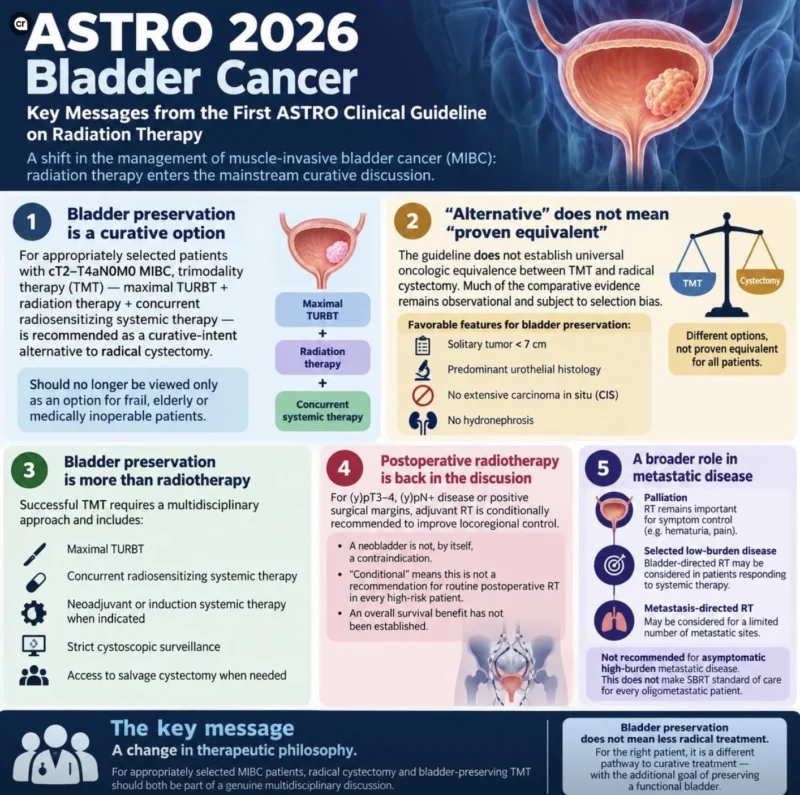
ASTRO’s first dedicated guideline on radiation therapy for bladder cancer is important – not because it introduces a new technique, but because it repositions RT within the curative management of muscle-invasive bladder cancer (MIBC).
For appropriately selected patients with cT2-T4aN0M0 disease, trimodality therapy (TMT) – maximal TURBT followed by RT with concurrent radiosensitizing systemic therapy – is now recommended as a curative-intent alternative to radical cystectomy.
This matters.
Bladder preservation should no longer be viewed mainly as an option for elderly, frail or medically inoperable patients. In selected patients who are also surgical candidates, TMT can represent an active curative choice after multidisciplinary discussion.
But ‘alternative’ does not mean ‘proven equivalent.’
The guideline does not establish oncologic equivalence between TMT and cystectomy for every patient. Much of the comparative evidence remains observational and therefore vulnerable to selection bias.
Patient selection remains crucial: solitary tumor less than 7 cm, predominant urothelial histology, absence of extensive CIS and absence of hydronephrosis are favorable features.
And bladder preservation is not simply ‘radiotherapy instead of surgery.’ It requires maximal TURBT, radiosensitizing systemic therapy, appropriate systemic treatment when indicated, strict cystoscopic surveillance and access to salvage cystectomy.
Postoperative RT also deserves attention.
For (y)pT3-4, (y)pN+ disease or positive margins, ASTRO conditionally recommends adjuvant RT to improve locoregional control. Importantly, a neobladder is not by itself a contraindication.
But ‘conditional’ matters: this should not be interpreted as routine postoperative RT for every high-risk patient, and an overall survival benefit has not been established.
In metastatic disease, RT remains important for symptom control, while bladder-directed RT and metastasis-directed RT may be considered in selected patients with low-burden disease responding to systemic therapy. This should not be interpreted as making SBRT standard of care for every oligometastatic patient.
The real message?
The major change is not a new dose or technique.
It is a change in therapeutic philosophy.
A patient with MIBC should not automatically hear ‘cystectomy first, radiotherapy only if surgery is impossible.’
For appropriately selected patients, cystectomy and bladder-preserving TMT deserve genuine multidisciplinary discussion.
At the same time, ASTRO does not replace radical cystectomy or establish universal equivalence between surgery and TMT.
Bladder preservation does not mean less radical treatment.
For the right patient, it represents a different pathway to curative treatment – with the goal not only of survival, but also of preserving a functional bladder.”
You may also be interested in: Urine cfRNA in Bladder Cancer: Detection and Treatment Response