
Talha Badar, Associate Professor of Medicine at Mayo Clinic, shared on X:
“Menin inhibitors in AML: biology – approvals – combinations – resistance
Menin inhibition has rapidly moved from a biological concept to an established therapeutic strategy in AML.
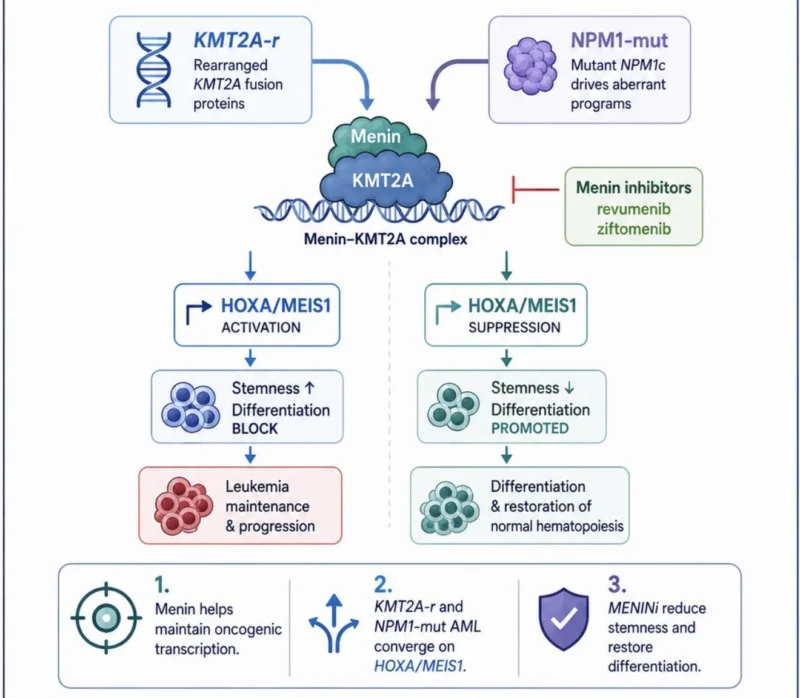
Why does it work? KMT2A-r and NPM1-mut AML are genetically distinct-but both converge on the HOXA/MEIS1 transcriptional program, which maintains leukemic stemness and blocks differentiation.
Menin helps sustain this program. Menin interacts with KMT2A and helps maintain transcription of genes including HOXA9 and MEIS1. Blocking the menin–KMT2A interaction suppresses this leukemic program and promotes myeloid differentiation. Importantly, mutant NPM1 also creates a transcriptional state dependent on this axis:
KMT2A-r → MENIN/HOX-MEIS ← NPM1-mut. Think of menin inhibition fundamentally as a differentiation strategy, not simply cytotoxic therapy.
Two oral menin inhibitors established this pathway as therapeutically actionable:
- Revumenib
- Ziftomenib
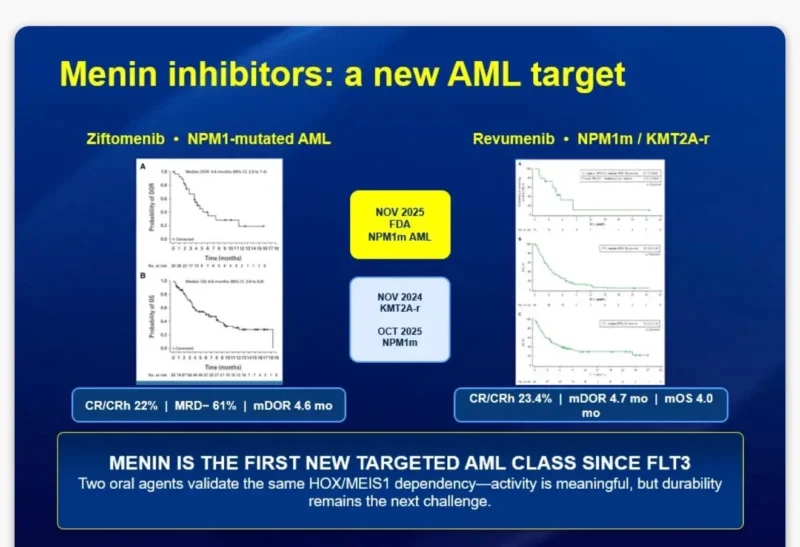
In heavily pretreated R/R AML, both produced CR/CRh rates ~20–25%, with deep/MRD-negative responses in some patients. But the limitation became equally clear: responses can be meaningful, but durability remains limited.
That raised the obvious question: move MENINi earlier?
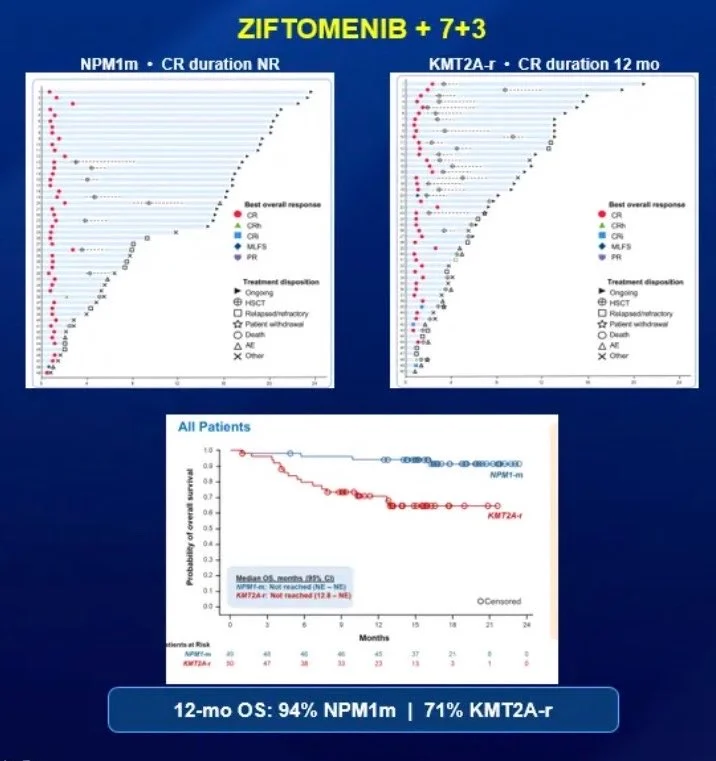
Early frontline combination data suggest the answer may be yes. Ziftomenib + 7+3 Deep responses have been reported in both NPM1-mut and KMT2A-r AML.
Early 12-month OS estimates:
- NPM1-mut: ~94%
- KMT2A-r: ~71%
Follow-up remains short, but this may ultimately be where MENINi have their greatest impact: before resistant clones emerge. EHA2026 presentation by Dr. Zeidan et al.
The lower-intensity strategy is equally intriguing: AZA + VEN + revumenib.
In newly diagnosed NPM1-mut/KMT2A-r AML:
- CRc ~81% overall
- ~89% KMT2A-r
- ~79% NPM1-mut
Reported median OS:
- ~18 mo KMT2A-r
- ~15.5 mo NPM1-mut
Early data-but a compelling biological triplet: epigenetic therapy + apoptotic targeting + differentiation therapy. Dr. Zeidner et al JCO 2025.
The story is becoming a drug-class story, not simply revumenib/ziftomenib. Early enzomenib + AZA/VEN data in R/R AML:
- ORR ~77%
- CRc ~50%
Among patients naïve to VEN and prior MENINi:
- ORR ~85%
- CRc ~62%
Enzomenib monotherapy also showed median OS of approximately:
- 11.8 mo — KMT2A-r
- 8.5 mo — NPM1-mut
Multiple agents targeting the same biology are showing clinically meaningful activity.
Menin dependence may extend beyond NPM1-mut and KMT2A-r. One compelling example: NUP98-rearranged acute leukemia. At EHA2026, revumenib monotherapy in R/R NUP98-r acute leukemia (n=36) showed:
- CRc ~28%
- Responses generally within 1–3 cycles
- Median response duration ~7 months
- Several responders bridged to allo-HSCT NUP98-r leukemias also frequently harbor WT1 co-mutations.
The broader lesson: MENINi may target a transcriptional dependency—not simply a mutation.
Then comes perhaps the most fascinating biology: How does AML escape menin inhibition?
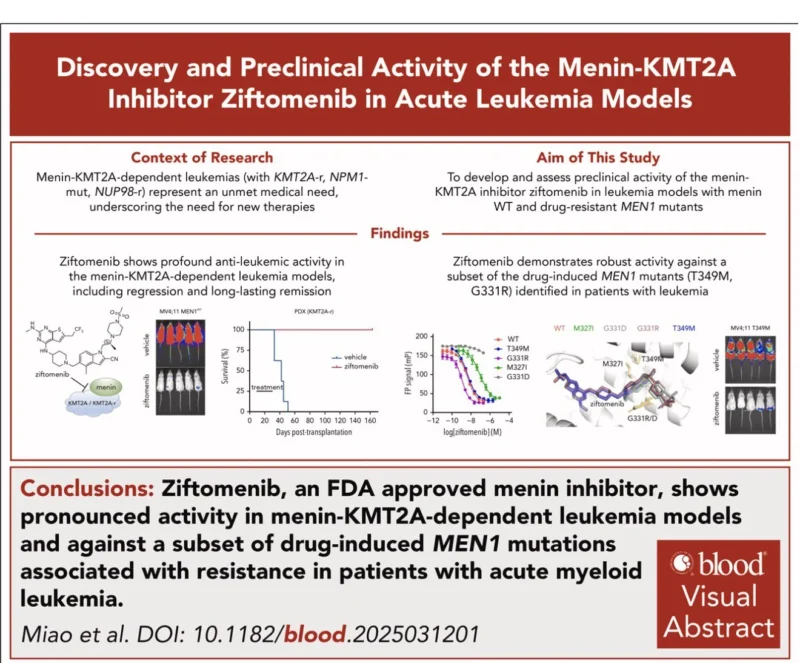
One mechanism is acquired MEN1 mutation. Under therapeutic pressure, mutations can emerge in the menin drug-binding interface, reducing inhibitor binding and restoring leukemic transcription.
But resistance is not uniform. Preclinical ziftomenib data showed:
- retained activity: T349M, G331R
- resistance: M327I, G331D
This raises an intriguing possibility: menin inhibitors may not be completely cross-resistant.
Unfortunately, clinical outcomes after MENINi failure remain poor. In a multicenter cohort of 84 patients:
- 74% were refractory
- 26% responded then relapsed
Among patients receiving non-trial salvage:
- HMA/VEN: ORR ~38%; CR/CRi ~15%
- IC + VEN: ORR ~83%; CR/CRi ~67%
MENINi rechallenge produced no responses. Interestingly, 2 patients switched from bleximenib – revumenib and both responded-another signal that some resistance may be agent-specific rather than universally class-wide.
Most importantly: Median OS after salvage ≈4.4 months. Dr. Chin et al.
So where is the field heading? The first chapter proved that menin inhibition works. The next is about making responses durable:
- MENINi + AZA/VEN upfront
- MENINi + intensive chemotherapy
- MRD-guided treatment duration
- Maintenance after consolidation/HSCT
- MEN1 mutation-guided MENINi sequencing
- Combinations that suppress resistant clones before they emerge
The bigger lesson: Menin inhibition has validated HOX/MEIS dependence as a druggable vulnerability in AML. Now the challenge is turning response into durable disease control.”
You may also find this interesting: Making Innovative Oncology Therapies Accessable for All Patients: Tommy Bramley