
Sibylle Loibl, Chief Executive Officer at the German Breast Group Research Company (GBG Forschungs GmbH), shared on LinkedIn:
“When chemotherapy is considered, does it always have to come first?
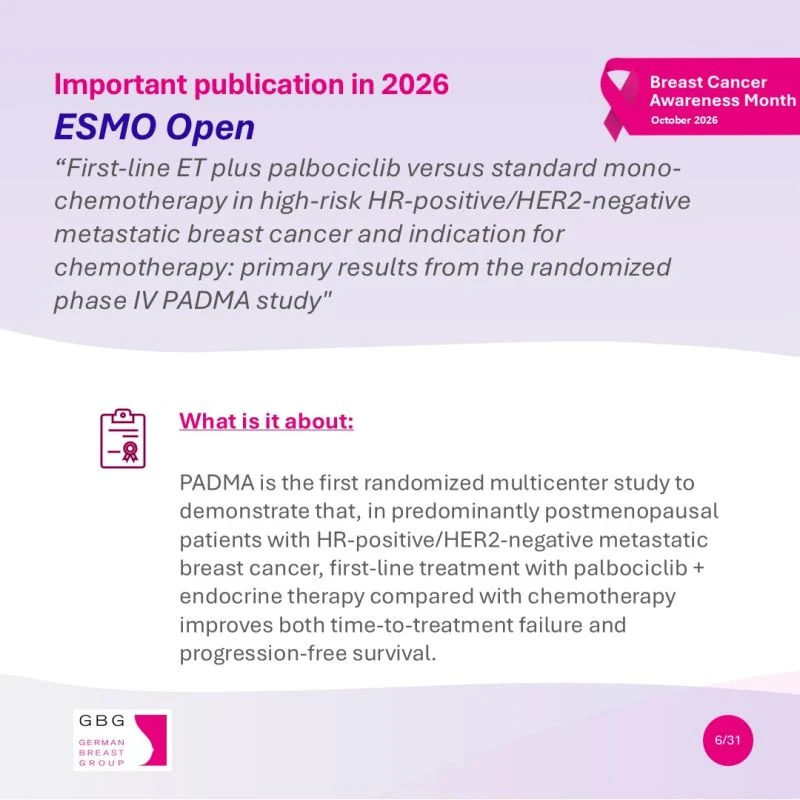
That was the question behind the randomized PADMA trial in patients with hormone receptor-positive (HR-positive), HER2-negative metastatic breast cancer.
For patients with metastatic breast cancer, endocrine therapy combined with a CDK4/6 inhibitor is an established treatment option. But what about patients with high-risk disease for whom chemotherapy is considered appropriate?
PADMA compared palbociclib + endocrine therapy with investigator-selected single-agent chemotherapy as first-line treatment.
The results were striking:
- Time to treatment failure: 17.2 vs. 6.1 months
- Progression-free survival: 18.7 vs. 7.8 months
- Both differences were statistically significant.
Overall survival, however, did not differ significantly between the treatment groups.
So, what can we take away from PADMA?
For predominantly postmenopausal patients with HR-positive/HER2-negative metastatic breast cancer, palbociclib plus endocrine therapy provided longer disease control than single-agent chemotherapy, even in a population in whom chemotherapy was considered appropriate.
Published in ESMO Open, 2026.”
Title: First-line ET plus palbociclib versus standard mono-chemotherapy in high-risk HR-positive/HER2-negative metastatic breast cancer and indication for chemotherapy: primary results from the randomized phase IV PADMA study
Authors: M. Schmidt, M. Thill, J. Rey, B. Rautenberg, V. Bjelic-Radisic, T. Decker, J. Rom, M. Kögel, K. Lübbe, A. Nacke, S. Seiler, M. Just, V. Müller, R. Buss-Steidle, J. Terhaag, C. Mundhenke, C. Denkert, J. Holtschmidt, S. Loibl.
You can also read: HER2CLIMB-05 Strengthens First-Line Maintenance in HER2-Positive Metastatic Breast Cancer With Tucatinib.