





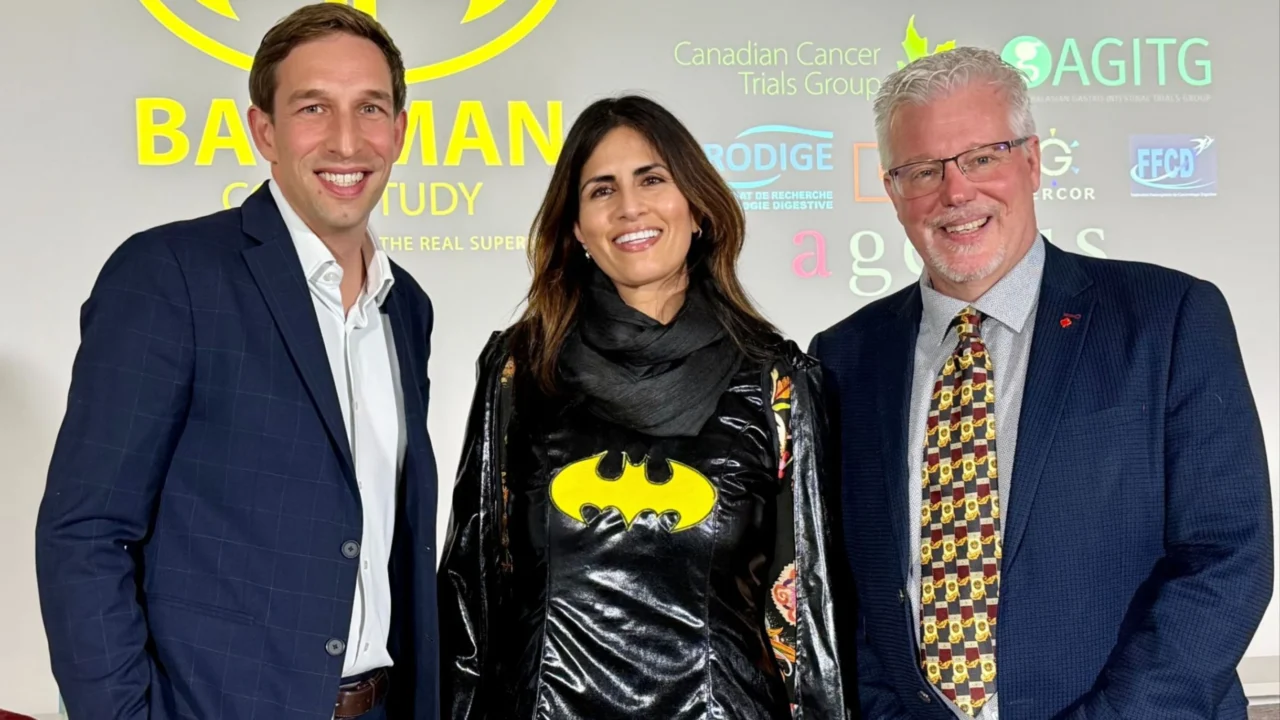
Sharlene Gill, Professor of Medicine at University of British Columbia, shared on LinkedIn:
“Earlier this week, the biotechnology company Agenus unexpectedly announced that it was discontinuing support for the Phase III BATTMAN (CCTG CO.33) clinical trial, abruptly ending an ambitious international study designed to answer one of the most important questions in colorectal cancer today: can the immunotherapy combination of botensilimab and balstilimab improve survival for the 90–95% of patients with metastatic colorectal cancer whose tumors are microsatellite stable (MSS) and have remained largely resistant to immunotherapy?
I’ve had the privilege of watching this trial come to life over the past several years. Under the Canadian Cancer Trials Group leadership of Jonathan Loree and Chris O’Callaghan, investigators, statisticians, international cooperative groups and patient partners worked tirelessly together to build what was intended to be a registration-intent study enrolling approximately 830 patients across Canada, Australia, New Zealand and France. Its abrupt closure, just over 3 months after the first patient enrolled, is profoundly disappointing.
Patients with treatment-refractory mCRC have few remaining options – the timing of this decision is even harder to understand given the encouraging long-term data presented only weeks earlier at ESMOGI26 from the phase I BOT+BAL study in this population which further ‘strengthened the foundation’ for the BATTMAN trial. (Agenus press release, July 6 2026) – its subsequent sudden and premature closure represents a major lost opportunity.
But my concern extends beyond this one trial. We know that drug development is inherently risky and companies will inevitably make difficult business decisions…what deserves greater discussion is what responsibilities accompany those decisions once a clinical trial has launched and patients have placed their trust in that enterprise?

Patients volunteer for trials knowing the treatment may not benefit them personally – I think it is one of the most extraordinary acts of altruism and generosity in medicine. They rightfully deserve confidence that every reasonable effort will be made to answer the scientific question once the trial is launched. Industry, government and academia collectively owe them transparency and stewardship of that commitment, and if a trial needs to be discontinued early, we should expect a process that reflects the shared investment of patients, investigators and partners. To me, this is the social contract of clinical research.
Scientific progress depends on a foundation of mutual accountability and public trust. That trust is precious and I hope this experience prompts a broader conversation about how we can all better preserve that trust and strengthen the partnerships that make clinical research possible.”
Other articles about colorectal cancer on OncoDaily.
Statement from Agenus
Agenus recognizes the disappointment surrounding the termination of BATTMAN and the importance of accuracy, transparency and responsible stewardship for patients, investigators and the clinical community.
BATTMAN was a cooperative-group study sponsored by the Canadian Cancer Trials Group (CCTG). Agenus supplied botensilimab (BOT) and balstilimab (BAL) and committed up to $25 million over three years as part of the study’s broader funding structure.
Agenus made the decision to discontinue its future financial support for BATTMAN and concentrate its available resources on the neoadjuvant BOT/BAL Phase 3 study, where the company believes intervening earlier with immunotherapy may offer the greatest opportunity to benefit patients in a curative-intent treatment setting. Following that decision, CCTG, in its role as study sponsor, formally terminated BATTMAN.
This decision does not diminish the substantial unmet need facing patients with late-line MSS metastatic colorectal cancer or Agenus’s gratitude to the patients who volunteered for the study.
Agenus has communicated to CCTG its willingness to continue supplying BOT and BAL for patients already receiving the combination through BATTMAN when continued treatment is considered medically appropriate and permitted under applicable requirements. Agenus remains prepared to work with CCTG, participating institutions and treating physicians toward a responsible, patient-centered transition.
Following the termination of BATTMAN, Agenus established a compassionate-access pathway for eligible patients with metastatic colorectal cancer in Canada, Australia and New Zealand—three of the countries in which BATTMAN was planned to enroll patients. This pathway is available both to patients who began receiving BOT and BAL through BATTMAN and to other eligible patients with metastatic colorectal cancer.
Agenus also continues to support its existing authorized patient-access program in France, the fourth country in which BATTMAN was planned to enroll patients.
Physicians should visit Agenus’ access page at https://www.agenusbio.com/access-to-investigational-medicines-policy for country-specific regulatory pathways and the appropriate Agenus contact for access requests.