Sendurai Mani, Associate Director of Translational Oncology at the Legorreta Cancer Center, is presenting a series exploring some of the most influential scientific papers that have shaped the field of cancer research on LinkedIn:
I recently shared an AI-generated (Claude) list of the top 200 papers that have shaped cancer research on LinkedIn. Today, I share more about Paper 7.
Paper 7: Trastuzumab + Chemotherapy – When HER2 Went From a Bad Prognostic Marker to a Therapeutic Target
What if one of the features that made a cancer more aggressive could also become its greatest therapeutic vulnerability?
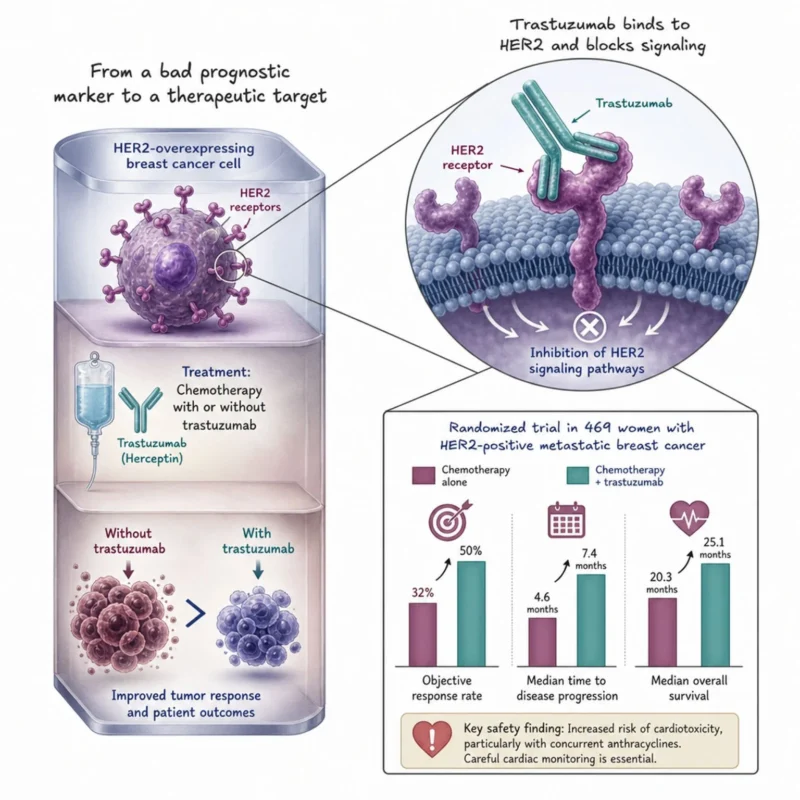
In 2001, Dennis Slamon and colleagues published a pivotal New England Journal of Medicine trial evaluating trastuzumab (Herceptin), a monoclonal antibody targeting HER2, in women with HER2-overexpressing metastatic breast cancer.
The biological foundation had been laid years earlier.
HER2 amplification has been linked to aggressive breast cancer and poorer outcomes. The next question was transformative:
Could we directly target HER2 and change the course of the disease?
In this randomized trial, 469 women received either standard chemotherapy alone or chemotherapy plus trastuzumab.
The results provided a striking answer.
Adding trastuzumab increased the objective response rate from 32% to 50%, extended the median time to disease progression from 4.6 to 7.4 months, and improved the median overall survival from 20.3 to 25.1 months, despite patients in the chemotherapy-only group being allowed to receive trastuzumab after progression.
This was more than a positive breast cancer trial.
It was powerful clinical proof of a principle that now sits at the heart of precision oncology:
Find the molecular alteration – identify the dependency – build a therapy against it – select the patients whose tumors carry the target.
The HER2 story is especially remarkable when viewed alongside Paper 6.
1987: HER2 amplification helps identify a subgroup of breast cancers with worse outcomes.
2001: That same molecular feature helps identify patients who can benefit from a therapy specifically directed against it.
That transition, from biomarker to drug target, captures the promise of translational cancer research.
The enduring lesson: the molecular abnormality that makes a cancer dangerous can sometimes also reveal how to defeat it.
Authors: Dennis J. Slamon, Brian Leyland-Jones, Steven Shak, Hank Fuchs, Virginia Paton, Alex Bajamonde, Thomas Fleming, Wolfgang Eiermann, Janet Wolter, Mark Pegram, Jose Baselga, and Larry Norton