Sendurai Mani, Associate Director of Translational Oncology at the Legorreta Cancer Center, is presenting a series exploring some of the most influential scientific papers that have shaped the field of cancer research on LinkedIn:
“Paper 6: HER2 Amplification – Connecting a Cancer Gene to Patient Outcomes
I recently shared an AI-generated (Claude) list of the top 200 papers that have shaped cancer research on LinkedIn. Today, I share more about Paper 6.
What if a genetic alteration inside a tumor could tell us not only how the cancer works but also how aggressively it might behave?
In 1987, Dennis Slamon and colleagues published a landmark paper in Science examining the HER2/neu (ERBB2) gene in human breast cancer.
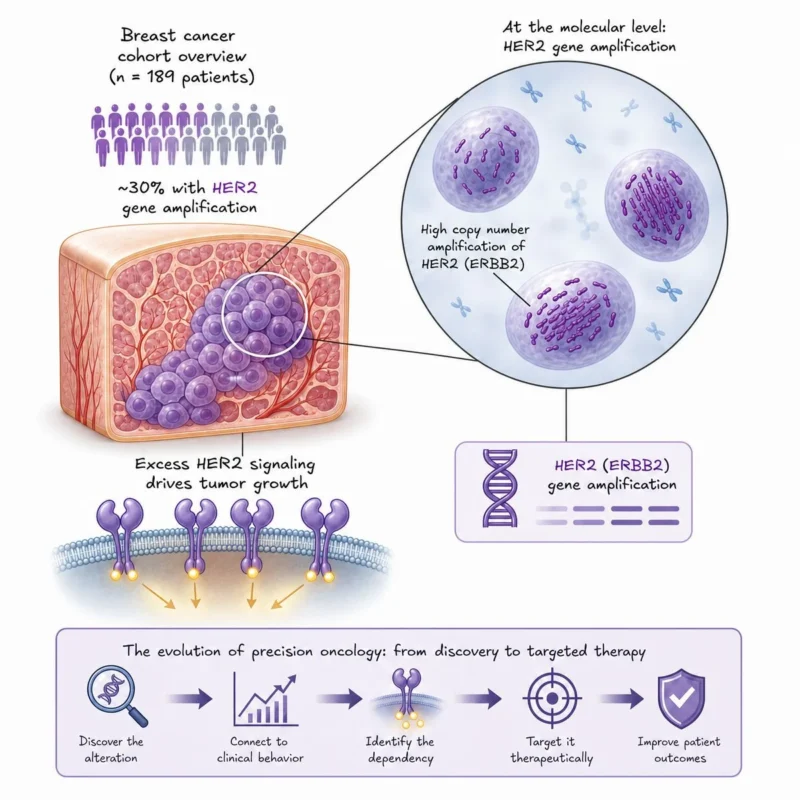
They analyzed tumors from 189 patients with primary breast cancer and found HER2 gene amplification in roughly 30% of cases.
But the most important observation was the clinical connection.
HER2 amplification was significantly associated with shorter time to disease relapse and reduced overall survival. In patients with lymph-node-positive breast cancer, HER2 amplification emerged as an important predictor of outcome.
This helped establish a powerful concept in oncology:
A molecular alteration could define a biologically and clinically distinct subgroup of cancer.
At the time, HER2 was primarily a clue about tumor biology and prognosis.
But that clue eventually became a therapeutic opportunity.
Recognition that some breast cancers were driven by excessive HER2 signaling provided the biological rationale for targeting HER2. This ultimately contributed to the development of trastuzumab (Herceptin) and, later, an entire generation of HER2-directed therapies.
The story of HER2 captures the evolution of precision oncology beautifully:
Discover the alteration – connect it to clinical behavior – identify the dependency – target it therapeutically.
Today, HER2 is not simply a prognostic marker. It is one of the clearest examples of how molecular classification can fundamentally change cancer treatment.
The enduring lesson: when we divide cancers by their molecular drivers rather than only by where they arise, entirely new therapeutic possibilities emerge.”
Authors: Dennis J. Slamon, Gary M. Clark, Steven G. Wong, Wendy J. Levin, Axel Ullrich, and William L. McGuire