Sendurai Mani, Associate Director of Translational Oncology at Legorreta Cancer Center, shared on LinkedIn:
“Top 200 most influential cancer papers – Paper 79: Reading melanoma’s genomic history – uncovering the signature of ultraviolet light
I recently shared an AI-generated (Claude) list of the top 200 papers that have shaped cancer research on LinkedIn:
Today, I share more about Paper 79.
Can a cancer genome preserve evidence of the environmental exposure that helped shape it?
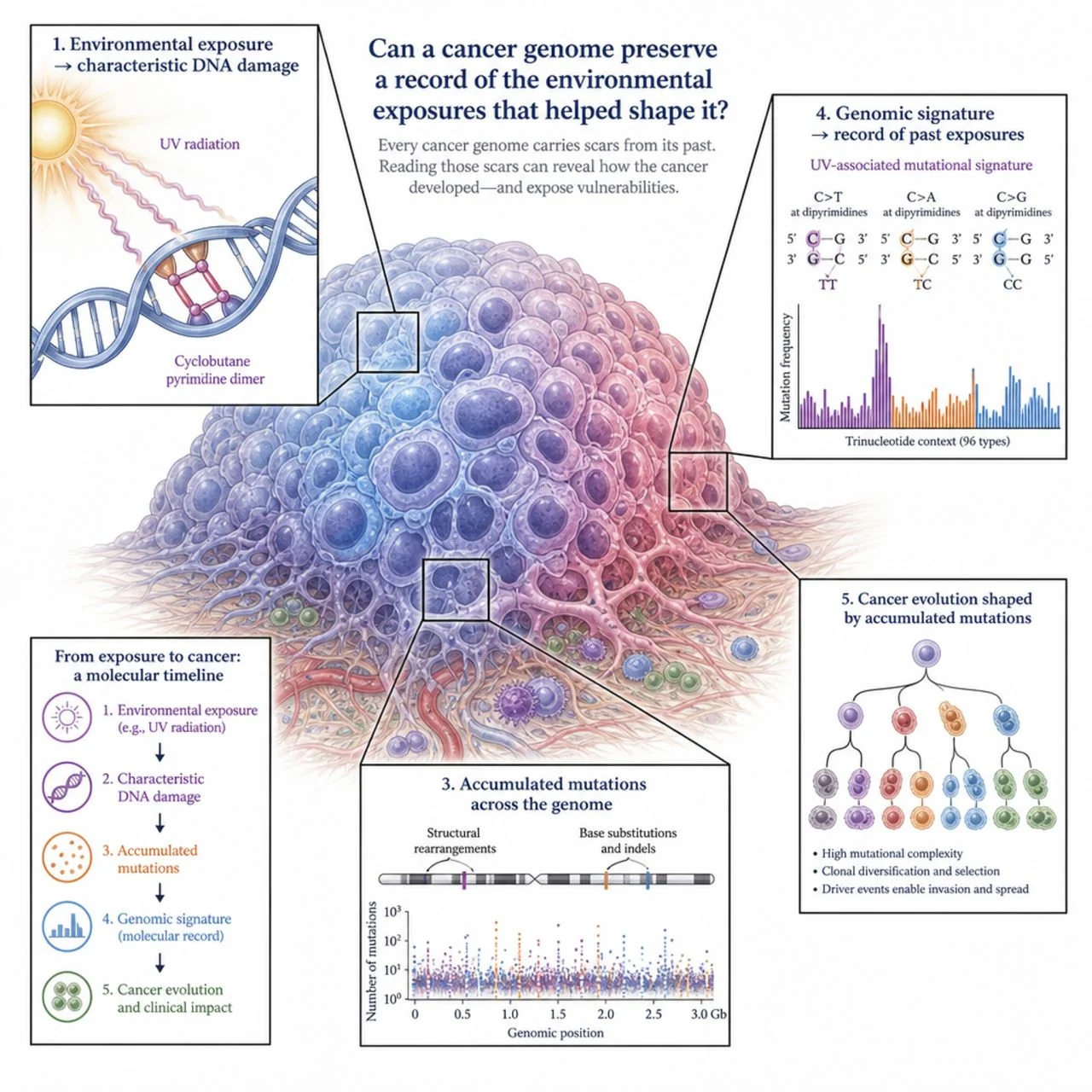
In 2010, Erin Pleasance and colleagues published a landmark Nature study presenting a comprehensive catalogue of somatic mutations from a malignant melanoma genome.
The researchers sequenced a melanoma cell line and a matched normal lymphoblastoid cell line from the same individual, allowing inherited variants to be separated from tumor-acquired mutations.
They identified more than 33,000 somatic base substitutions.
But the pattern was as important as the number.
The dominant mutational signature reflected DNA damage caused by ultraviolet (UV) light, while the distribution of mutations also provided evidence of DNA-repair processes operating across the genome.
In other words, the cancer genome contained a molecular record of its past.
The concept became:
Environmental exposure – DNA damage – characteristic mutations – genomic signature.
This helped establish the idea that patterns of mutations can reveal the biological processes and exposures that have acted on a tumor over time.
That principle would later expand into the field of cancer mutational signatures.
The study also reinforced the distinction between driver mutations, which contribute to cancer development, and the many passenger mutations that can still carry valuable information about a tumor’s history.
The enduring lesson: A cancer genome is more than a list of mutations. It can be a historical record of the damage, repair, and evolutionary processes that shaped the tumor.
Pleasance ED, Cheetham RK, Stephens PJ, et al. A comprehensive catalogue of somatic mutations from a human cancer genome. Nature. 2010;463:191–196.
Title: A comprehensive catalogue of somatic mutations from a human cancer genome
Authors: Erin D. Pleasance, R. Keira Cheetham, Philip J. Stephens, David J. McBride, Sean J. Humphray, Chris D. Greenman, Ignacio Varela, Meng-Lay Lin, Gonzalo R. Ordóñez, Graham R. Bignell, Kai Ye, Julie Alipaz, Markus J. Bauer, David Beare, Adam Butler, Richard J. Carter, Lina Chen, Anthony J. Cox, Sarah Edkins, Paula I. Kokko-Gonzales, Niall A. Gormley, Russell J. Grocock, Christian D. Haudenschild, Matthew M. Hims, Terena James, Mingming Jia, Zoya Kingsbury, Catherine Leroy, John Marshall, Andrew Menzies, Laura J. Mudie, Zemin Ning, Tom Royce, Ole B. Schulz-Trieglaff, Anastassia Spiridou, Lucy A. Stebbings, Lukasz Szajkowski, Jon Teague, David Williamson, Lynda Chin, Mark T. Ross, Peter J. Campbell, David R. Bentley, P. Andrew Futreal, Michael R. Stratton.
Other articles from Sendurai Mani on OncoDaily.