Sendurai Mani, Associate Director of Translational Oncology at Legorreta Cancer Center, shared on LinkedIn:
“Top 200 most influential cancer papers Paper 54: APC – mapping the genetic foundation of familial adenomatous polyposis
I recently shared an AI – generated (Claude) list of the top 200 papers that have shaped cancer research on LinkedIn.
Today, I share more about Paper 54.
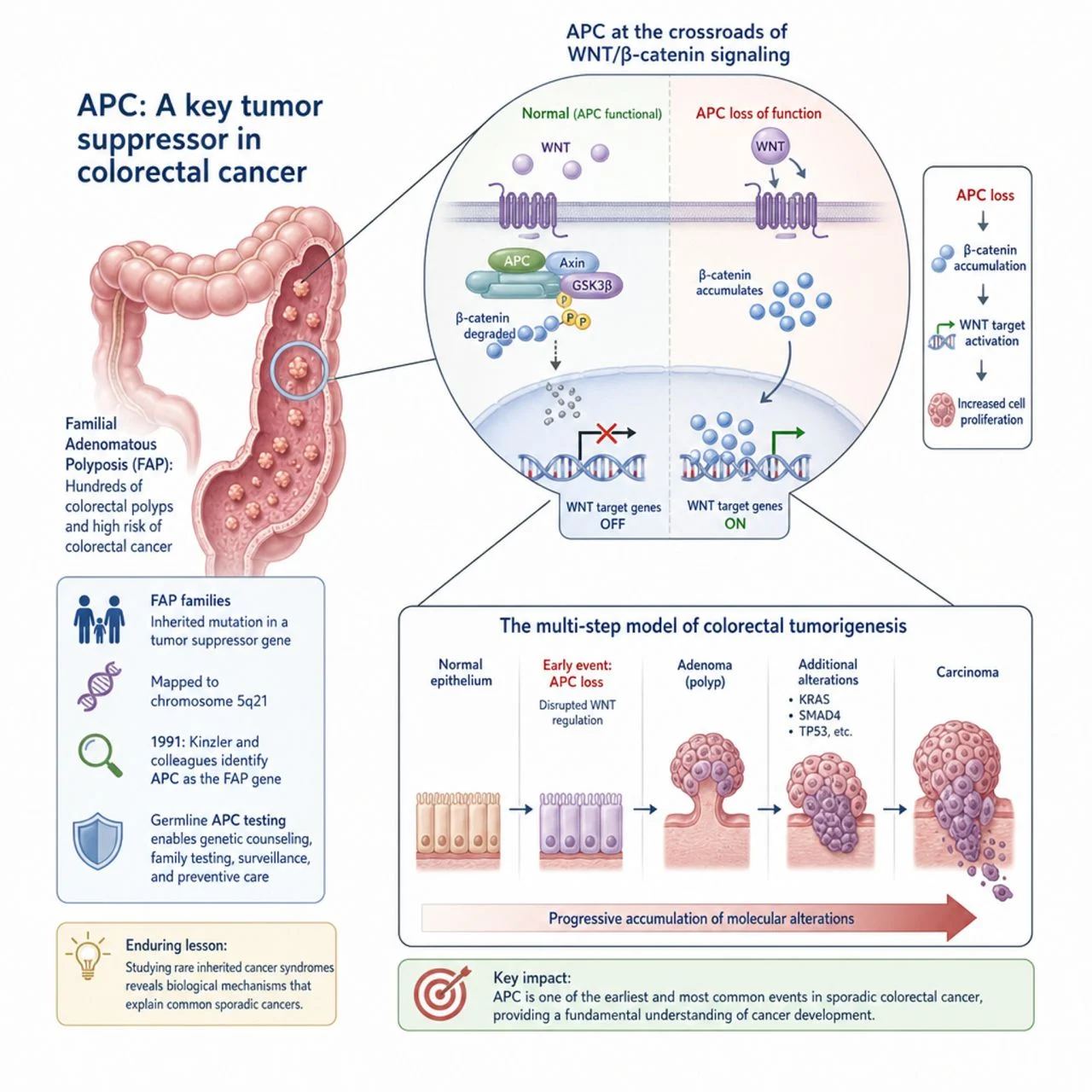
What if a hereditary syndrome producing hundreds of colon polyps could reveal one of the earliest genetic steps toward colorectal cancer?
In 1991, Kenneth Kinzler and colleagues published an influential Science paper identifying genes within the familial adenomatous polyposis (FAP) locus on chromosome 5q21.
FAP is an inherited syndrome in which affected individuals develop numerous colorectal adenomas and face an extremely high lifetime risk of colorectal cancer without preventive intervention.
The study helped narrow and characterize the region containing the gene responsible for FAP.
That gene became known as APC – adenomatous polyposis coli.
APC would later emerge as one of the most important tumor suppressors in colorectal cancer.
Its normal function includes regulation of β-catenin and Wnt signaling, a pathway central to intestinal cell renewal.
When APC function is lost:
β-catenin accumulates – Wnt-responsive genes activate – abnormal proliferation begins.
APC alterations are not limited to hereditary FAP.
They are among the most common early genetic events in sporadic colorectal tumorigenesis.
The scientific progression became:
Familial polyposis – chromosome 5q21 – APC – Wnt β-catenin signaling – colorectal tumor initiation.
The enduring lesson: Studying rare inherited cancer syndromes can uncover genes that explain the biology of common sporadic cancers.
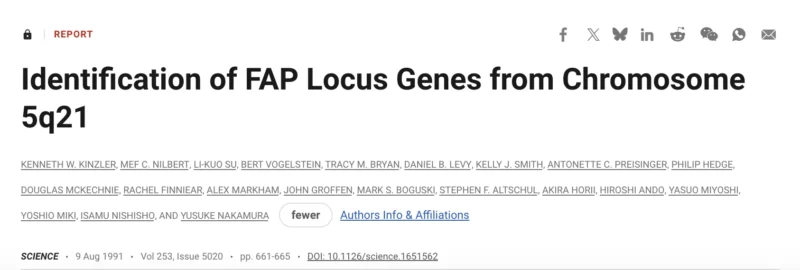
Kinzler KW, Nilbert MC, Su LK, et al. Identification of FAP locus genes from chromosome 5q21. Science. 1991;253:661–665.
DOI.”
Title: Identification of FAP Locus Genes from Chromosome 5q21
Authors: Kenneth W. Kinzler, Mef C. Nilbert, Li-Kuo Su, Bert Vogelstein, Tracy M. Bryan, Daniel B. Levy, Kelly J. Smith, Antonette C. Preisinger, Philip Hedge, Douglas McKechnie, Rachel Finniear, Alex Markham, John Groffen, Mark S. Boguski, Stephen F. Altschul, Akira Horii, Hiroshi Ando, Yasuo Miyoshi, Yoshio Miki, Isamu Nishisho, Yusuke Nakamura
Other articles featuring Sendurai Mani on OncoDaily.