






Sendurai Mani, Associate Director of Translational Oncology at Legorreta Cancer Center, shared on LinkedIn:
“Top 200 most influential cancer papers – Paper 21: CED-3 – uncovering the machinery of programmed cell death.
I recently shared an AI-generated (Claude) list of the top 200 papers that have shaped cancer research on LinkedIn: Today, I share more about Paper 21.
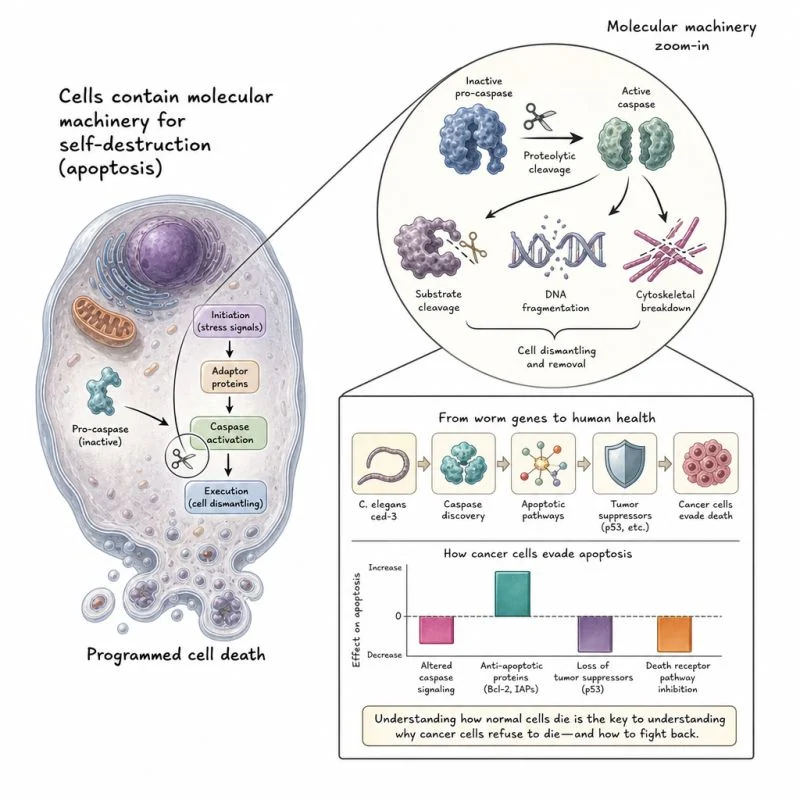
What if cells contain their own molecular machinery for self-destruction?
In 1993, Junying Yuan, Shai Shaham, Susan Ledoux, H. Michael Ellis, and H. Robert Horvitz published a landmark Cell paper that helped reveal how programmed cell death is executed.
The discovery came from the tiny nematode C. elegans, in which exactly 131 cells are programmed to die during normal development.
Genetic studies had identified ced-3 as essential for this process. But what did it encode?
Yuan and colleagues cloned ced-3 and discovered that its protein resembled mammalian interleukin-1β-converting enzyme (ICE), now known as caspase-1.
This provided a crucial insight: Programmed cell death is controlled by evolutionarily conserved proteolytic machinery.
The finding helped pave the way for understanding the caspase family, a group of proteases that play central roles in apoptosis. The connection to cancer is fundamental.
Paper 20 described what apoptosis looks like. Paper 21 helped reveal how the death program works at the molecular level.
Cancer cells can evade apoptosis through multiple mechanisms, including altered caspase signaling, increased anti-apoptotic proteins, and loss of tumor suppressor pathways such as p53.
The scientific journey is remarkable: Apoptosis → cell-death genes → caspases → apoptotic pathways → understanding how cancer escapes death.
It is also a powerful example of how basic science can transform medicine: discoveries in a tiny worm revealed mechanisms fundamental to human cancer biology.
Horvitz later shared the 2002 Nobel Prize in Physiology or Medicine for discoveries concerning genetic regulation of organ development and programmed cell death.
The enduring lesson: To understand why cancer cells refuse to die, we first had to understand how normal cells are programmed to die.
Yuan J, Shaham S, Ledoux S, Ellis HM, Horvitz HR. The C. elegans cell death gene ced-3 encodes a protein similar to mammalian interleukin-1β-converting enzyme.”
Other articles from Sendurai Mani on OncoDaily.