Sabine D. Brookman-May, Professor of Urology at Munich University and Senior Vice President and Therapeutic Area Head of Urologic Oncology at Aura Biosciences, shared Markus Eckstein’s, Senior Physician/Pathologist and Clinician Scientist at the University Hospital Erlangen, post on X, adding:
“Great work and important insights again from Markus Eckstein for future clinical development.
Really interesting work in a challenging bladder cancer subtype SmCCB Bladder Small Cell Carcinoma.
- The striking divergence between genomic NECTIN4 amplification and actual target expression is an important reminder: we cannot simply extrapolate biology from conventional UC to SmCCB
- DLL3 and SLFN11 may point us towards a more biologically rational treatment strategies.”
Quoting Markus Eckstein’s post:
“Small cell carcinoma of the bladder: why ADC targets from conventional UC do not simply carry over, and what may work instead.
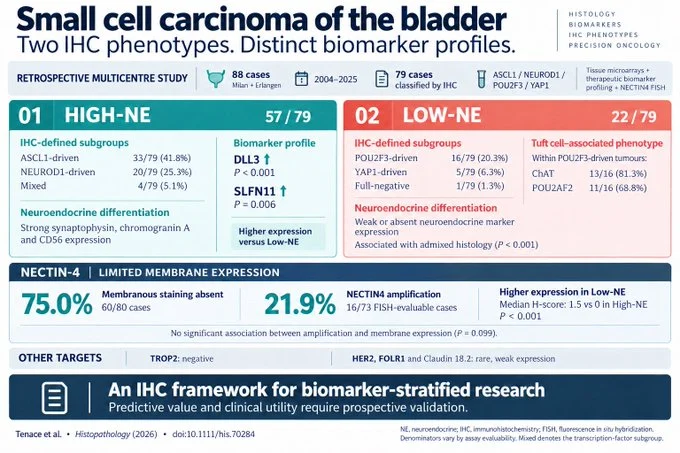
New in Histopathology: 88 SmCCB from Milan and Erlangen, 79 fully profiled by IHC for ASCL1, NEUROD1, POU2F3, YAP1, HNF4α, NE and tuft cell markers, plus 7 therapeutic targets and NECTIN4 FISH.
Two phenotypes
- High-NE (57/79): ASCL1-driven, NEUROD1-driven or mixed, diffuse synaptophysin, chromogranin and CD56
- Low-NE (22/79): POU2F3-driven, YAP1-driven or TF-negative, weak or absent NE markers, significantly associated with admixed urothelial, glandular or squamous histology
–
ADC and BiTE targets, one by one: Nectin-4 (membranous)
- Completely negative in 75% (60/80)
- Median H-score 0, mean 11.6, max 220
- Higher in Low-NE than High-NE (median 1.5 vs 0, P<0.001), consistent with retained urothelial differentiation
NECTIN4 amplification (FISH)
- 16/73 (21.9%), a frequency comparable to conventional UC
- No difference between High-NE and Low-NE (P=0.835)
- No association with membranous protein (P=0.099)
TROP2
- Completely negative across the cohort
HER2, FOLR1, Claudin 18.2
- Rare and weak expression only
DLL3
- Positive in 35/43 evaluable High-NE cases (81%)
- Nearly absent in Low-NE (P<0.001)
- Relevant for DLL3-directed BiTEs such as tarlatamab and for DLL3 ADCs in development
SLFN11
- Median H-score 125, significantly higher in High-NE (P=0.006)
- Supports testing DNA-damaging strategies in this group
Key takeaways
- High-NE SmCCB is largely Nectin-4 protein negative, yet carries NECTIN4 amplifications at rates similar to conventional UC. The amplification is present, the protein is not.
- Our hypothesis: this points to NE transdifferentiation from a urothelial precursor that already harboured the amplification. The gene status is retained, while the urothelial protein program, including Nectin-4, is switched off during lineage change. The equal amplification rate in both phenotypes fits this model. It needs confirmation in paired and clonal analyses.
- Practical consequence: NECTIN4 FISH alone should not be read as a surrogate for target presence in SmCCB. Gene status and membranous protein both need to be assessed.
- Enfortumab vedotin benefit cannot be assumed in High-NE SmCCB. Low-NE tumours with residual urothelial features remain the more plausible candidates for UC-type ADCs.
- High-NE SmCCB behaves biologically like SCLC: DLL3-high, SLFN11-high. This makes it a rational population for SCLC-directed strategies.
- A tuft cell-like subset exists: POU2F3-driven tumours co-express POU2AF2 (11/16) and ChAT (13/16), with preclinical mSWI/SNF vulnerabilities.
- A simple workflow (NE markers ± TF panel) can stratify SmCCB in routine diagnostics today.
Limits: retrospective, TMA-based, no treatment or outcome annotation. Treatment-annotated and paired pre/post-therapy cohorts are the next step.
Big shout out to Nazario Tenace from San Raffaele he drove this work as fellow. Bright future for this talented pathologist. Shout out also at great collaborators from Sann Raffaele.
Great collaboration between San Raffaele Milan and UK Erlangen, led by Nazario Tenace, with Andrea Necchi.”
Title: Immunohistochemical stratification of bladder small cell carcinoma reveals two major phenotypes with distinct therapeutic biomarker profiles
Authors: Nazario P Tenace, Maurizio Colecchia, Arndt Hartmann, Maurilio Ponzoni, Claudio Doglioni, Sebastian Rauch, Marco Moschini, Andrea Necchi, Alberto Briganti, Francesco Montorsi, Markus Eckstein
You can also read:
Prognostic Value of Perioperative ctDNA Across Bladder Cancer Histologies