Ryan Schoenfeld, Chief Executive Officer at The Mark Foundation for Cancer Research, shared on LinkedIn:
“When exciting results from the daraxonrasib pancreatic cancer clinical trial were presented recently at the plenary session of ASCO 2026, it was a big moment for a disease with historically few therapeutic options. But in cancer research, the immediate next question is always ‘how will the tumor fight back?’
In a new study just published in Nature Medicine, Ida Aronchik of Revolution Medicines and her co-authors (including The Mark Foundation for Cancer Research grantees Andrew Aguirre and Brian Wolpin from the Dana-Farber Cancer Institute) provide an early answer to that question by studying circulating tumor DNA from patients in the drug’s Phase 1/2 trial.
Instead of mutating the specific site where the drug binds – a common issue seen with previous generations of RAS-targeting drugs – it turns out that these tumors resisted mainly by increasing the number of mutated gene copies they produce (KRAS amplification) or by switching on backup growth pathways.
The researchers then used human and mouse models to test combinations designed to block those specific backup routes. Pairing daraxonrasib with therapies targeting DNA damage response, growth factor receptors, or even companion RAS inhibitors (like zoldonrasib) effectively headed off resistance in the lab.
Single-agent targeted therapies are not always a permanent fix for aggressive cancers like pancreatic cancer. By mapping out a tumor’s escape routes early, we can design smarter combination treatments that keep patients responding longer.
Furthermore, in seeing these mechanisms of resistance to daraxonrasib come to light, I am struck that now more than ever it is a critical time to double down on research towards early detection, diagnosis, and prevention for pancreatic cancer, as well as towards new therapeutic approaches to treating high-risk precancerous lesions. Alongside our partners American Association for Cancer Research and The Lustgarten Foundation, we are proud to support important research along these lines as part of the recently launched Early Detection Award program.
See below a link to the paper for a great read. Congrats to the team on this excellent work!”
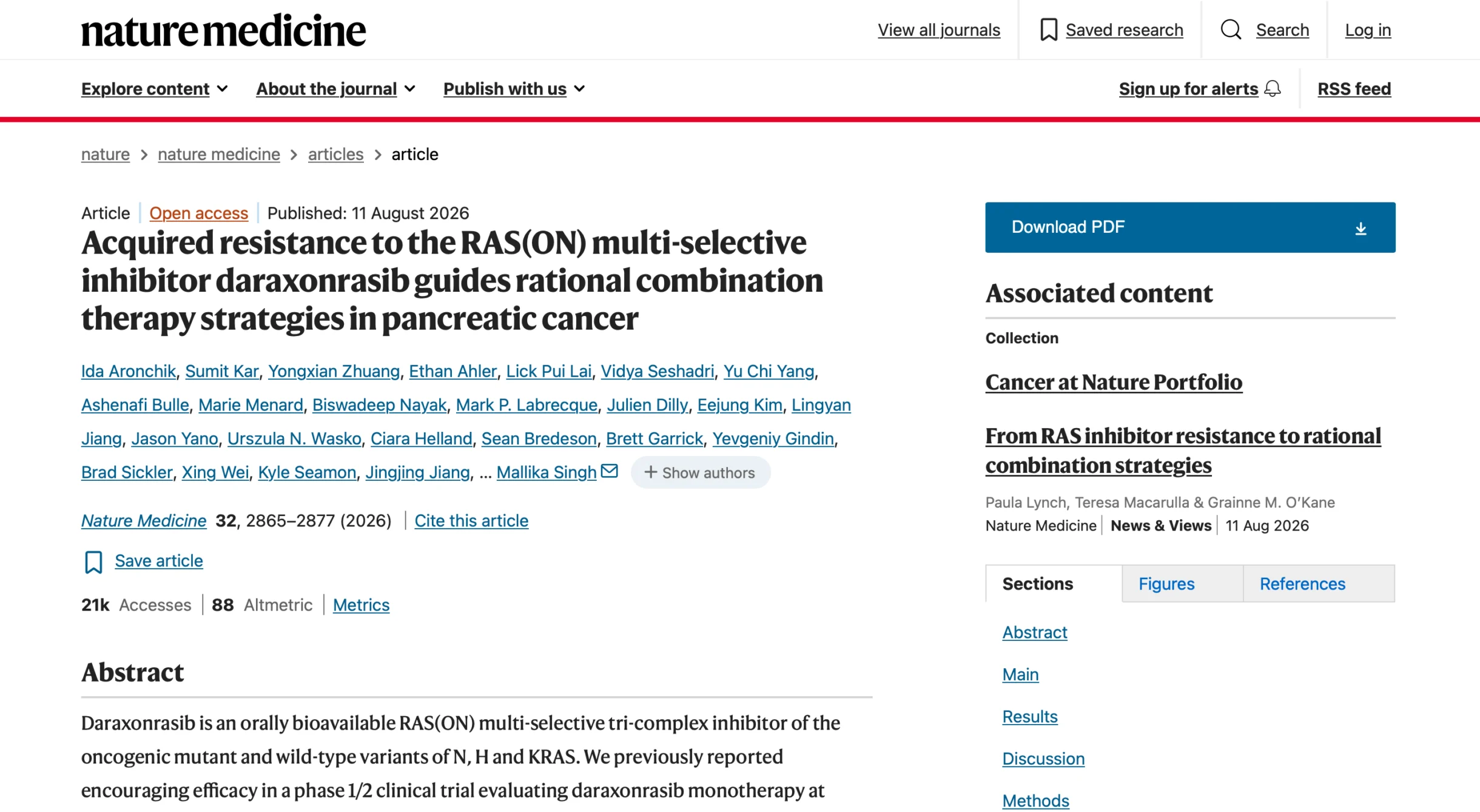
Title: Acquired resistance to the RAS(ON) multi-selective inhibitor daraxonrasib guides rational combination therapy strategies in pancreatic cancer
Authors: Ida Aronchik, Sumit Kar, Yongxian Zhuang, Ethan Ahler, Lick Pui Lai, Vidya Seshadri, Yu Chi Yang, Ashenafi Bulle, Marie Menard, Biswadeep Nayak, Mark P. Labrecque, Julien Dilly, Eejung Kim, Lingyan Jiang, Jason Yano, Urszula N. Wasko, Ciara Helland, Sean Bredeson, Brett Garrick, Yevgeniy Gindin, Brad Sickler, Xing Wei, Kyle Seamon, Jingjing Jiang,
Kian-Huat Lim, Matthew Holderfield, Elsa Quintana, Aparna Hegde, Zeena Salman, Alexander Starodub, Alexander Spira, Wungki Park, David S. Hong, Minal Barve, Meredith Pelster, David Sommerhalder, Salman R. Punekar, Ignacio Garrido-Laguna, Brian M. Wolpin, Anirban Maitra, W. Clay Gustafson, Steve Kelsey, Jacqueline A. M. Smith, Kevin K. Lin, Andrew J. Aguirre, Mallika Singh.
Read the full article.
You can also read:
Daraxonrasib Resistance in Pancreatic Cancer Points to New Combination Strategies