



Runcie Chidebe, Education Administrative College Intern – Interprofessional Learning at Cleveland Clinic, shared on LinkedIn:
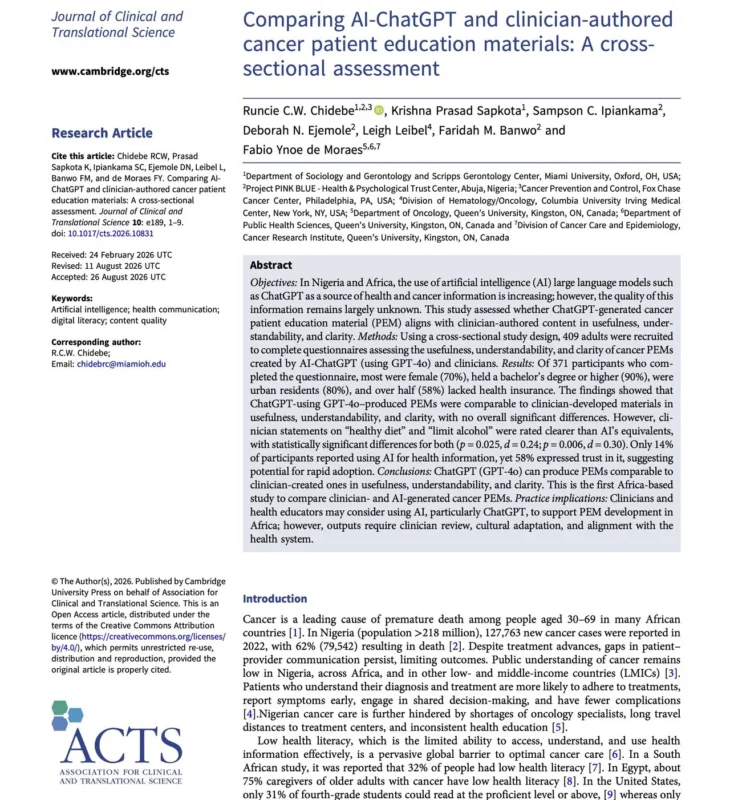
“A few days ago, our article, ‘Comparing AI-ChatGPT and clinician-authored cancer patient education materials: A cross-sectional assessment,’ was published in Cambridge’s Journal of Clinical and Translational Science. To our knowledge, this is the first study to evaluate the use of artificial intelligence (AI)-generated cancer prevention PEMs in Nigeria and across Africa.
Digital tools have helped personalize cancer information to meet patient needs, especially in underserved settings. AI, such as large LLMs like ChatGPT, represents a new generation of digital tools capable of generating dynamic responses to patient queries.
Previous studies suggest that AI tools like ChatGPT can generate understandable and acceptable cancer patient education materials (PEMs). However, data, evidence, and studies on AI and cancer PEMs from low- and middle-income countries (LMICs) and Africa are scarce and still emerging. To close this knowledge gap, we compared the clarity, usefulness, and understandability of ChatGPT-generated PEMs with clinician-authored PEMs in Nigeria. We hypothesized that ChatGPT-generated PEMs would match clinician-authored content in usefulness, understandability, and clarity.
Our findings showed that:
- ChatGPT-using GPT-4o – produced PEMs were comparable to clinician-developed materials in usefulness, understandability, and clarity, with no overall significant differences.
- However, clinician statements on ‘healthy diet’ and ‘limit alcohol’ were rated clearer than AI’s equivalents, with statistically significant differences for both.
- Only 14% of participants reported using AI for health information, yet 58% expressed trust in it, suggesting potential for rapid adoption.
- When seeking health information, 73% relied on doctors, 52% on Google, 36% on other social media, 22% on ‘Aproko Doctor’ (a Nigerian physician influencer), and 14% on AI tools like ChatGPT.
- Most (95%) accessed the internet via smartphones, while 49% used laptops.
- Regarding technology use, 30% used fitness wearables
- 36% used health-related mobile apps, and only 4% used cancer-related apps.
- 90% expressed interest in using cancer apps for prevention and care
We argued that AI adoption across Africa is increasing, underscoring the urgent need to incorporate more African evidence-based and culturally relevant information into AI outputs to prevent misinformation among the African population.
Learn more.
Special thanks to my co-authors, Miami University and Project Pink blue
Let me know what you think via the comments section. Also, let’s collaborate to replicate this study across other African countries. Please let’s connect.”
Other articles featuring Runcie Chidebe on OncoDaily.