
Piotr Wysocki, Head of the Oncology Department at University Hospital in Kraków, shared on LinkedIn:
“Sometimes, the most important therapeutic decision begins with questioning the original diagnosis.
From the Department of Oncology, Jagiellonian University-Medical College Hospital in Cracow, Poland
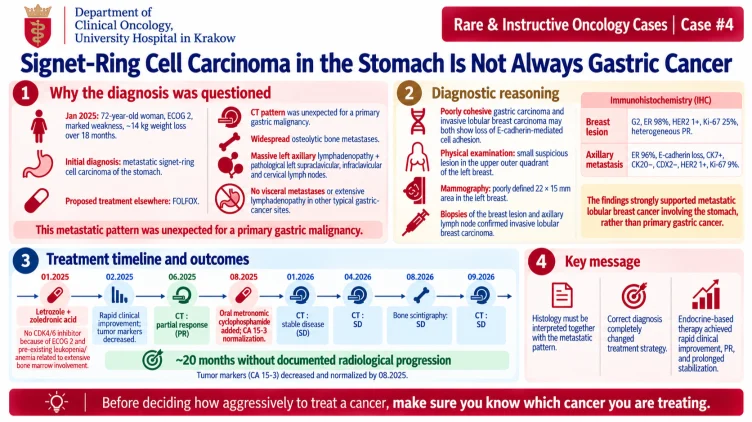
In January 2025, a 72-year-old woman came to see me for a second opinion after being diagnosed with metastatic signet-ring cell carcinoma of the stomach.
She had been offered FOLFOX chemotherapy but feared she might not survive it. Her condition was concerning:
- ECOG 2
- pronounced weakness
- weight loss of approximately 14 kg (25% of her body weight) over 18 months.
Her primary concern was the toxicity of chemotherapy. Mine became the accuracy of her diagnosis.
Something about the metastatic pattern did not fit.
Gastroscopy had revealed signet-ring cell carcinoma, while CT demonstrated
- extensive gastric wall thickening
- widespread osteolytic skeletal metastases
- massive left axillary lymphadenopathy accompanied by pathological left supraclavicular, infraclavicular, and cervical lymph nodes – a distribution unexpected for a primary gastric malignancy.
Importantly, there were no visceral metastases or extensive lymphadenopathy in other regions typically involved in disseminated gastric cancer.
I considered the biological similarities between poorly cohesive gastric carcinomas and invasive lobular breast carcinoma, particularly the loss of E-cadherin-mediated cell adhesion, which may produce a similar discohesive growth pattern.
This biological overlap, together with the unusual metastatic distribution, prompted me to question the original diagnosis.
During my physical examination, I identified a small, suspicious lesion in the upper outer quadrant of the left breast.
I suspected the opposite – that the breast might actually be the primary tumor site.
January 2025 – The diagnostic turning point
Mammography revealed a poorly defined 22 × 15 mm area in the left breast.
Biopsies of the breast lesion and axillary lymph nodes confirmed invasive lobular breast carcinoma.
The breast tumor was
- G2
- ER 98%
- HER2 1+
- Ki-67 25%
- with heterogeneous PR expression.
The axillary metastasis showed
- ER 96%
- loss of E-cadherin
- CK7 positivity
- negative CK20/CDX2 staining
Together with the clinical presentation, these findings strongly supported metastatic lobular breast cancer involving the stomach, rather than primary gastric cancer.
This completely changed our therapeutic strategy.
Instead of FOLFOX, we initiated letrozole and zoledronic acid in January 2025. Given the patient’s poor performance status (ECOG 2) and pre-existing leukopenia and anemia associated with extensive bone marrow involvement by metastatic disease, we decided against adding a CDK4/6 inhibitor because of concerns about further hematologic toxicity.
The patient experienced rapid clinical improvement, accompanied by declining tumor markers.
June 2025 – CT confirmed a partial response (PR).
In August 2025, following a modest increase in tumor markers despite continued clinical benefit, we added oral metronomic cyclophosphamide to letrozole, which led to CA15.3 normalization.
Subsequent imaging demonstrated prolonged disease stabilization:
January and April 2026: SD on CT.
August 2026: Stable bone scintigraphy.
September 2026: Continued SD on CT.
Approximately 20 months after initiating endocrine-based treatment, the patient remains without documented radiological progression.
Interestingly, CEA closely reflected the early clinical improvement, whereas CA 15-3 initially increased despite the subsequent radiologically confirmed response.
Why am I sharing this case?
- First – The metastatic pattern matters. A gastric biopsy showing signet-ring cell carcinoma does not necessarily establish the stomach as the primary tumor site. Extensive skeletal metastases and massive unilateral axillary lymphadenopathy prompted me to reconsider the diagnosis.
- Second – Understanding tumor biology matters. The similarities between poorly cohesive gastric carcinoma and invasive lobular breast carcinoma, particularly E-cadherin loss, helped guide the diagnostic reassessment.
- Third – The correct diagnosis can completely transform treatment. A patient who feared she might not survive FOLFOX instead received endocrine-based therapy, achieving rapid clinical improvement, a partial response, and prolonged disease stabilization.
Although the independent contribution of metronomic cyclophosphamide cannot be established, the overall clinical benefit has been substantial.
Moreover, the MECCA study results show that metronomic chemotherapy added to an aromatase inhibitor is an active strategy that provides benefit at least comparable to CDK4/6i.
If the patient experiences radiological/clinical disease progression, she will begin SERD+CDK4/6i therapy.
Before deciding how aggressively to treat a cancer, make sure you know which cancer you are treating.”
You may also be interested in: FFCD-AC: 1L Chemotherapy for Metastatic Recurrence of Ampullary Adenocarcinoma