






Olivier Elemento, Director of Englander Institute for Precision Medicine at Weill Cornell Medicine, shared a post on LinkedIn:
“The largest spatial proteomic atlas of follicular lymphoma (FL) yet built: 4.2 million single cells from 156 tumor cores across 131 patients.
Our new bioRxiv preprint with colleagues at NYU, BC Cancer (Vancouver), and Josep Carreras (Barcelona).
Until now, no FL spatial proteomic atlas at this scale existed. Prior imaging studies were too small to link tissue architecture to outcome.
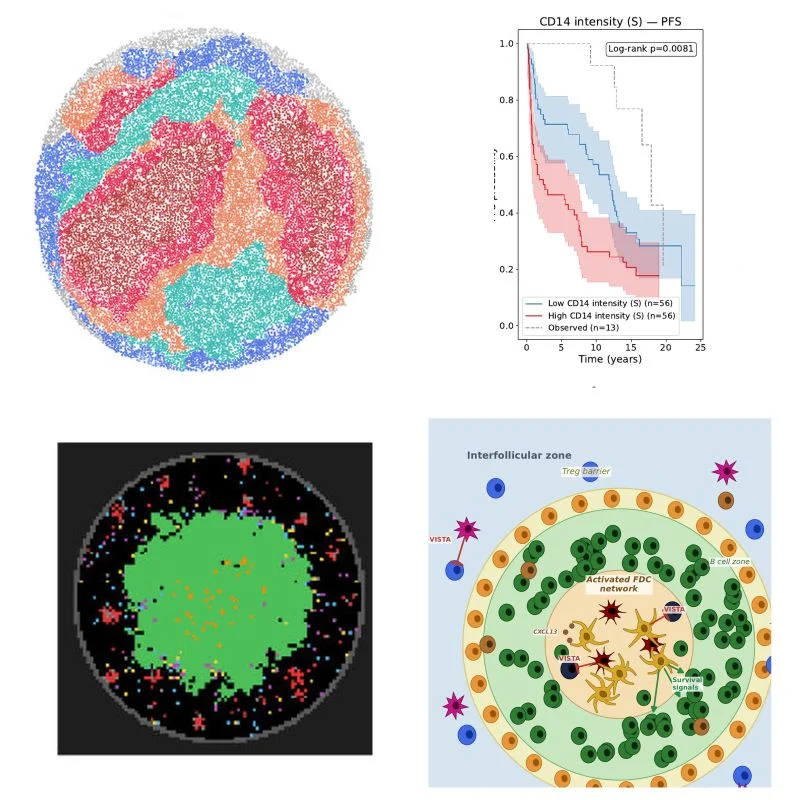
We applied two complementary 39-marker imaging mass cytometry panels to FL tissue and mapped each cell’s spatial neighborhood. What we see is that FL exploits tissue architecture itself as an immune evasion strategy. The follicle behaves as an immune-privileged sanctuary. CD8 T cells are largely excluded from it, and the ones that do get in are exhausted. A Treg-enriched barrier at the follicle boundary separates the sanctuary from the surrounding effector-rich tissue.
CD14 is a classic monocyte marker. In this atlas we also find it on follicular dendritic cells that support tumor B cell proliferation. Per-cell CD14 intensity predicts progression-free survival (HR=1.50, p=0.0007), independent of FLIPI, grade, and stage.
VISTA dominates checkpoint expression across all myeloid subtypes in this atlas, well beyond PD-L1. Agent-based modeling predicts synergistic tumor clearance from anti-VISTA combined with a CD20-CD3 bispecific antibody.
I want to thank Hiranmayi Ravichandran, Wendy Beguelin, David Scott, Steidl Christian, and Ari Melnick for the collaboration.”
Title: Spatial Proteomics Reveals Dual-Compartment Immune Evasion Architecture and Core Lymphomagenic Stromal Niches in Follicular Lymphoma
Authors: Olivier Elemento, Hiranmayi Ravichandran, Wendy Béguelin, David W. Scott, Christian Steidl, Ari M. Melnick
Other articles featuring Olivier Elemento on OncoDaily.