
Neta Erez, Professor at the Faculty of Medicine at Tel Aviv University, shared on LinkedIn:
“Excited to share that our latest work has been published in Cancer Research.
High-grade serous ovarian cancer spreads throughout the peritoneal cavity, but not much is known about how metastatic niches become permissive.
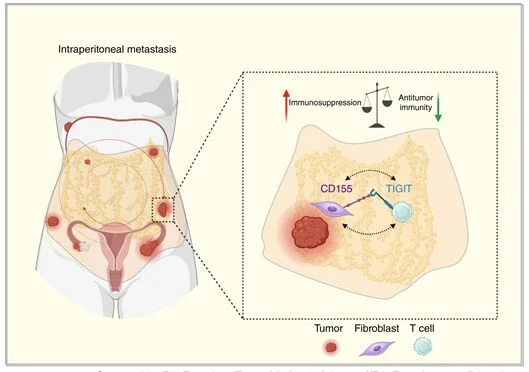
In this study, we found that cancer-associated fibroblasts (CAFs) actively shape an immunosuppressive metastatic niche by recruiting myeloid cells and driving T-cell dysfunction via the TIGIT-CD155 immune checkpoint axis.
An additional intriguing finding is that intraperitoneal metastasis appears to follow a spatial hierarchy: the omentum is colonized first and undergoes stromal and immune remodeling before widespread peritoneal dissemination.
Together, our findings highlight CAF-immune cell interactions as key drivers of ovarian cancer metastasis and suggest new opportunities to therapeutically target the metastatic microenvironment .
Congratulations to Neta Salomon who spearheaded this project, and to the outstanding team whose work was instrumental in this study: : Ye’ela Scharff, Yuval Rubinstein, Lea Monteran, Nour Ershaid and my longtime collaborator Dan Grisaru.”
Title: Stromal–Immune Interactions Promote Immune Suppression in Intraperitoneal Metastasis of Ovarian Carcinoma Available to Purchase
Authors: Ye’ela Scharff, Yuval Rubinstein, Lea Monteran, Nour Ershaid, Noam Cohen, Yael Zait, Asaf Aizic, Ido Laskov, Dan Grisaru, Neta Erez.
Other articles about AACR on OncoDaily.