
After cancer treatment, one of the most important questions is whether any cancer cells remain in the body. Minimal residual disease (MRD) testing uses highly sensitive blood tests to detect traces of tumor DNA that may indicate persistent cancer long before recurrence becomes visible on imaging. These tests have transformed cancer care by enabling earlier detection of relapse and helping physicians make more informed treatment decisions.
However, blood-based testing represents only one source of information. Every patient also has a diagnostic tissue specimen obtained at the time of diagnosis: a specimen that contains extensive information about the biological behavior of the tumor. Advances in digital pathology and artificial intelligence are making it possible to extract this information and combine it with molecular MRD testing, potentially providing a more complete and individualized assessment of recurrence risk.
Beyond Detection: Toward Biological Understanding
Minimal residual disease testing is evolving from a predominantly molecular discipline into a truly multimodal paradigm. Circulating tumor DNA (ctDNA) provides a highly sensitive measure of residual disease burden and captures an aspect of cancer biology that was previously inaccessible through conventional clinical assessment. The presence or absence of ctDNA offers direct evidence regarding whether tumor-derived material remains detectable within the patient after treatment.
At the same time, the tissue specimen used to establish the original diagnosis contains a remarkably rich and largely underutilized source of biological information. Histopathologic evaluation has long relied upon human interpretation of morphology and architecture. Today, digital pathology and computational approaches can quantify these same features at a scale and precision not previously possible. Tumor architecture, cellular morphology, spatial organization, immune infiltration, stromal composition, vascular patterns, treatment-induced changes, and numerous additional features can now be measured objectively and reproducibly from routine diagnostic slides.
Importantly, these tissue-derived phenotypes are not merely descriptive observations. They frequently reflect the biological mechanisms that drive tumor growth, invasion, dissemination, immune evasion, treatment resistance, and ultimately recurrence. In many respects, the diagnostic slide represents a biologic record of the tumor’s behavior and evolutionary potential.
As digital pathology and artificial intelligence mature, diagnostic slides are increasingly becoming a source of quantitative biomarkers that can complement molecular MRD assays. Histologic patterns associated with aggressive behavior, metastatic potential, immune escape, or persistent residual disease can be extracted directly from routinely acquired slides without additional tissue consumption. Unlike many emerging biomarkers, this information is already available for virtually every patient diagnosed with cancer.
From Binary Detection to Continuous Risk Prediction
The conceptual framework shown in Figure 1 illustrates how tissue-derived intelligence may complement molecular MRD assessment. ctDNA-based MRD testing provides direct evidence of residual disease, whereas computational analysis of diagnostic tissue specimens captures biologic features associated with tumor aggressiveness and recurrence potential.
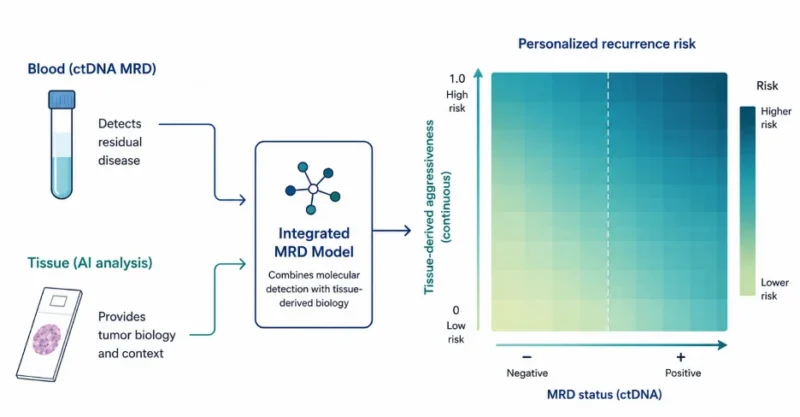
Figure 1. Conceptual framework for multimodal MRD assessment. ctDNA-based MRD testing provides direct evidence of residual disease, whereas AI-derived analysis of the diagnostic tissue specimen captures biologic features associated with tumor aggressiveness. Integration of these complementary data sources enables personalized recurrence risk prediction. The heatmap illustrates a conceptual risk surface in which recurrence risk increases with both MRD positivity and tissue-derived aggressiveness, transforming MRD assessment from binary detection to biologically contextualized prediction.
Viewed independently, each modality provides valuable and complementary information. ctDNA primarily answers the question: Is residual disease present? Tissue-derived biomarkers can provide insights into diagnosis, prognosis, treatment response, and tumor biology. Within the context of MRD, they help answer a different but equally important question: How biologically aggressive is this tumor?
Towards Biologically Contextualized Predictions
The integration of these complementary data sources creates an opportunity to move beyond binary detection toward biologically informed prediction. Together, circulating and tissue-derived signals may capture both residual disease burden and underlying tumor biology, generating a synergistic view that is more informative than either modality alone. In the conceptual risk plane (illustrated in Figure 1), recurrence risk increases with both MRD positivity and tissue-derived aggressiveness. MRD-positive patients generally exhibit higher risk than MRD-negative patients; however, substantial heterogeneity remains within both groups. Tissue-derived biomarkers may help explain and quantify that heterogeneity by identifying biologic features associated with more favorable or more aggressive disease behavior.
This approach recognizes that recurrence risk is unlikely to be a binary phenomenon. Rather, risk exists on a continuum determined by both residual disease burden and the underlying biology of the tumor. The combination of molecular and tissue-derived information therefore has the potential to provide a more nuanced and clinically actionable assessment of patient risk.
A Bold Vision for the Next Phase of MRD
Cancer is fundamentally a multidimensional disease, and its assessment will increasingly require multidimensional measurement. The long-term future of MRD assessment will likely involve the integration of multiple complementary modalities, including ctDNA, tissue-derived biomarkers, data from comprehensive genomic profiling, radiographic imaging, clinical variables, treatment history, germline factors, proteomics, and other emerging sources of biologic information.
However, the next major step toward this future may already be available today. Every patient undergoing tumor-informed molecular MRD testing already possesses two routinely acquired data sources: a blood sample and a diagnostic tissue specimen. As a result, the integration of computational pathology and liquid biopsy represents a uniquely practical and immediately scalable opportunity to advance precision oncology.
Rather than viewing tissue and blood as competing sources of information, they should be viewed as complementary windows into the same disease process. Liquid biopsy provides a dynamic measure of residual disease burden, while computational pathology provides insight into the biologic characteristics that influence disease persistence, progression, and recurrence. Together, these modalities may establish the foundation for a new generation of multimodal MRD systems that transform recurrence assessment from simple detection into comprehensive biologic prediction.
Ultimately, integrating molecular evidence from blood with biologic intelligence derived from tissue has the potential to improve risk stratification, personalize surveillance strategies, guide therapeutic decision-making, and identify high-risk patients earlier in their disease course. In this integrated MRD framework, the diagnostic slide evolves from a static record of diagnosis into a dynamic source of prognostic and predictive information when creating the personalized care pathway for a given patient.
Signatera has been developed and its performance characteristics determined by the CLIA certified laboratory performing the test. The test has not been cleared or approved by the US Food and Drug Administration (FDA). CAP accredited, ISO 13485 certified, and CLIA certified. © 2026 Natera, Inc. All Rights Reserved.
This content was created in partnership with Natera, Inc.