Matt Sherer, Director of Oncology Service Line at UMC Health System, shared on LinkedIn:
“I just wrote an article on access to oncology care. Please read and comment. I look forward to the discussion.
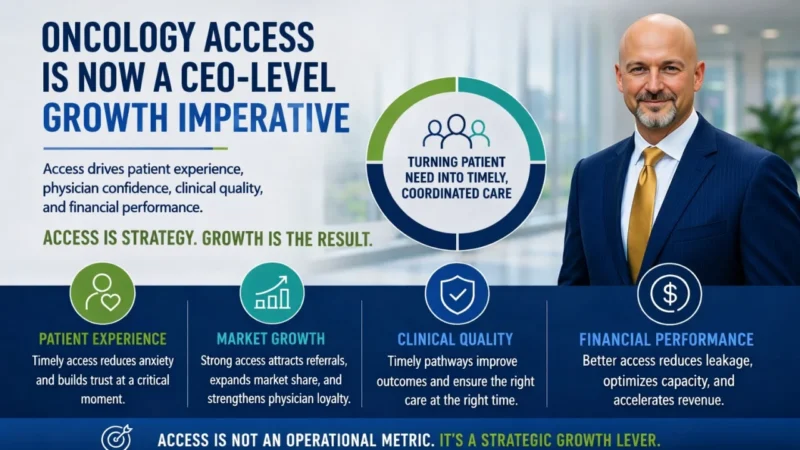
Oncology access is not an operational metric. It’s a strategic growth lever.
Most health system CEOs still think oncology access is a scheduling problem. They’re wrong – and it’s costing them patients, referrals, and market share they’ll never get back.
For years, access has been shoved downward. To clinic managers. To schedulers. To template committees nobody wants to sit on. Appointment slots, referral queues, intake workflows – all treated as back-office plumbing beneath the executive gaze.
That was a mistake. And in oncology, it’s now an expensive one.
Cancer care is getting harder every year. Patients arrive sicker and more complex. Workforce shortages aren’t going away. Prior authorization adds days to every treatment start. Multidisciplinary care demands a level of coordination most health systems were never designed to deliver.
In that environment, if you can’t get patients in quickly, you don’t just annoy them.
You lose them. And you lose the referrals, the revenue, and the physician trust that walked in with them.
Access starts at the worst moment of someone’s life
A newly diagnosed cancer patient isn’t experiencing your “workflow.” They’re experiencing fear – measured in days and weeks, not clicks and tickets.
Every handoff is a chance to build trust or destroy it. Referral. Intake. Navigation. Diagnostics. Prior auth. Consult. Treatment start. Patients feel every gap between those steps. So do the physicians who sent them.
Systems that deliver a clean journey earn loyalty. Systems that don’t find out – usually too late – that their referrals have quietly walked across the street.
Access is your growth strategy, whether you admit it or not
Cancer programs pour money into physician recruitment, proton beams, robotic surgery, and gleaming new facilities.
None of it matters if patients can’t get in the door.
The most advanced cancer center in your market will lose to a less sophisticated competitor with a two-day time-to-consult. Every time.
Referring providers don’t grade you on your clinical reputation. They grade you on whether their patient got a callback, was seen quickly, and was treated without them having to chase you. That’s it.
Strong access grows referral networks. Weak access bleeds them. Stop calling that a scheduling issue.
Access is a quality issue too
Clinical excellence depends on timing. Great oncologists can’t rescue a program that takes three weeks to move a patient from diagnosis to treatment plan.
The question is not whether you deliver excellent care. It’s whether you deliver it before the disease – or the competition – moves first.
Access is the first honest signal of whether your cancer program is actually an integrated system, or just a collection of departments sharing a logo.
And it’s a financial lever CEOs keep ignoring
Bad access hides its damage across your P&L:
- Referral leakage
- Underutilized physicians, you paid a fortune to recruit
- Empty infusion chairs
- Administrative rework that eats margin
- Delayed revenue capture
- Patients who leave and never come back
Fix access, and throughput, productivity, and financial performance follow. Every single time.
Access isn’t a cost center. It’s one of the highest-ROI levers in your entire cancer service line – and most executives aren’t touching it.
The question CEOs should actually be asking
Stop asking:
‘How many appointments do we have available?’
Start asking:
‘How fast does our system turn a scared patient into a treated one?’
That question changes everything. It forces you off the clinic dashboard and onto the enterprise scoreboard.
What the winners are doing
High-performing cancer programs manage access as an enterprise capability:
- Executive-level access dashboards reviewed monthly
- Disease-specific access targets with teeth
- Referral leakage measured as a strategic KPI
- Integrated nurse navigation
- Physician template governance
- Prior authorization cycle-time tracking
Most of all, they’ve stopped pretending access is somebody else’s job.
Bottom line
Access is the first – and often only – impression patients and referring physicians form of your cancer program. It drives trust, growth, quality, and margin, usually before a single treatment decision is made.
If you’re a CEO chasing sustainable oncology growth and access isn’t on your strategy table, you’re not running a cancer program. You’re running a waiting list.
CEO takeaway: Oncology access isn’t a scheduling problem. It’s the clearest measure of whether your health system can actually deliver on the promises it markets.
What’s the one access metric your executive team reviews every month? If the answer is “none,” that’s your competitor’s next opportunity.”
You can also read ‘Why Do Millions of Cancer Patients Still Lack Access to Radiotherapy?‘