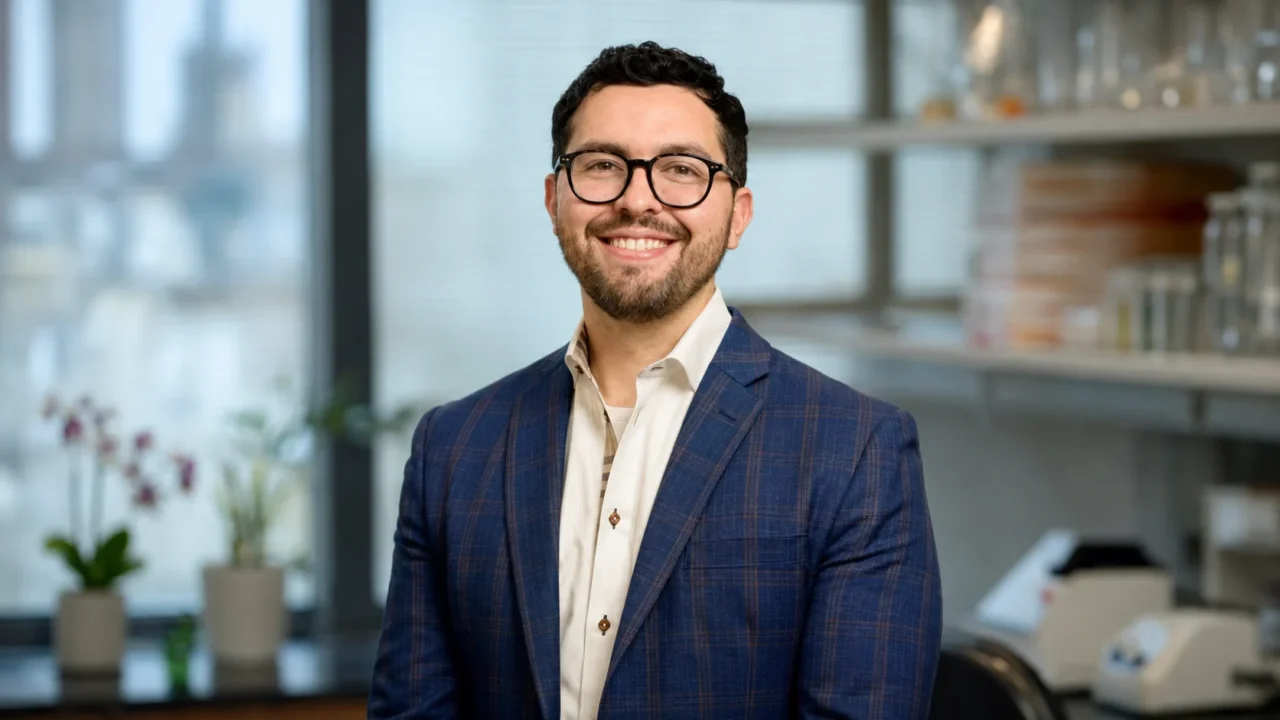
Juan Osorio, Assistant Attending at Memorial Sloan Kettering Cancer Center and Director of Clinical Operations and Translational Immunology at The Rockefeller University, shared on LinkedIn:
“Excited to share our new study in AACR Journals Clinical Cancer Research!
Can we harness CD40 agonism to treat bladder cancer? And can the spatial organization of immune cells help explain who responds?
CD40 agonism is a powerful strategy to activate dendritic cells (DCs) and initiate antitumor immunity, but clinical translation has been limited by systemic toxicity and suboptimal agonistic activity.
To overcome these challenges, we developed 2141-V11, an Fc-engineered CD40 agonist optimized for engagement of FcγRIIB, the inhibitory Fc receptor required for optimal CD40 agonism.
Building on our first-in-human trial in metastatic cancer, we evaluated intravesical 2141-V11 in patients with BCG-unresponsive non-muscle-invasive bladder cancer (NMIBC), where bladder-preserving options remain limited.
In a fantastic collaboration with clinical investigators in the urologic oncology/GU oncology service led by Bernie Bochner at Memorial Sloan Kettering Cancer Center and outstanding immunologist Lucas Blanchard from the Ravetch lab at The Rockefeller University, we conducted a phase I trial involving 25 patients.
Key findings:
- Favorable safety profile, with a recommended phase II dose of 70 mg.
- Preliminary clinical responses in 40% of patients.
- Perhaps most intriguing: Not all tertiary lymphoid structures (TLS) are created equal!
Although TLS were frequently present, their abundance and maturity were not associated with response. Instead, responders showed enrichment of spatially organized DC–CXCL13⁺ CD4⁺ T cell–CD8⁺ T cell triads, whereas nonresponders exhibited increased DC–Treg proximity following treatment.
Title: Spatial Immune Organization Associates with Response to CD40 Agonism in BCG-Unresponsive Non–Muscle-Invasive Bladder Cancer: A Phase I Trial
Authors: Juan C. Osorio, Lucas Blanchard, Ning Yao, Syed M. Alam, Ali Ghasemzadeh, Steven Grudman, Karissa Whiting, Venkatraman E. Seshan, Andrew Mijacika, Carlo Sevilla, Juan C. Angulo-Lozano, Ved P. Sharma, Morgan Tomberlin, Melissa McCarter, Jessica Pfau, Jeffrey L. Wong, David A. Knorr, Timothy F. Donahue, Robert Smith, Eugene J. Pietzak, Benjamin Greenbaum, Hikmat Al-Ahmadie, Jonathan E. Rosenberg, Jeffrey V. Ravetch, Bernard Bochner
These findings suggest that how immune cells are organized and interact within tumors may matter more than simply how many are present. They also raise exciting questions about how regulatory interactions may constrain CD40 agonism.
Our findings support further evaluation of intravesical 2141-V11, now advancing into a phase II trial!
It takes a village to move a therapy from antibody engineering to clinical testing. Immensely grateful to our outstanding collaborators including Jonathan Rosenberg Benjamin Greenbaum and many others, and especially the patients who made this work possible.
Excited to see where our CD40 program takes us next, in bladder cancer and beyond!”
You can also read:
FDA Approves Expanded Indication for Anktiva in BCG-Unresponsive NMIBC