






Glen Clack, Chief Medical Officer at TheraCryf, shared on LinkedIn:
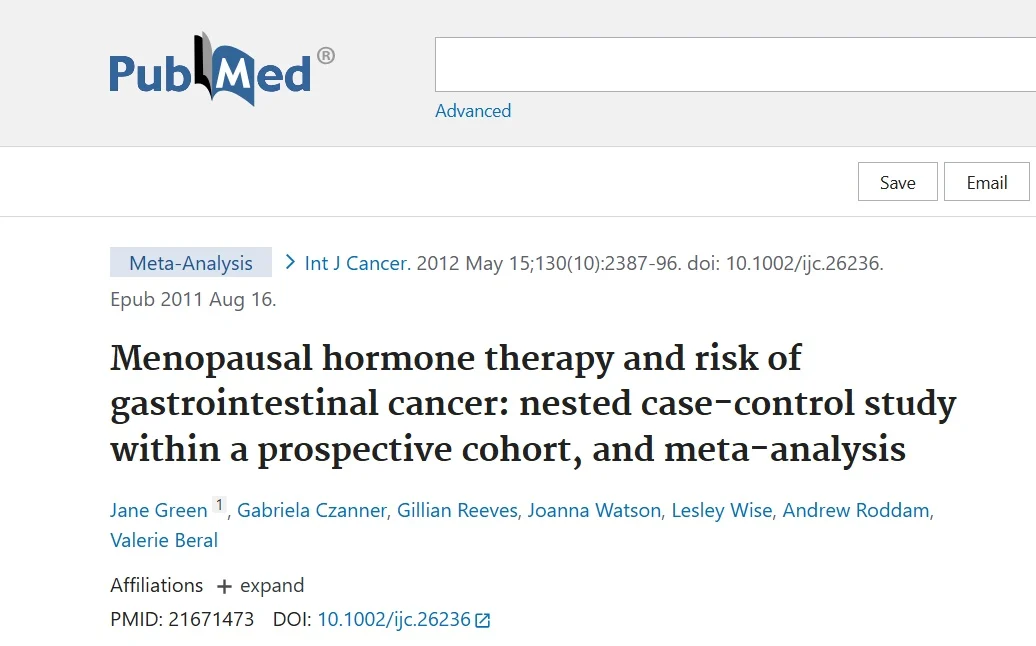
“Menopausal hormone therapy and risk of gastrointestinal cancer: nested case-control study within a prospective cohort, and meta-analysis.
There is a particular moment at breakfast, somewhere between the second cup and the last of the marmalade, when one reads a headline and the toast pauses in mid-air.
Menopausal hormone therapy, reports a new paper in JNCI, is associated with roughly a 30% reduction in esophageal and gastric cancer.
Five Nordic countries, 19,518 cases, 195,094 controls, registries of a completeness that would reduce the average British dataset to tears. Splendid stuff; and the team behind it are first rate.
Then one reads Table 1, and the marmalade goes down untasted.
Some 58% of the ‘menopausal hormone therapy’ users were taking low-dose vaginal estrogen: which is to say that the headline exposure is, more than anything else, a preparation specifically designed not to reach the bloodstream.
And in the authors’ own 5-year sensitivity analysis, that non-systemic preparation outperformed the systemic one, 0.71 against 0.75.A fly in the ointment, one might say. But there is a second, and it is a whopper.
The strongest association of the lot was for esophageal squamous cell carcinoma: the tobacco-and-alcohol tumor, which the paper’s own introduction politely excludes from the hormonal hypothesis.
An effect that is largest in the tissue with no mechanism, and largest again in the formulation with no systemic absorption, is not pharmacology. It is a portrait of the sort of woman who gets prescribed things and turns up to her appointments.
The authors observe that adjusting for obesity, smoking, alcohol and the rest did not attenuate the estimates, and take this as arguing against confounding.
I would not advocate that inference. Adjustment for the confounders one has measured says precisely nothing about the ones one has not; and coded obesity ran at 8% among women aged 65 to 81, which is less a proxy than a rumor.
Here is the rub. The prescription codes were sitting right there. Oral against transdermal; estradiol against conjugated equine estrogen; micronized progesterone against medroxyprogesterone acetate; begun at 50 or begun at 70.
Molecule, route, timing: all three presents in the data, not one of them analyzed. Instead, everything from a 10-microgram pessary to full systemic combined therapy was decanted into a single Procrustean variable, which was then handed a dose-response curve and asked to say something biological.
This is not a criticism of the investigators, who are commendably candid about healthy-user bias in their closing paragraph. It is a criticism of the variable.
And do note the symmetry. ‘HRT prevents cancer’ is the identical category error to ‘HRT causes cancer’, merely with the sign reversed; and the second of those has had 20 years to do its damage.
The exposure label is not the exposure. It never was.
More coffee.
Read the Full article.”
Title: Menopausal hormone therapy and risk of gastrointestinal cancer: nested case-control study within a prospective cohort, and meta-analysis
Authors: Jane Green, Gabriela Czanner, Gillian Reeves, Joanna Watson, Lesley Wise, Andrew Roddam, Valerie Beral
Other articles featuring Glen Clack on OncoDaily.