



George L. Kumar, Senior Director at AstraZeneca, shared on LinkedIn:
“Red Blood Cells as an Unexpected Biomarker Source for Early Gastric Cancer
Most gastric cancers are still found by endoscopy. It works, but it is invasive and a burden for patients, and many people never get screened. A reliable blood test that tells us who most needs an endoscopy could change that.
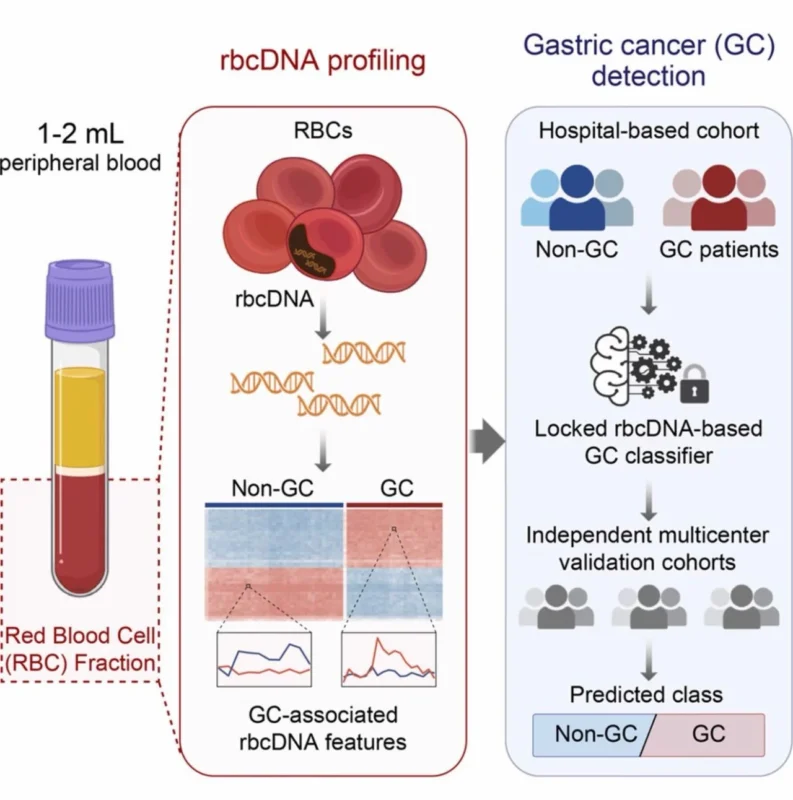
Yao and colleagues took an unusual approach. Most liquid biopsy work focuses on cell-free DNA in plasma. This team looked at DNA held inside red blood cells instead.
What they found:
- Low-depth sequencing of red blood cell DNA picked up features linked to gastric cancer.
- Their classifier needed only 1-2 mL of blood.
- It detected early-stage disease, where blood-based tests usually have the most trouble.
- It told gastric cancer apart from benign and precancerous gastric conditions, which matters for avoiding unnecessary follow-up.
- Performance held up across three independent hospital-based cohorts.
Why this matters:
Telling cancer apart from precancerous lesions is one of the hardest problems in non-invasive detection, and a small blood volume makes a test practical to use widely. Getting the same results in three cohorts makes the signal more believable.
The authors note what comes next: prospective clinical studies in screening-relevant populations. Hospital-based cohorts are a strong start, but real-world screening will be the real test.
Red blood cells have long been seen as passive carriers. They may also hold diagnostic information we have barely started to use.”
Title: Early detection of gastric cancer using DNA features in red blood cells, with multicenter validation
Authors: Xingyun Yao, Haobo Sun, Cheng Fang, Qingqu Guo, Jun Wang, Guofeng Chen, Songzhao Zhang, Baozhong Li, Yanwu Jin, Ganshu Xia, Zhiqiang Liu, Fei Meng, Jie Jin, Xiaofei Gao, Yuehua Han.
Read the article here.
You may also be interested in:
Amanda Pullinger: Exploring Advances in Gastric Cancer Care at National Cancer Center Korea