George L. Kumar, Senior Director at AstraZeneca, shared on LinkedIn:
“The Virus Hunt That Gave Us Cancer Immunotherapy.
Some of medicine’s biggest breakthroughs started as answers to completely different questions.
A new Landmark Perspective in Science by Rafi Ahmed (Emory Vaccine Center) and Steven Rosenberg (National Cancer Institute) marks 50 years since one of those moments.
Title: How the hunt for human retroviruses led to the discovery of interleukin-2 and a path to immunotherapy
Authors: Rafi Ahmed and Steven Rosenberg
Read the Full Article
The original problem:
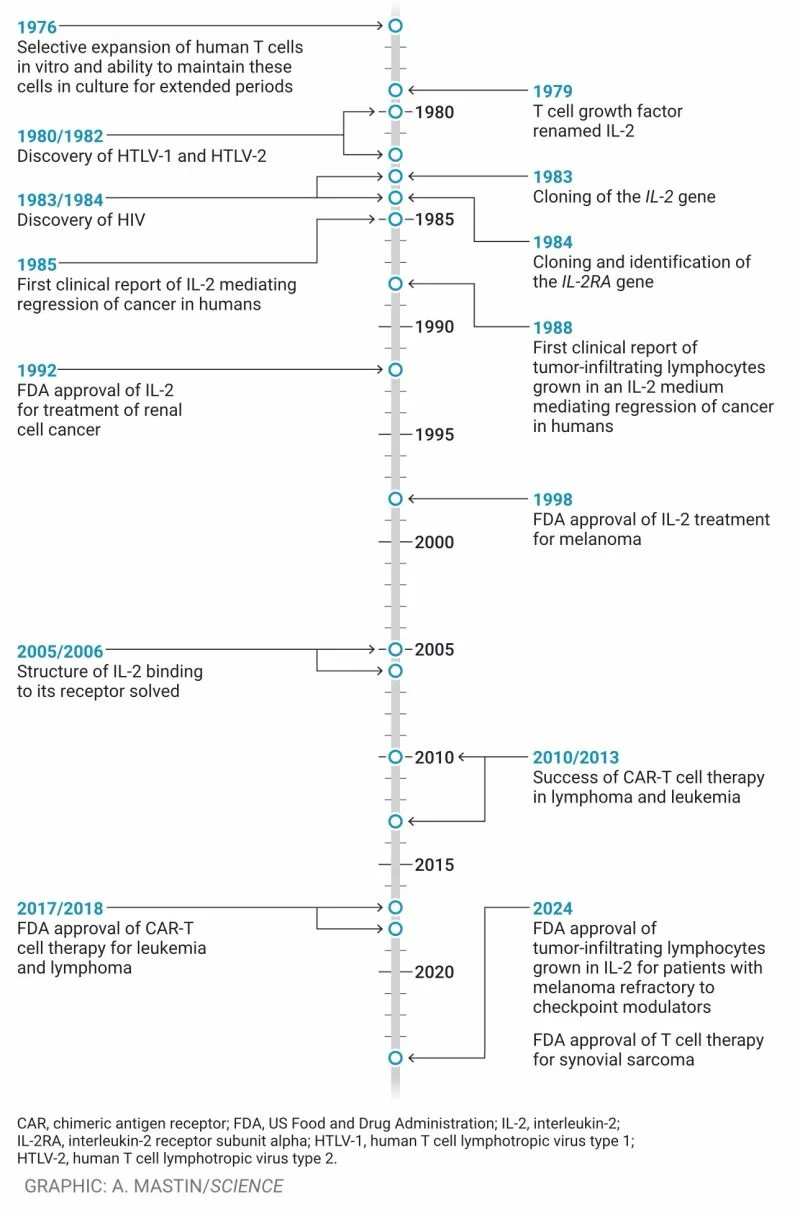
- In 1976, Robert Gallo’s lab at NCI was trying to find out whether human retroviruses existed. To do that, they needed to keep human T cells growing in the lab, which nobody could do reliably.
The unexpected answer:
- They discovered a ‘T-cell growth factor’ that let T cells multiply in culture. We now know it as interleukin-2 (IL-2).
The virology payoff:
- Being able to grow T cells made it possible to discover the first human retroviruses, HTLV-1 and HTLV-2, launching the field of human retrovirology.
The cancer payoff
IL-2 also opened the door to harnessing T cells against cancer:
- High-dose IL-2 became the first immunotherapy approved by the FDA for cancer, for metastatic kidney cancer and melanoma
- Growing tumor-infiltrating lymphocytes (TILs) outside the body laid the groundwork for adoptive cell therapy
- That path ultimately runs to today’s TIL and CAR-T therapies
Still evolving.
IL-2 biology keeps revealing new roles, including in regulatory T cells and immune balance, which is reshaping how it’s being explored in both cancer and autoimmunity.
The lesson: fundamental science, pursued for its own sake, often pays off in ways no one could predict. A tool built to answer a virology question became a pillar of modern immuno-oncology. As funding debates continue, this story is worth remembering.
What ‘accidental’ discovery in your field had the biggest downstream impact?”
You may also be interested in: CheckMate-274: Are We Measuring Long-Term Immunotherapy Toxicity Adequately?