George L. Kumar, Senior Director at AstraZeneca, shared on LinkedIn:
“Can AI-Measured Tumour Density Predict Who Benefits From Intensified Chemoradiotherapy?
Title: Tumour cell density quantified by artificial intelligence is associated with differential benefit from irinotecan-based chemo-radiotherapy in locally advanced rectal cancer: a post-hoc study of the phase 3 ARISTOTLE trial
Authors: Zhuoyan Shen, Douglas Brand, Mikaël Simard, Nicholas P. West, Andre Lopes, Rubina Begum, Ying Zhang, Gary Royle, David Sebag-Montefiore, Charles-Antoine Collins Fekete, Maria A. Hawkins
Read The Full Article.
What if a single AI-derived measurement from a routine H&E biopsy could tell us which rectal cancer patients actually benefit from a more intensive treatment – and which ones don’t?
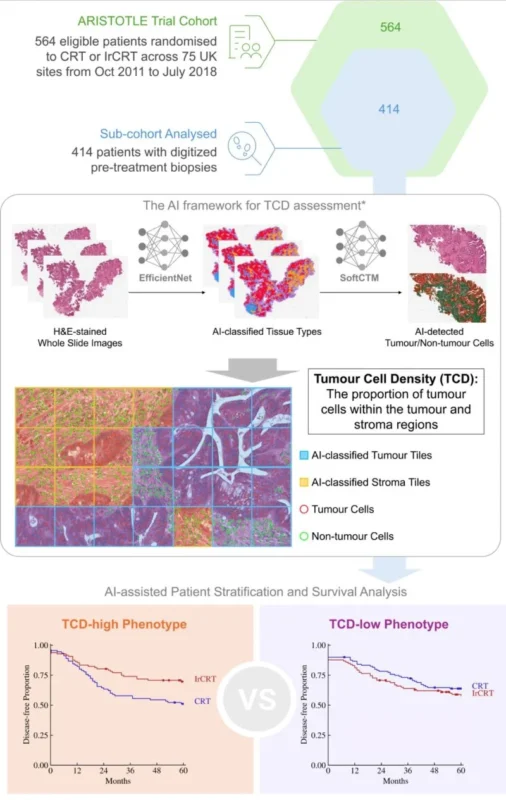
A new post-hoc analysis of the ARISTOTLE trial (414 patients with locally advanced rectal cancer) set out to test exactly that.
The idea: quantify tumour cell density (TCD) – the proportion of tumour cells across epithelial and stromal regions – directly from digitised whole-slide images using an AI framework, then ask whether treatment response tracks with it.
Patients were split into TCD-high (45%) and TCD-low (55%) using a 50% cut-off, and cross-referenced against two treatment arms: standard chemoradiotherapy (capecitabine + RT) vs. an irinotecan-intensified regimen (IrCRT).
The signal was striking:
- In TCD-high patients, adding irinotecan was associated with meaningfully better outcomes – longer disease-free survival (HR 0.57), longer overall survival (HR 0.50), and a higher pathological complete response rate (23% vs. 11%).
- In TCD-low patients, the picture flipped – no DFS benefit, and a trend toward worse overall survival with the intensified regimen (HR 1.55).
A significant treatment- TCD interaction held for both DFS (p = 0.009) and OS (p = 0.001).
Why this matters: this is a clean example of a computational pathology readout behaving like a candidate predictive biomarker – not just prognostic, but potentially able to separate who should escalate therapy from who should be spared the added toxicity. And it comes from tissue that’s already sitting in every pathology lab.
The authors are appropriately measured: this is a hypothesis-generating analysis, the pCR finding didn’t survive multiple-testing adjustment, and independent retrospective and prospective validation is the necessary next step. But the framing is compelling – extracting more decision-relevant information from the biopsy we already take.
Worth watching as AI-derived tissue metrics move from descriptive to predictive.
Figure Courtesy: Zhuoyan Shen. eBioMedicine. University College London, Gower Street, London, WC1E 6BT, United Kingdom.”