



George Kumar, Senior Director at AstraZeneca, shared on LinkedIn:
“Why Immunotherapy Biomarkers Stumble, and a Smarter Way to Fix It
Why do predictive biomarkers for immune checkpoint inhibitors (ICIs) work well in one cohort and then falter in the next?
A new study points to a key culprit: tumor microenvironment heterogeneity. Some tumors look molecularly similar yet respond very differently to therapy. When these biologically distinct states are pooled together, they behave like out-of-distribution samples, muddying the signal that links checkpoint activity to response.
The researchers’ solution is simple in concept: identify the confounders and remove them before training the model.
Key takeaways:
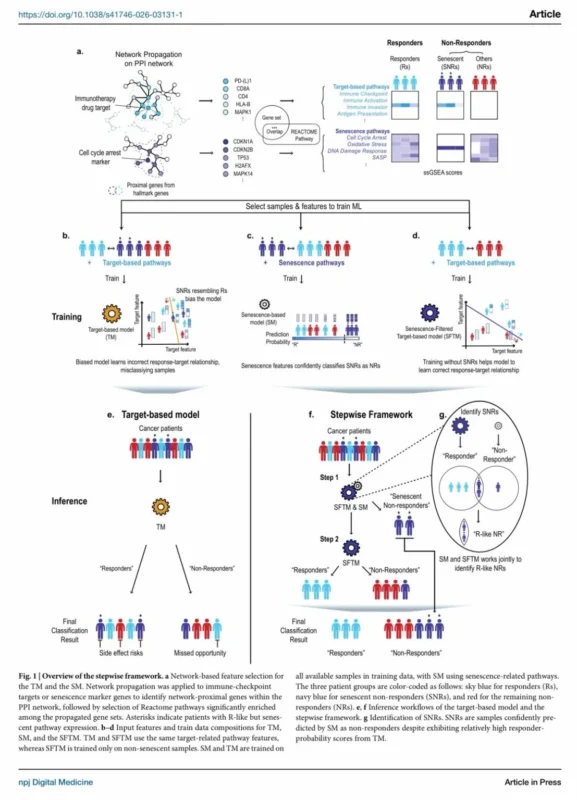
- A stepwise framework uses network-based representations of immune checkpoint and senescence pathways to flag ‘senescence-associated non-responders’ (SNRs).
- Excluding these tumors before model training improved accuracy, AUROC, precision, and specificity across melanoma, gastric, bladder, and lung cancer cohorts.
- Performance held up in external validation on independent melanoma cohorts.
- The excluded tumors were enriched for senescence-associated markers, suggesting senescence-related transcriptional programs act as biological confounders that limit standard target-based models.
Why it matters:
Better ICI response prediction may not always require a new biomarker. Sometimes it requires recognizing which tumor states don’t follow the expected biology, and accounting for them explicitly. Confounder-aware filtering of TME states offers a practical, biologically grounded way to make predictive models more consistent across cohorts.
For those of us working on biomarker development and companion diagnostics, this is a useful reminder: the biology of who doesn’t respond, and why, can be as informative as the signal itself.
Figure Courtesy: Digital Medicine. Sanguk Kim. Pohang University of Science and Technology, Pohang, Republic of Korea.”
Other articles featuring George Kumar on OncoDaily.