






Ermelinda Damko, Sr. Scientist at Regeneron, shared a post on LinkedIn:
“Protein degraders were supposed to be the endgame of small‑molecule pharmacology: don’t just inhibit the target, erase it from the cell. But most of us are still playing with half a toolkit.
We talk obsessively about which protein to degrade and how tightly we bind it.
We rarely talk about which E3 ligase we recruit, how programmable that choice is, or how much that decision will matter when tumors start pushing back.
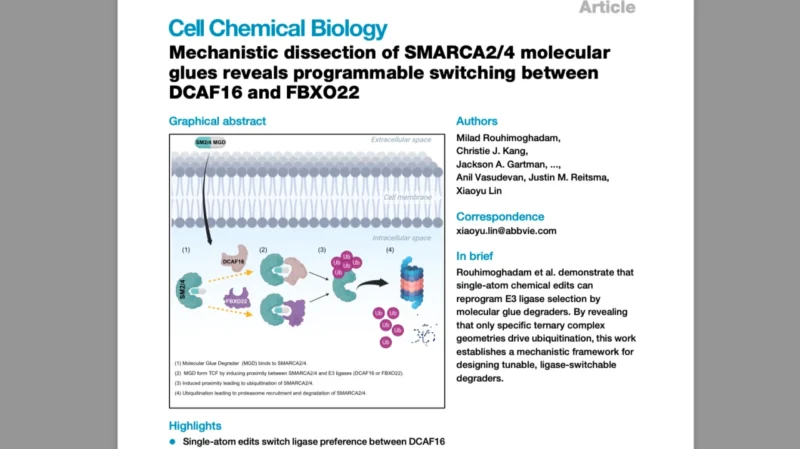
The new SMARCA2/4 molecular glue work on DCAF16 and FBXO22 quietly blows that gap wide open:
- Single‑atom edits in an alkynyl‑pyridine tail flip the same scaffold from DCAF16‑selective to FBXO22‑biased, or even require both ligases for full SMARCA2/4 knockdown.
- Same target, same bromodomain recognition, same overall chemotype – different ligase logic.
- Some ternary complexes are non‑productive: geometry, not proximity, decides whether ubiquitin actually moves.
If you work in drug discovery, that should land like a small earthquake.
It suggests that:
- Ligase choice is a tunable design parameter, not background infrastructure.
- Covalent ligase ‘hotspots’ (like DCAF16 Cys173) can be reused as programmable interfaces across targets.
- Dual‑ligase degraders are a plausible strategy for resistance robustness when one ligase is downregulated or mutated under treatment.
In other words, the right unit of design is no longer ‘the degrader molecule.’ It’s degrader + ligase + disease context. Until we design at that level, targeted protein degradation will stay data‑rich – beautiful ternary curves, proteomic volcano plots, crystal structures – and insight‑poor when it comes to prospective design rules.
Question for the field: if ligase logic is now programmable, what’s the first target class where you would deliberately design dual‑ligase degraders for resistance robustness rather than discover them by accident?
Programming Ligase Choice in SMARCA2/4 Molecular Glues
Targeted protein degradation has given drug discovery a new kind of molecule: one that does not simply inhibit a protein, but actively removes it. Yet the field still treats E3 ligases too often as fixed infrastructure rather than as design variables. The recent SMARCA2/4 molecular glue studies centered on DCAF16 and FBXO22 suggest that this assumption is becoming untenable. They show that ligase choice can be tuned chemically, and in some cases made redundant, within a single monovalent degrader scaffold.
That makes these studies important for two distinct reasons. First, they present one of the clearest demonstrations to date that molecular glues can be made ligase‑programmable. Second, they establish SMARCA2/4 as a compelling proof‑of‑concept for applying that idea in a therapeutically meaningful oncology setting.
A target class built for translational relevance
SMARCA2 and SMARCA4 are the mutually exclusive ATPase engines of the SWI/SNF chromatin‑remodeling complex, a major regulator of transcriptional state, lineage identity, and chromatin accessibility. Mutations in SWI/SNF components occur across a substantial fraction of human cancers, and SMARCA4 loss in particular has created a sustained interest in exploiting paralog dependence on SMARCA2.
This biological logic has already shaped the field. Functional studies have repeatedly shown that SMARCA4‑deficient tumors can become dependent on SMARCA2, creating a synthetic‑lethal vulnerability that is unusually attractive for targeted therapy. That vulnerability has driven the emergence of multiple SMARCA2/4‑directed modalities, including bromodomain ligands, ATPase inhibitors, PROTACs, and monovalent degraders.
SMARCA2/4 is therefore not just another degrader target. It is a test case where target dependency is biologically grounded, modality innovation is already active, and the therapeutic rationale is concrete. That makes it an ideal setting in which to ask a more ambitious question: not merely whether a target can be degraded, but whether the ligase used for that degradation can be selected, tuned, or diversified as part of the design strategy.
What these studies actually show
The central finding is deceptively simple. A series of alkynyl‑pyridine SMARCA2/4 molecular glues, all built around the same bromodomain‑recognition logic, can shift degradation dependency between DCAF16 and FBXO22 through remarkably subtle changes in the degradation tail.
One compound (compound 1) behaves as a DCAF16‑selective glue. Close analogs 2–4, differing by minimal carbon‑level edits in the degradation tail, either shift degradation dependency toward FBXO22 (compound 2), maintain bi‑ligase competence with a functional bias toward DCAF16 (compound 3), or return to strict DCAF16 dependence (compound 4). Across the series, SMARCA2/4 and the related BAF subunit PBRM1 remain the primary degradation events in DIA proteomics, with minimal evidence of broad off‑target destabilization.
This is a genuine conceptual advance. In much of targeted protein degradation, ligase selection has historically been constrained by ligand availability rather than determined by disease biology or degradation geometry. These studies reverse that hierarchy. Here, the chemistry begins to encode the ligase.
Just as important is what the data say about mechanism. DCAF16 engagement depends strongly on Cys173, which emerges as a key covalent hotspot for productive degradation; C173S markedly attenuates SMARCA2 degradation by compound 1 and abolishes compound‑induced SMARCA2–DCAF16 ternary complex formation, ubiquitination, and PSMD3 (proteasome) recruitment. FBXO22 engagement relies on a different cysteine landscape, particularly Cys228 as essential and Cys326 as contributory for SMARCA2 degradation by FBXO22‑biased glues. These residues are not acting as generic reactive liabilities. They function more like chemically addressable interfaces through which scaffold architecture can direct ligase recruitment.
The broader message is not simply that two ligases can be used. It is that minimal structural edits can determine which ligase is used, and whether that engagement is productive. That is a level of mechanistic specificity the field has rarely demanded of itself.
The deeper mechanistic insight: geometry outranks binding
Perhaps the most important lesson is that ternary complex formation alone is not enough. Some of these compounds detectably engage both DCAF16 and FBXO22 in NanoBRET TCF assays, yet only one ligase supports efficient ubiquitination and degradation for a given analog.
That distinction matters. It means the decisive variable is not whether target and ligase are brought into proximity, but whether they are brought together in a geometry that permits ubiquitin transfer. In that sense, these studies reinforce a principle that has become increasingly clear in the PROTAC field: productive ternary complex geometry is the true functional currency of targeted degradation.
This has major implications for design. It suggests that future degrader campaigns should treat binary binding, ternary engagement, ubiquitination, and proteasome recruitment as separate mechanistic layers rather than as interchangeable proxies for one another. A nonproductive ternary complex is not a near miss. It is a warning that the geometry is wrong.
That insight also helps explain why simple measures of electrophilicity or cysteine reactivity are insufficient. ALARM NMR and calculated pKa values show that the reactive cysteines in DCAF16 and FBXO22 fall within comparable ranges, and NMR‑based reactivity assays indicate that compounds 1 – 4 have similar overall electrophilic behavior. Across the series, what changes is the way the scaffold orients the target and ligase relative to one another. The mechanism is therefore not reducible to ‘which cysteine can react’, but depends on how chemical architecture translates reactivity into productive assembly.
This is where the studies are most data‑rich and insight‑poor. The authors elegantly document the existence of productive and nonproductive ternary complexes, but they do not yet provide a generalizable geometric rule set that medicinal chemists can apply prospectively. The structural modeling is compelling as a rationalization, not as a design manual.
Why this matters as a platform
If taken seriously, these findings begin to define a ligase‑programmable molecular glue platform.
The first platform feature is that ligase choice becomes tunable. DCAF16 and FBXO22 are not incidental options discovered post hoc. They emerge as selectable outputs of scaffold design, with compound‑specific ligase dependencies validated by combined knockout, TCF, ubiquitination, and degradation assays.
The second is that ligase cysteines can be treated as programmable interfaces. DCAF16 Cys173 in particular now appears to be a reusable entry point across different molecular glue chemotypes, being required not only by the SMARCA2/4 series but also by an established BRD4 glue, ML 1‑50. This suggests that covalent ligase engagement may be systematized rather than treated as a one‑off empirical trick.
The third is that dual‑ligase competence becomes imaginable as a deliberate goal. Some compounds in the series (notably 2 and 3) require engagement of both DCAF16 and FBXO22 for full SMARCA2 degradation in engineered knockout backgrounds, creating a functional form of redundancy within a single monovalent degrader architecture.
This last point may prove especially important. Much of degrader design still assumes that a single ligase is sufficient, but that assumption creates a potential fragility. If ligase expression, localization, redox state, or mutation status shifts in tumors under treatment pressure, then a degrader hardwired to one ligase may lose effectiveness. The dual‑ligase‑capable SMARCA2/4 glues described here, validated in HEK293T and Calu‑6 models with CRISPR knockouts and overexpression, offer the beginnings of a molecular backup strategy that will need to be tested directly in tumor settings.
That idea deserves more attention than it usually gets. In kinase drug discovery, redundancy and pathway escape are central design concerns. In targeted protein degradation, ligase dependency has too often been treated as static. These SMARCA2/4 studies suggest it should instead be treated as an axis of robustness.
Broader platform design lessons
The broader therapeutic lesson is that degrader platforms should be designed less like collections of target binders and more like controllable systems with multiple tunable variables. Target affinity remains necessary, but it is no longer sufficient as the organizing principle. The SMARCA2/4 glue series suggests that ligase identity, covalent topology, ternary geometry, ubiquitination competence, proteasome handoff, and resistance tolerance all belong in the primary design brief rather than being treated as downstream consequences.
That shift has practical implications for discovery strategy. A serious platform effort should ask at least five questions early: which ligases are chemically recruitable in the relevant cellular compartment, which of those ligases are biologically stable in the disease context, which ternary complexes are productive rather than merely detectable, which architectures preserve selectivity at the proteome level, and which ligase choices are most resilient to adaptation under treatment pressure. In other words, the right unit of design is not the degrader alone. It is the degrader‑plus‑ligase‑plus‑disease context.
This is also where the phrase data‑rich, insight‑poor becomes most useful. The field has become increasingly good at generating degradation curves, ternary complex traces, proteomic volcano plots, and structural rationalizations after the fact. It is still less good at integrating those datasets into predictive design rules that travel from one target class to another. A mature therapeutic platform would convert mechanistic observations into forward‑looking heuristics: when dual‑ligase competence is worth pursuing, when covalent ligase capture is likely to be an advantage rather than a liability, and when a clean ternary readout should be discounted because it lacks downstream ubiquitination productivity.
Seen in that light, the SMARCA2/4 studies matter not only because they expand one chemistry series, but because they hint at what a next‑generation degrader discovery stack should look like.
The future platform will need to integrate medicinal chemistry, quantitative ternary‑complex biology, ligase expression mapping, resistance modeling, and disease‑selective translational strategy from the start. That is the broader design lesson: therapeutic degradation will advance fastest when ligase logic is treated as a programmable part of drug mechanism, not as background infrastructure.
Why this matters for oncology
The oncology implications are not merely abstract. SMARCA2/4 sits in a disease context where the biological dependency is already unusually strong and where therapeutic selectivity is linked to paralog biology.
For SMARCA4‑deficient tumors, the central translational question is no longer whether SMARCA2 is a plausible target. It is how best to exploit that dependency. ATPase inhibitors, bromodomain ligands, PROTACs, and monovalent glues each come with different liabilities and opportunities, from off‑target chromatin effects to resistance driven by alternative SWI/SNF subunits. The new contribution of ligase‑programmable glues is that they introduce E3 usage itself as a tunable variable in that therapeutic equation.
That opens several possibilities. Different tumor settings may favor different ligases because of expression level, subcellular context, oxidative environment, or evolutionary pressure under drug treatment. Some disease states may be best served by DCAF16‑selective engagement. Others may tolerate or even benefit from FBXO22 preference, especially where FBXO22 biology intersects with specific oncogenic pathways. Still others may ultimately favor compounds able to recruit both.
Seen this way, SMARCA2/4 becomes more than a target. It becomes a proof‑of‑concept for context‑aware degradation, where the relevant design question is not just ‘can this protein be degraded’? but ‘through which ligase architecture should it be degraded in this disease’?
That is a much more mature framing of precision oncology. It moves the field beyond target identification and into mechanism‑aware execution.
Where the field is still insight-poor
The irony is that the studies are highly data‑rich while still leaving the field insight‑poor in operational terms.
They show that ligase switching is possible. They show that covalent hotspots matter. They show that productive geometry outranks simple binding. But they stop short of converting those findings into a general playbook that discovery teams can use prospectively.
What is still needed is a framework for deciding when to pursue single‑ligase versus dual‑ligase architectures, how to rank ligases for a given target class, what assay cascades best discriminate productive from nonproductive engagement early in optimization, and how to integrate tumor‑specific ligase biology into degrader design. In practice, that means codifying, not just demonstrating, the relationships among ternary complex geometry, ubiquitination kinetics, degradation efficiency, and resistance mechanisms.
Those are not minor questions. They determine whether this work remains a beautiful case study or becomes the foundation of a broader design discipline. Right now, the SMARCA2/4 series reads as a proof‑of‑principle more than a field manual.
The real opportunity
The real opportunity is to stop treating ligases as passive infrastructure and start treating them as controllable components of therapeutic mechanism.
SMARCA2/4 is an excellent place to begin because the disease relevance is strong, the synthetic‑lethal rationale is established, and the degrader chemistry is already rich enough to expose the underlying principles. But the implications extend far beyond one chromatin‑remodeling target.
If minimal structural edits can redirect ligase preference, if cysteine hotspots can serve as reusable programming nodes, and if dual‑ligase recruitment can be built into monovalent glues, then targeted protein degradation is moving toward a more sophisticated era. The future platform will not just ask how to bind the target. It will ask how to choose the degradation machinery.
That is the real lesson here. These studies do not merely expand the SMARCA2/4 toolkit. They suggest a path toward degraders whose ligase logic is as deliberately designed as their target affinity.”
Other articles featuring Ermelinda Damko on OncoDaily.