Castalia Fernández, Radiation Oncology Specialist at GenesisCare, shared on X:
“Optimizing Radiotherapy for LS-SCLC: The Superiority of Twice-Daily (BID) Dosing and the Shift Toward Dose Escalation
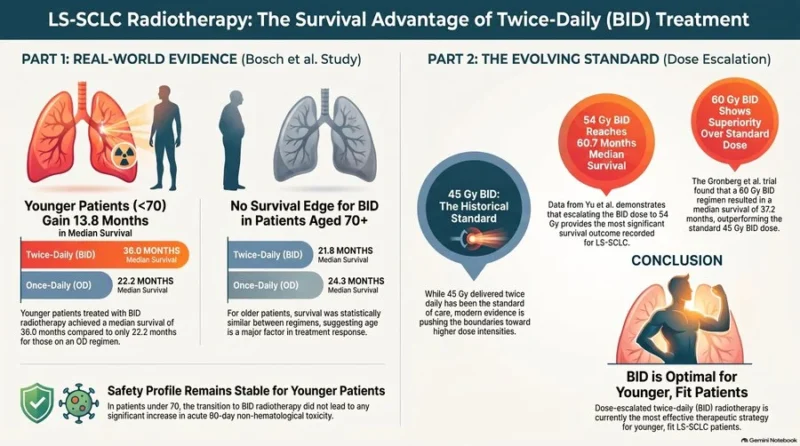
Recent evidence is reshaping the treatment landscape for Limited-Stage Small Cell Lung Cancer (LS-SCLC). A comprehensive real-world study from the Netherlands (Bosch et al.) highlights a critical divide in treatment efficacy based on patient age and fractionation schedules
- The Real-World Evidence: BID vs. OD
In patients under 70 years old, twice-daily (BID) radiotherapy-typically 45 Gy in 30 fractions-demonstrated a clear survival advantage over once-daily (OD) schedules.
- Survival: Younger patients treated with BID achieved a median overall survival of 36.0 months, compared to only 22.2 months for those on OD schedules.
- Safety: Importantly, the BID regimen did not increase severe 90-day acute toxicity in this younger cohort, making it both more effective and equally safe.
- The Age Factor (70+ Years)
For patients aged 70 and older, the data shows a different trend. There was no significant difference in survival between BID (21.8 months) and OD (24.3 months).
Furthermore, older patients treated with BID showed numerically higher toxicity levels. This suggests that for elderly or frailer patients, treatment must be highly individualized.
- The New Frontier: Dose Escalation
While 45 Gy BID has long been the standard, the study highlights that increasing the dose further can lead to even more remarkable outcomes for “fit” patients:
- 54 Gy BID: Recent Phase 3 trials (Yu et al.) reported an unprecedented median survival of 60.7 months.
- 60 Gy BID: Phase 2 data (Grønberg et al.) showed a median survival of 37.2 months compared to 22.6 months with the standard dose.
- Clinical Takeaway
For younger patients with good performance status, twice-daily radiotherapy is the superior choice, and dose escalation (moving beyond 45 Gy) represents the next logical step to maximize long-term survival.”