






Brendan Zangari, Immune-Oncology and Gene-Therapy Scientist, shared on LinkedIn:
“Today’s article is about synthetic cytokine receptors for engineered T cell therapies.
It was produced by brilliant researchers at Stanford.
The authors made orthogonal IL-2 receptors (o2Rs) which (i) commonly contain an extracellular domain which binds an IL-2 orthologue (ii) which vary in the signal they transduce, by nature of the intracellular domain.
They compare signals from IL-2, IL-7, IL-9, and others.
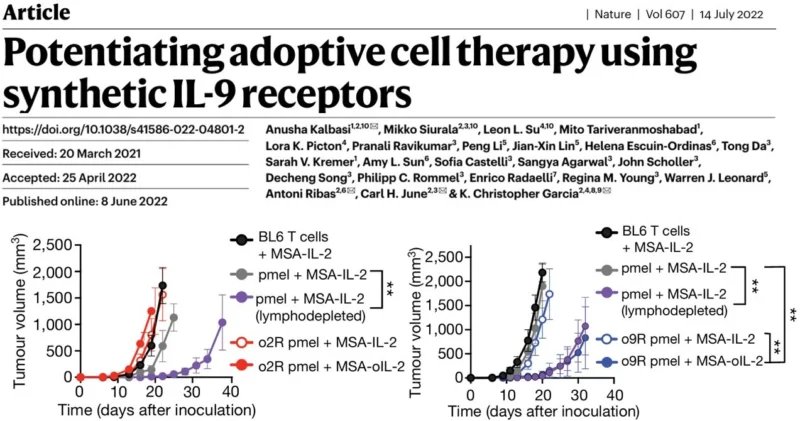
I would like to focus on Figure 2. It describes a model in which B16-F10 melanoma tumors are established in mice, then treated with pmel T cells (T cells with TCRs cognate to gp100, an antigen expressed by B16-F10).
As a negative control the authors use BL6 T cells incapable of tumor recognition, supported by IL-2 stabilized by mouse serum albumin (MSA-IL-2).
As a positive control the authors use pmel T cells administered with MSA-IL-2; after lymphodepletion chemotherapy.
On the left we see a chart where T cells supported by o2Rs are compared against controls. Notice how these cells perform similar to the negative control, even when the orthogonal signal is added (MSA-oIL-2).
On the right we see a chart where T cells supported by o9Rs are compared against controls. Notice how the IL-9 signal permits tumor control similar to the positive control group in which lymphodepletion was performed prior to therapy.
The authors confirm the finding in a head-to-head comparison in figure 3J.
The figures suggest that tumor control could be achieved by either lymphodepletion and cytokine support or simply IL-9 support; the signal from IL-9 was sufficient to achieve tumor control without lymphodepletion.
This finding is interesting because patients receiving cell therapy are commonly lymphodepleted prior to infusion to promote engraftment. It is exciting to consider that IL-9 signaling could instead be used to support cell therapies; less chemotherapy is always a good thing.
In the time since the authors have authored a follow up paper; check out ‘IL-9 as a naturally orthogonal cytokine…‘
It describes IL-9 receptors as being poorly expressed by immune cells; that these receptors are like an evolutionary relic. Their work underlines the potential for cell therapy T cells to be outfitted with native IL-9 receptors.
They demonstrate that standard IL-9 has a better toxicity profile in mice than standard IL-2. The implications of this are exciting.
Have to wonder what kinds of translational endeavors might come of this work.
Kudos to these researchers for their brilliant work.”
Other articles about immuno-oncology on OncoDaily.