Bartek Tomasik, Assistant Professor at Medical University of Gdańsk, shared on LinkedIn:
“Happy to share the publication of the MULTIPREVENT study protocol in Public Health.
Title: MULTIPREVENT: Integrated screening for smoking-related multimorbidity using low-dose chest computed tomography
Authors: Piotr Widłak, Jakub Mieczkowski, Bartłomiej Tomasik, Katarzyna Sienkiewicz, Joanna Bidzińska, Magdalena Sitkiewicz, Magdalena Szczepanowska, Robert Dziedzic, Edyta Szurowska, Witold Rzyman.
Read the full article
This project builds on many years of lung cancer screening experience in Gdańsk. Long before Bartek Tomasik LDCT screening became a central part of European cancer policy, the Gdańsk team was already developing organised screening pathways, prospective cohorts, imaging protocols and long-term follow-up strategies. Today, this work is evolving into something broader.
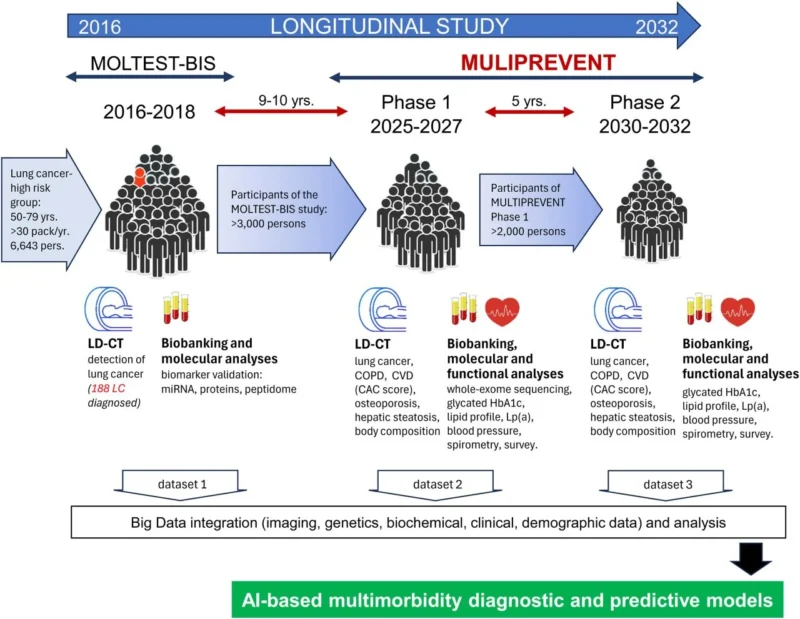
MULTIPREVENT asks whether a lung cancer screening examination can become a platform for integrated prevention. By combining low-dose chest CT with spirometry, cardiovascular and metabolic biomarkers, genetic profiling, radiomics and AI-based modelling, we aim to assess not only lung cancer risk, but also COPD, cardiovascular disease, osteoporosis, diabetes and other smoking-related conditions.
The study follows participants from the earlier MOLTEST-BIS cohort over more than a decade, integrating imaging, clinical, biochemical and genetic data to develop practical tools for personalised risk prediction and prevention.
This project is the result of long-term planning, persistence and a clear scientific vision developed by Gdańsk by Prof. Witold Rzyman and his team.
You can also read: Joseph W. Cullen Prevention/Early Detection Award 2025 Recognizes Prof. Witold Rzyman’s Impact on Lung Cancer Screening

Their consistent work has made Gdański Uniwersytet Medyczny (Medical University of Gdańsk) one of the pioneers of lung cancer screening in Poland and Europe, and has now created the foundation for moving from disease-specific screening towards integrated prevention of multimorbidity.
A publication is an important milestone, but the real goal is larger: to make every screening examination provide as much meaningful preventive information as possible.”