Al-Ola Abdallah, Associate Professor at the University of Kansas Medical Center, shared on X:
“New publication in CLML-Journal by Prerna Mewawalla and her team at AGH.
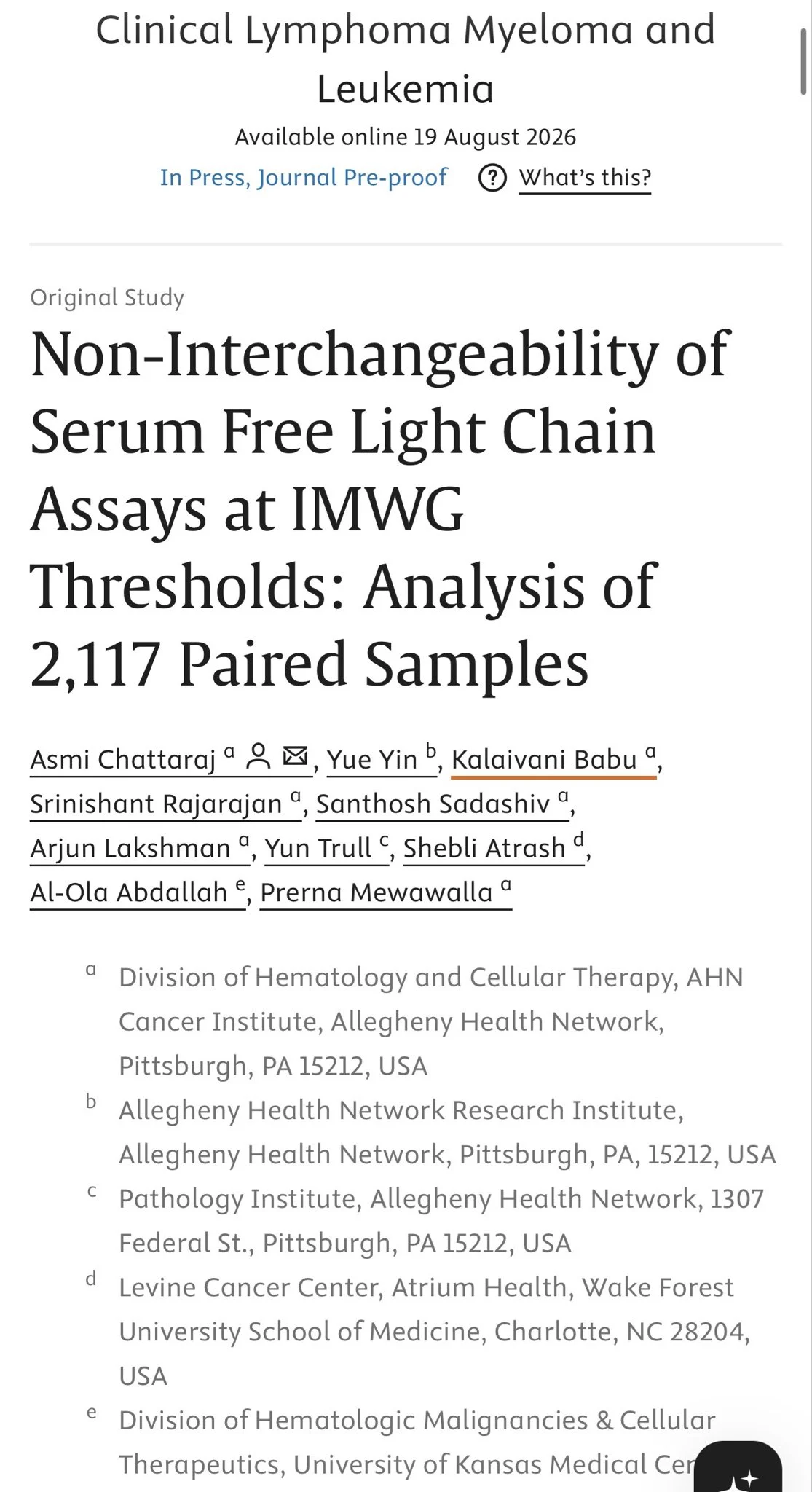
‘Non-Interchangeability of Serum Free Light Chain Assays at IMWG Thresholds,’ analyzing 2,117 paired samples.
The clinical message: strong correlation between assays does not mean they are interchangeable for individual patients.
We compared:
- Binding Site Freelite on Optilite
- Siemens N Latex FLC on BN II
These platforms differ in antibody design, calibration, and detection method – all of which may influence the reported κ, λ, and κ:λ values.
The assays correlated reasonably well:
- Free κ: r = 0.83
- Free λ: r = 0.70
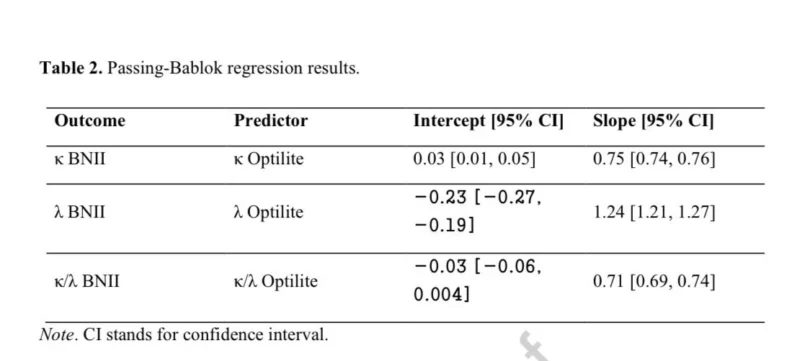
However, systematic proportional bias remained:
- BN II κ ≈ 0.75 × Optilite
- BN II λ ≈ 1.24 × Optilite
- BN II κ:λ ≈ 0.71 × Optilite
Correlation is not agreement.
Across the cohort, Optilite produced:
- Higher median κ: 28.3 vs 21.2 mg/L
- Higher median κ:λ ratio: 1.42 vs 1.00
BN II produced:
- Higher median λ: 20.1 vs 18.4 mg/L
These differences matter most near clinical decision thresholds.
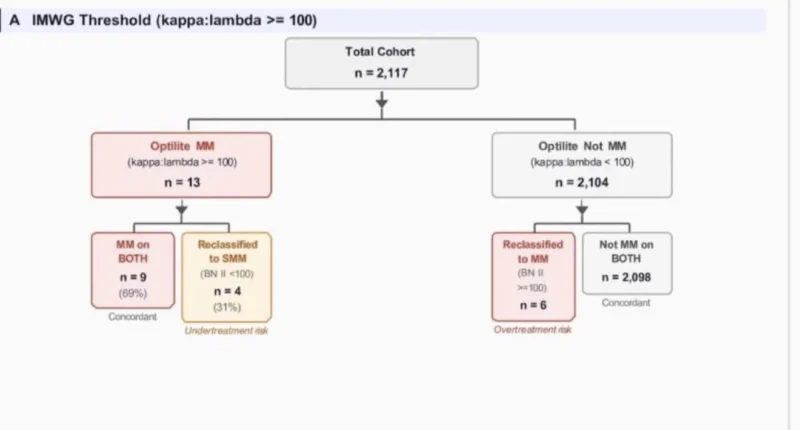
At the IMWG myeloma-defining threshold – an involved/uninvolved FLC ratio ≥100 with involved FLC ≥100 mg/L – nine patients were classified concordantly, while additional cases were classified differently depending on the platform. That could change SMM versus active MM classification.
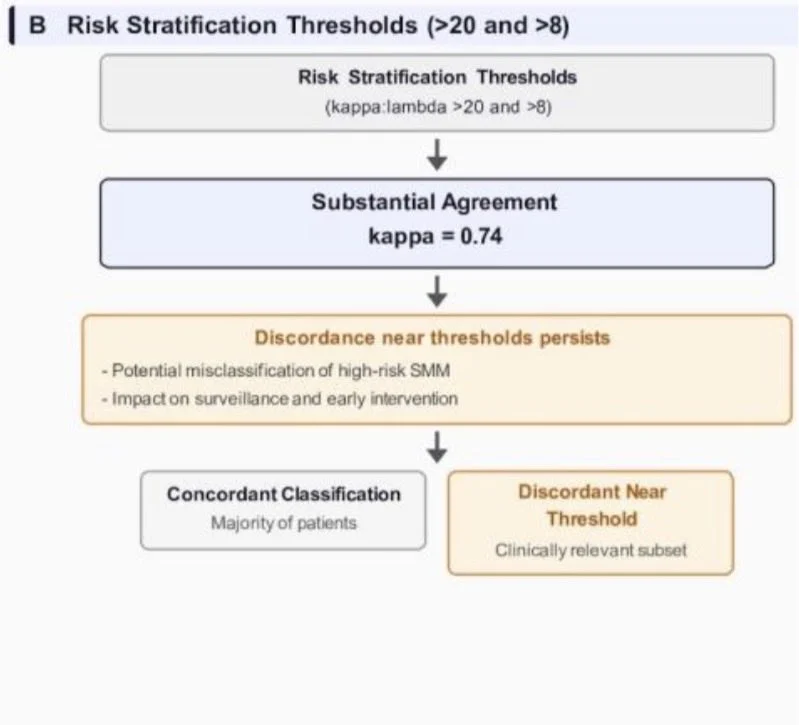
Discordance was also observed at ratios used for precursor-disease risk stratification:
- FLC ratio >20 in the 2/20/20 SMM model
- FLC ratio >8 as a progression risk factor
Agreement was substantial, but not sufficient to assume patient-level interchangeability.
Clinical implications:
- Identify which assay the laboratory uses
- Use the same assay for longitudinal monitoring
- Be cautious with values close to a diagnostic cutoff
- Integrate FLC results with marrow findings, imaging, urine studies, renal function, and the overall clinical picture
The findings are especially relevant because the IMWG FLC ratio ≥100 criterion was originally validated using Freelite – not Siemens N Latex. Applying the same numerical threshold across different platforms assumes equivalence that has not been established.
A broader issue: the biological validity of the ratio ≥100 criterion itself is being reconsidered. Contemporary studies suggest that some patients meeting this criterion-particularly those with low urine monoclonal protein-have a lower 2-year progression risk than initially reported.
Important limitations and critiques:
- Retrospective, single-center analysis
- Few patients met the ≥100 threshold
- No renal-function or outcome correlation
- Borderline results were not routinely repeated
- No assessment of how discordance affected treatment decisions
- Findings cannot determine which assay better predicts progression
A few reporting issues also deserve clarification in the final version:
- The discordant counts in the text do not match Table 3
- Table 3 totals appear to include 1,919-not 2,117-samples
- The analysis is reported using κ:λ rather than clearly presenting involved/uninvolved ratios for both κ- and λ-clonal disease
- Some Bland-Altman limits appear to have missing negative signs
Bottom line: neither assay is necessarily inferior, but they should not be treated as numerically interchangeable.
We need assay-specific thresholds, harmonized calibration, and prospective validation linked to clinical outcomes.”
Title: Non-Interchangeability of Serum Free Light Chain Assays at IMWG Thresholds: Analysis of 2,117 Paired Samples
Authors: Asmi Chattaraj, Yue Yin, Kalaivani Babu, Srinishant Rajarajan, Santhosh Sadashiv, Arjun Lakshman, Yun Trull, Shebli Atrash, Al-Ola Abdallah, Prerna Mewawalla.
Read the full article.
This also can be interesting: Multiple Myeloma in 2026: Comprehensive Clinical Update