Adrian Lee, Director and Professor at University of Pittsburgh and Professor at UPMC Hillman Cancer Center, shared on LinkedIn:
“New paper from our group, led by Neil Carleton (co-first author with Jian Zou) in JAMA Network Open: a systematic review and meta-analysis evaluating survival and the variables associated with response duration in older women with ER-positive breast cancer treated with primary endocrine therapy (pET).
pET is a fairly common practice in parts of Europe, but in the US it’s typically reserved only for patients with very limited life expectancy or marked frailty, largely out of concern that skipping surgery compromises long-term outcomes. Is that caution actually justified by the data, or are we relying on age-based assumptions rather than tumor biology?
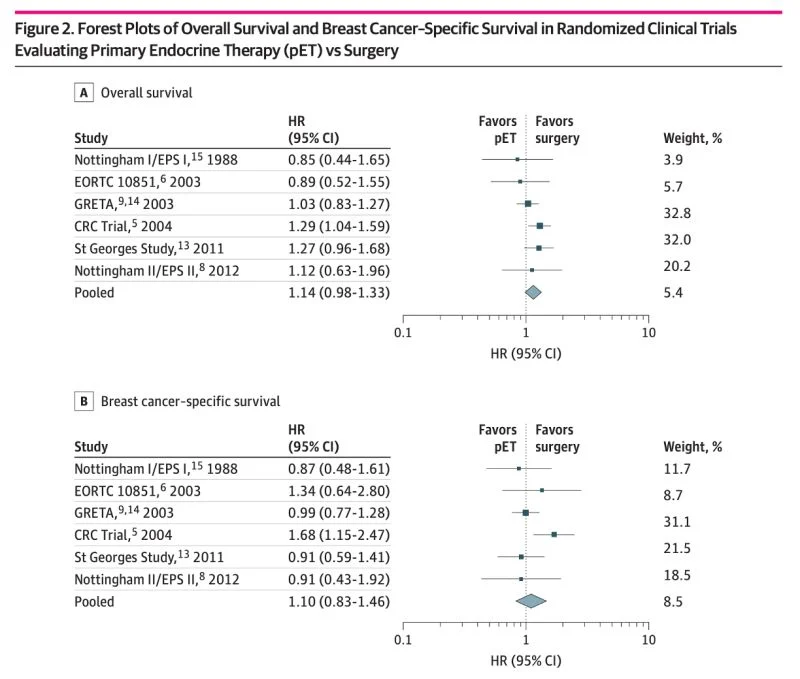
Pooling 29 studies and over 22,000 patients (6 RCTs, 23 observational cohorts spanning five decades), the findings are striking:
- No statistically significant survival difference between pET and upfront surgery, across both overall survival and breast cancer-specific survival
- Response duration tracked tightly with tumor biology – high ER expression, low Ki-67, smaller tumor size, all predicted years of durable disease control
- Frailty, comorbidity, and functional status were consistently tied to worse overall survival, yet standardized geriatric assessment tools remain underused in routine oncology practice – pointing to a real gap in how we identify which patients stand to benefit most from avoiding surgery
This paper directly connects to our Nature Aging work on HSD17B7-driven estrogen conversion and CCL2-mediated immunosuppression in aging breast tumors.
Title: Primary Endocrine Therapy vs Upfront Surgery for Older Women With Estrogen Receptor–Positive Breast Cancer
Authors: Neil Carleton, Jian Zou, Yangyang Mu, Steffi Oesterreich, Shannon Puhalla, Julia Foldi, George Tseng, Adrian V. Lee, Priscilla F. McAuliffe
That paper showed that aging itself reshapes tumor biology – altering local estrogen metabolism and immune surveillance.
This new meta-analysis is the clinical counterpart to that idea: the variables that actually explain who responds and for how long are biological, not chronological.
Together, they build the case for moving past the US’s more conservative, age-based approach toward frameworks grounded in tumor biology and physiologic vulnerability – closer to what’s already informing practice in parts of Europe.
Huge congratulations to Neil, Jian Zou, and the full team for pulling together five decades of trial data into something genuinely useful for clinicians making hard decisions with frail, older patients.”
You can also read:
HR-Positive, HER2-Negative Breast Cancer in Algeria: Beyond Endocrine Therapy Alone