





Abhishek A. Solanki, Professor of Radiation Oncology at Loyola University Chicago, shared on X:
“I am excited to share our multi-institutional F-SHARP phase I/II trial, now published in JCO:
There are limited prospective data defining the optimal management of intraprostatic radiorecurrence (IPR) after definitive radiation therapy for prostate cancer.
We asked two key questions:
- Is dose-escalated focal salvage high-dose-rate brachytherapy safe and effective for IPR?
- Can Decipher (Veracyte) identify patients at higher risk of recurrence after salvage re-irradiation who may benefit from therapeutic intensification?
Patient Selection and Tx N=62 participants from 2017-2023 with IPR after definitive RT from 3 institutions (Loyola, UVA, and UTSW).
- 60% had EBRT & 24% had LDR
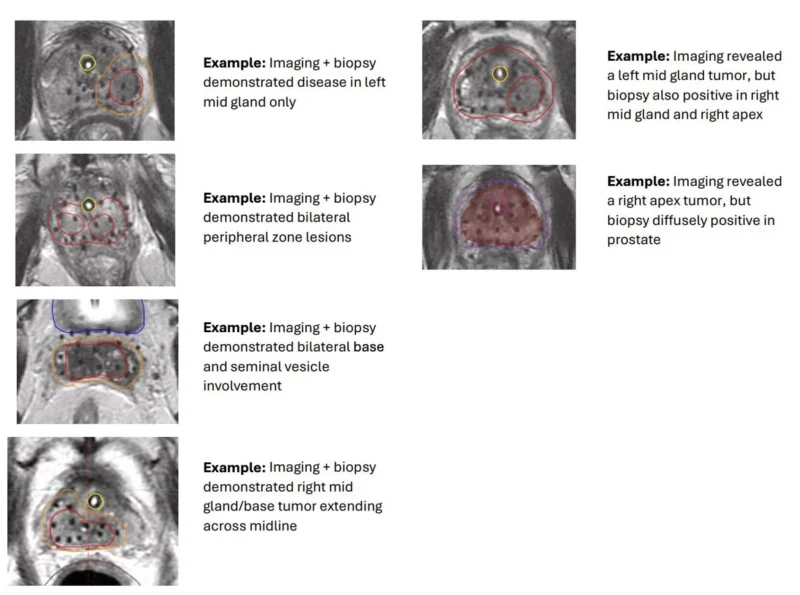
- Median duration from prior RT was 8 years HDR: Goal of 30 Gy in 1-2 fractions, limiting dose to prioritize normal tissue structures. We used a focal approach for planning – utilizing information from mpMRI, PET/CT and biopsy findings. This was primarily a ReRT monotherapy approach, as only 8% received concurrent ADT.
Toxicity and QoL
- No acute grade ≥3 GU/GI toxicity
- 3.2% late grade 3 toxicity (compares favorably to historic trials of ReRT)
- No changes in EPIC-26 or IPSS in follow-up reached thresholds for a minimal clinically important difference One of the main concerns about salvage ReRT has historically been the risk of severe toxicity due to the prior high dose RT. Our study suggests, at least at this time point, it is safe to pursue ReRT, although longer follow-up is necessary…
Efficacy 3-year outcomes
- Biochemical PFS: 62.7%
- Radiographic PFS: 67.5%
- Local recurrence-free survival: 73.0%
- Metastasis-free survival: 85.9% • Freedom from palliative ADT: 83.1%
- No difference between 1 vs. 2 fractions for any endpoints. Lessons:
- Dose-escalated focal salvage HDR outcomes are similar to other salvage LDR, HDR and SBRT efficacy results, although longer follow-up is necessary.
- >80% of patients were able to avoid ADT for 3+ years. This is an important consideration from a QoL and shared decision making.
- Of patients with a second prostatic recurrence, ~3/4 were right in the high dose area of the salvage HDR, suggesting inherent radiation resistance…
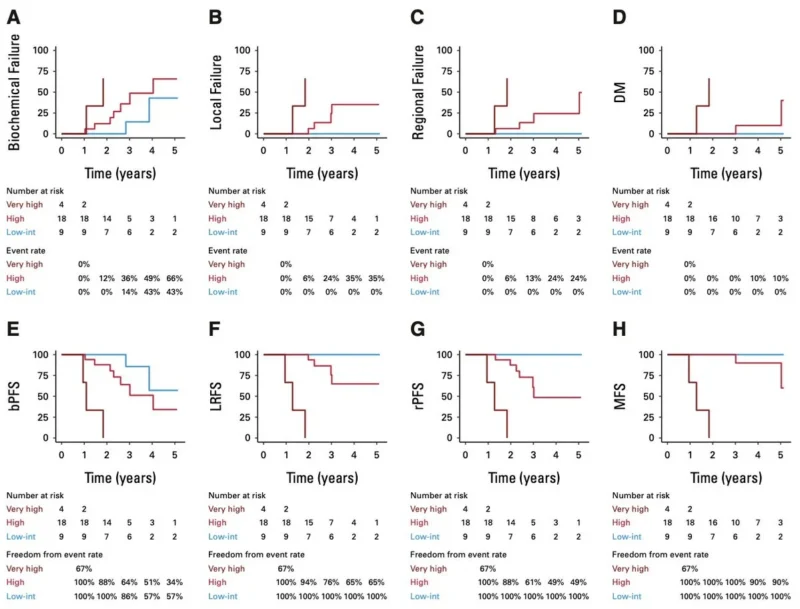
Decipher This is the first prospective evaluation of the prognostic impact of Decipher in the setting of IPR. 71% had high genomic risk (>0.60), a proportion higher than in the de novo setting. Decipher scores from IPR biopsies were prognostic across biochemical, radiographic, local, and metastatic outcomes. Suggesting it may identify patients who may benefit from local and systemic treatment intensification.
The Future? F-SHARP supports investigation of a future of risk-adapted salvage therapy: – Can patients with favorable genomics achieve durable control with focal local therapy alone? Or can some even undergo surveillance alone? – Should patients with high genomic risk receive intensified therapy?
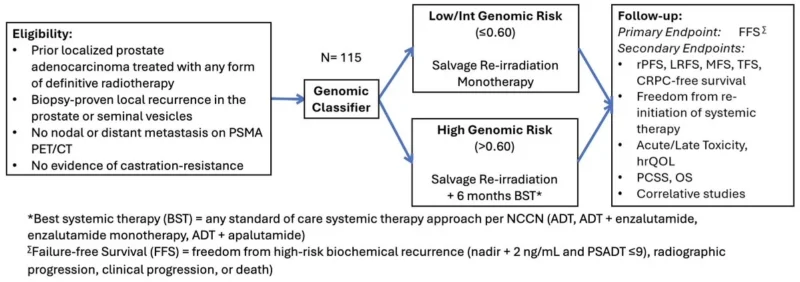
These are the questions we hope to answer in our successor study – G-SHARP, which will investigate a risk-adapted approach in which low/int Decipher risk patients will receive ReRT only, and those with high Decipher risk will receive ReRT + 6 months of best systemic therapy.
This study will hopefully be open in the next few months.
I would like to thank all of the patients who participated in this study, as well as all of my collaborators at Loyola, especially Matthew M. Harkenrider, UVA, UTSW, and Veracyte.
This project would not have been possible without an institutional translational research grant from the Cardinal Bernardin Cancer Center at Loyola, departmental support and mentorship from William Small Jr., and collaboration with Elai Davicioni.
Title: Dose-Escalated Focal Salvage High-Dose-Rate Brachytherapy and Genomic Classifier Risk Stratification in Radiorecurrent Prostate Cancer: The F-SHARP Phase I/II Clinical Trial
Authors: Abhishek A. Solanki, William Adams, James A. Proudfoot, Kristin Baldea, Güliz A. Barkan, Alec M. Block, Neil B. Desai, Ahmer Farooq, Michael R. Folkert, Aurelie Garant, Alex Gorbonos, Gopal Gupta, Hyejoo Kang, Eileen Kelly, Steven Kregel, Stanley L.
Liauw, Christopher K. Luminais, Michael Mysz, Marcus L. Quek, Timothy N. Showalter, James S. Welsh, Michael Woods, Elai Davicioni, William Small Jr., Matthew M. Harkenrider
Other articles about Prostate Cancer on OnocDaily.