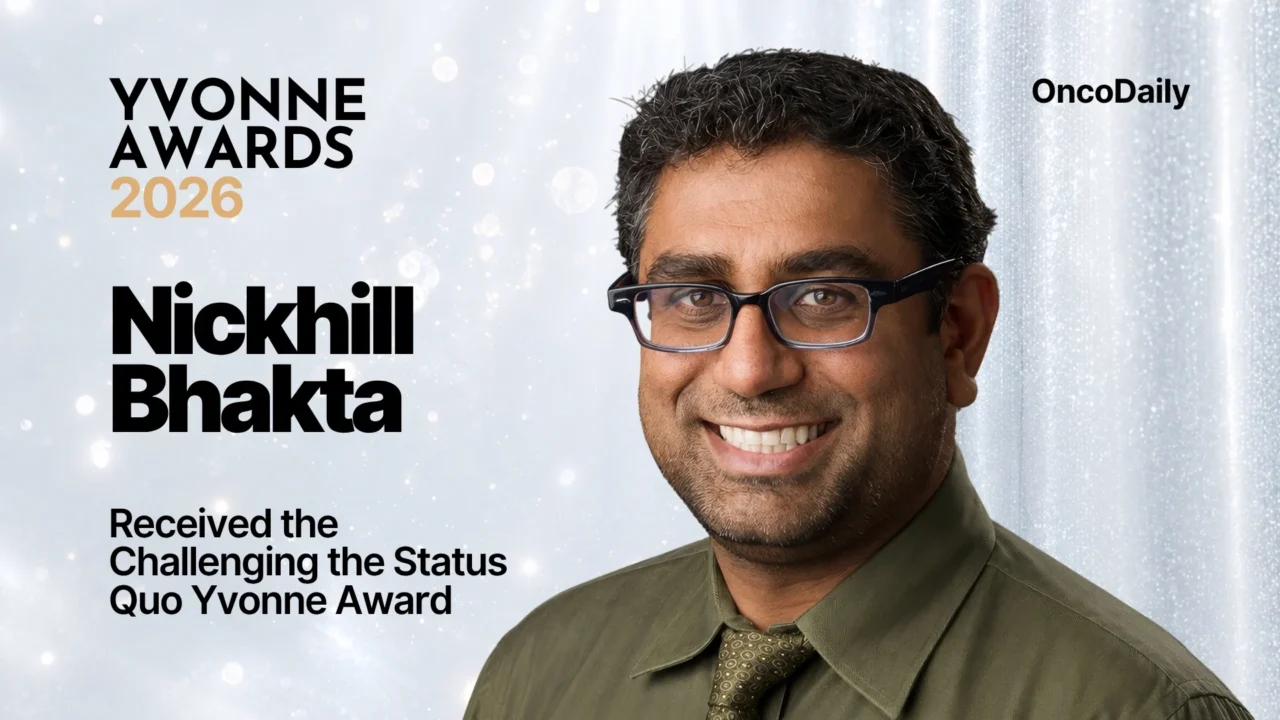
Nickhill Hitesh Bhakta, MD, MPH, was honored with the Challenging the Status Quo Yvonne Award during the Yvonne Awards Ceremony at OncoDaily Party 2026, held on May 29 at Park West in Chicago.
The recognition highlights Dr. Nickhill Bhakta’s work in global pediatric oncology, childhood cancer disease burden estimation, health economics, implementation science, survivorship, and resource-adapted cancer care. His career has focused on some of the most urgent unanswered questions in global childhood cancer: how many children develop cancer, how many survive, what the long-term consequences of cure are, and how health systems can finance sustainable childhood cancer programs.
The Challenging the Status Quo Yvonne Award recognizes leaders whose work questions accepted limits and creates new ways to improve cancer care. In Dr. Bhakta’s case, that work has helped reshape how the global oncology community measures childhood cancer burden, evaluates cost-effectiveness, builds registries, and supports care delivery in resource-variable settings.
A Career at the Intersection of Pediatric Oncology and Global Health
Nickhill Bhakta currently serves as an Associate Member in the Department of Global Pediatric Medicine at St. Jude Children’s Research Hospital, where he is also Director of the Disease Burden and Simulation Unit at St. Jude Global. His secondary appointments include Epidemiology and Cancer Control and Oncology.
His academic background reflects the interdisciplinary nature of his work. He earned a bachelor’s degree from Brown University, an MPH in Global Health from the Harvard School of Public Health, and an MD from the University of Cincinnati College of Medicine. He then completed pediatrics training at Children’s Hospital Los Angeles and a pediatric hematology/oncology fellowship at St. Jude Children’s Research Hospital.
This combination of clinical training, public health, epidemiology, and global health has shaped a career focused not only on treating children with cancer, but also on understanding the systems that determine whether children are diagnosed, treated, cured, and supported after cure.
Redefining How the World Measures Childhood Cancer
A major part of Nickhill Bhakta’s contribution has been advancing disease burden estimation for childhood cancer and hematologic diseases. His work has addressed a central gap in global pediatric oncology: many children with cancer are never diagnosed, which means traditional registries and incidence estimates often underestimate the true burden of disease.
Dr. Bhakta has co-led major global studies providing comprehensive estimates of childhood cancer disease burden using incidence, mortality, disability-adjusted life years, and approaches that account for children who are never diagnosed.
This work matters because measurement drives policy. If countries and global health systems cannot see the full burden of childhood cancer, they cannot plan services, allocate resources, build treatment programs, or evaluate progress. Dr. Bhakta’s research has helped make invisible children more visible in global cancer data.
Making the Case for Financing Childhood Cancer Care
Nickhill Bhakta also led the first study evaluating the cost-effectiveness of childhood cancer care, and the methods he developed have become a global standard for assessing the cost-effectiveness of childhood cancer programs.
This contribution is especially important because childhood cancer care is often wrongly viewed as too complex or too expensive for many health systems. Health economic evidence helps show where investment can produce meaningful survival gains and long-term societal benefit.
His work has also extended into the cost and cost-effectiveness of gene therapy for hemophilia B and broader studies of financial hardship in childhood cancer. These efforts place him at the center of a growing field focused on how to fund complex care fairly, sustainably, and with attention to families’ real-world financial burden.
Leading Global Programs Across Sub-Saharan Africa
Within St. Jude Global, Dr. Bhakta has served as Regional Advisory Committee Chair of the Sub-Saharan Africa regional program, overseeing activities across 12 countries and more than 70 hospitals.
This leadership reflects the practical side of global oncology. Improving childhood cancer outcomes requires more than publishing estimates or building models. It requires partnerships with hospitals, regional networks, clinicians, policymakers, registries, educators, and local leaders.
Through this work, Dr. Bhakta has helped support programs that strengthen childhood cancer care across diverse health systems, where resources, workforce, diagnostics, and treatment access can vary widely.
Building Registries, Guidelines, and Implementation Tools
Dr. Bhakta leads several major initiatives within Global Pediatric Medicine at St. Jude. These include the Hospital-Based Cancer Registry Network, ARIA Guide, and programs focused on novel diagnostics.
The SJCARES Registry is described as the first intentionally designed global pediatric hospital-based cancer registry. This work helps generate data from treatment centers and supports a clearer understanding of diagnosis, treatment, outcomes, and care delivery patterns in pediatric oncology.
The ARIA Guide focuses on implementing resource-adapted management guidelines for pediatric healthcare workers globally. Its goal is to support evidence-based treatment for children with cancer regardless of geography or available resources.
Together, these initiatives reflect a practical challenge to the status quo: children with cancer should not be excluded from evidence-based care because they live far from major cancer centers or in settings with fewer resources.
Advancing Novel Diagnostics for Children With Cancer
Nickhill Bhakta has also led work in novel diagnostics, including support for Illumina-based sequencing efforts with partners in India and Brazil and a large Oxford Nanopore-based research program implementing DNA-based diagnostics at 16 centers through an externally funded hybrid type 3 implementation trial.
This work reflects one of the key frontiers in global pediatric oncology. Molecular diagnostics are increasingly essential for accurate diagnosis, risk stratification, treatment planning, and research. Yet access to these tools remains uneven. By working on implementation models for DNA-based diagnostics, Dr. Bhakta’s program is helping bring advanced diagnostic capacity into broader global use.
Research Leadership With International Reach
Nickhill Bhakta leads two major global collaborations: the St. Jude–Institute for Health Metrics and Evaluation collaboration and the ChildGICR St. Jude–International Agency for Research on Cancer collaboration, serving as lead Principal Investigator through both initiatives.
These collaborations connect pediatric oncology with global epidemiology, cancer registration, data science, and policy-relevant measurement. They also reflect a broader truth about modern global oncology: progress depends on partnerships that combine clinical experience, population-level data, and implementation capacity.
His publication record includes work in leading journals such as The Lancet Oncology, JAMA Oncology, JCO Global Oncology, Pediatric Blood & Cancer, Cancer, Blood, EClinicalMedicine, and others, spanning childhood cancer burden, survivorship, cost-effectiveness, registry implementation, financial hardship, workforce analysis, and global care delivery.
A Clinician Grounded in Pediatric Hematology and Oncology
Although much of Nickhill Bhakta’s work is global and systems-focused, he remains grounded in clinical care. At St. Jude, he treats patients with leukemias and lymphomas in the outpatient clinic and attends several weeks per year on the inpatient ward.
This clinical role is important because his research questions are not abstract. They are connected to children and families facing cancer, to clinicians working in difficult settings, and to the reality that survival depends on diagnosis, treatment access, supportive care, follow-up, and health system capacity.
Mentorship and Training as Part of Global Impact
Nickhill Bhakta also has a strong record of mentorship. He oversees a team of postdoctoral and clinical research fellows through the Disease Burden and Simulation Unit and has served as thesis committee chair, thesis committee member, and primary research mentor for multiple trainees working in implementation science, epidemiology, cost-effectiveness, disease burden estimation, and adapted childhood cancer therapies.
His teaching also includes graduate-level lectures in global health, epidemiology, health indicators, childhood cancer burden, and scientific literature. This educational work helps train the next generation of global pediatric oncology researchers and implementation leaders.
Recognition for Challenging Accepted Limits
Dr. Bhakta’s honors include the AACR Team Science Award, the International Society of Paediatric Oncology Young Investigator Award, the Bradley Stuart Beller Merit Award from the Conquer Cancer Foundation, and the St. Jude Values Award in 2025.
These recognitions reflect the scope of his work across team science, global pediatric oncology, research excellence, and institutional leadership.
Honoring a Leader Changing the Global Childhood Cancer Conversation
The Challenging the Status Quo Yvonne Award recognizes Dr. Nickhill Bhakta for work that has shifted the way childhood cancer is measured, financed, implemented, and understood worldwide.
At OncoDaily Party 2026, his recognition highlighted a central message: improving childhood cancer outcomes globally requires more than new therapies alone. It requires data that reveal the true burden, economic models that support investment, registries that track care, guidelines adapted to real-world resources, diagnostics that reach more children, and partnerships that help hospitals deliver better care.
Through his work at St. Jude Children’s Research Hospital, St. Jude Global, the Disease Burden and Simulation Unit, and international collaborations across global cancer registration and health metrics, Dr. Bhakta continues to challenge the field to think bigger, measure better, and build systems where more children with cancer can survive and thrive.