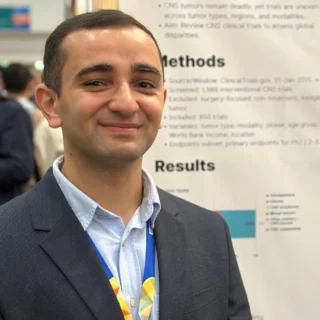
A major announcement marked the conclusion of OncoDaily’s exclusive webinar, Precision Medicine in Colorectal Cancer – MRD Surveillance & Emerging Guidelines, held on November 12, 2026, in partnership with Natera.
During the discussion, Dr. Robert Lentz, Medical Director for Colorectal Cancer at Natera, publicly announced for the first time that Natera is partnering with Agenus to perform Signatera circulating tumor DNA (ctDNA) testing in the Phase III ROBIN trial.
The announcement came during a session examining the expanding role of molecular residual disease (MRD) testing in colorectal cancer, from adjuvant treatment decisions to surveillance and neoadjuvant immunotherapy.
Hosted by Mariam, a medical oncologist and Editor-in-Chief of OncoDaily GI, the webinar brought together recent clinical evidence, practical patient cases, and developments in ctDNA-guided cancer care.
The Announcement: Natera Joins the Phase III ROBIN Trial
The most significant development of the webinar emerged during its final scientific discussion, which focused on neoadjuvant immunotherapy in colon cancer.
Dr. Lentz introduced the Phase III ROBIN trial, a randomized study investigating neoadjuvant botensilimab plus balstilimab compared with upfront surgery in patients with high-risk stage II and stage III microsatellite-stable (MSS) colon cancer.
Speaking on behalf of Natera, he announced the company’s partnership with Agenus to incorporate Signatera ctDNA testing into the trial.
The study will evaluate whether administering immunotherapy before surgery can improve outcomes in a patient population historically considered less responsive to immune checkpoint inhibition.
The ROBIN trial will compare two treatment strategies:
- Experimental arm: Neoadjuvant botensilimab plus balstilimab, followed by surgery.
- Control arm: Upfront surgery without neoadjuvant immunotherapy.
Adjuvant treatment in both groups will follow standard-of-care recommendations.
The primary endpoint is event-free survival, while a key secondary endpoint is Signatera ctDNA negativity at 12 months.
According to Dr. Lentz, the first patient is anticipated to enter the trial in the first quarter of 2027.
The collaboration introduces a molecular component to the Phase III investigation, allowing researchers to assess ctDNA negativity alongside conventional clinical outcomes.
From NICHE-2 to ROBIN: Why the Next Trial Matters
The ROBIN announcement followed Dr. Lentz’s review of recent neoadjuvant immunotherapy studies that have challenged established expectations in localized colon cancer.
He first discussed the NICHE-2 trial, which investigated short-course neoadjuvant nivolumab and ipilimumab in patients with mismatch repair-deficient (dMMR) colon cancer.
In NICHE-2, ctDNA was detectable in nearly all patients at baseline but became undetectable before surgery in 83% of patients. Molecular clearance correlated with pathological complete response and major pathological response.
Following surgery, ctDNA was negative in all evaluated patients, corresponding with a reported three-year disease-free survival rate of 100%.
However, the discussion moved beyond dMMR disease.
The UNICORN trial provided evidence of neoadjuvant immunotherapy activity in proficient mismatch repair (pMMR), microsatellite-stable colon cancer, a setting in which immunotherapy has traditionally demonstrated limited effectiveness.
Dr. Lentz highlighted that among pMMR patients treated with botensilimab and balstilimab, 36% achieved a major or complete pathological response, while 29% achieved a pathological complete response.
Importantly, Signatera testing demonstrated ctDNA clearance in all five pMMR responders with available results.
He also referenced findings from the NEST trial, which supported the emerging evidence for this immunotherapy combination.
These findings provided the scientific rationale for ROBIN, which will investigate the strategy in a randomized Phase III setting.
Unlike earlier studies focused on pathological response, ROBIN is designed to evaluate event-free survival while also examining ctDNA negativity as a key secondary endpoint.
Could ctDNA Change How Neoadjuvant Immunotherapy Is Evaluated?
Beyond the treatment comparison itself, the ROBIN trial raises an important question: could molecular response become a meaningful measure of treatment effectiveness in colon cancer?
Throughout the webinar, Dr. Lentz emphasized the potential of personalized ctDNA testing to provide information that conventional imaging and pathological assessment may not fully capture.
In neoadjuvant immunotherapy studies, ctDNA clearance has shown a strong association with pathological response.
The ability to detect molecular changes during and after treatment could help researchers understand which patients are responding and which may remain at risk of recurrence.
Dr. Lentz also discussed the possibility that ctDNA could eventually contribute to non-operative management strategies and serve as a surrogate endpoint in future clinical research.
However, these applications require further prospective validation.
With Signatera ctDNA negativity at 12 months included as a key secondary endpoint, ROBIN offers an opportunity to investigate the relationship between molecular response and clinical outcomes in a larger randomized trial.
Rethinking Colorectal Cancer Management Through MRD
Although the ROBIN announcement was the central development of the webinar, the preceding discussion addressed several areas in which ctDNA testing is already influencing clinical decision-making.
Dr. Lentz reviewed evidence from CIRCULATE-Japan GALAXY and other studies demonstrating the prognostic significance of postoperative ctDNA status.
He highlighted the substantial recurrence risk associated with positive postoperative ctDNA results and discussed how molecular findings may inform decisions about adjuvant chemotherapy escalation or de-escalation.
The webinar also examined emerging evidence from the ongoing SAGITTARIUS trial. An interim analysis presented at ESMO showed that postoperative ctDNA-negative results changed planned adjuvant chemotherapy decisions in 34% of patients evaluated in the physician-choice arm.
Most changes involved treatment de-escalation.
Another major discussion concerned surveillance after curative-intent treatment.
Dr. Lentz presented real-world findings from MD Anderson demonstrating that positive ctDNA results frequently prompted changes in clinical management, particularly additional imaging and more intensive monitoring.
The session also addressed locally advanced rectal cancer, where ctDNA testing may complement established surveillance methods during watch-and-wait management following total neoadjuvant therapy.
These discussions established the broader context for the ROBIN announcement: the growing interest in using molecular information not only to estimate recurrence risk but also to guide and evaluate treatment strategies.
The Next Chapter in MSS Colon Cancer
For decades, microsatellite-stable colorectal cancer has represented a major challenge for immunotherapy development.
While immune checkpoint inhibitors have transformed treatment for selected patients with dMMR or MSI-high disease, extending meaningful benefit to patients with pMMR/MSS tumors remains an important research priority.
The ROBIN trial will examine whether neoadjuvant botensilimab and balstilimab can translate the promising pathological responses observed in earlier studies into improved clinical outcomes.
The inclusion of Signatera testing adds another dimension to that investigation, with the potential to clarify how molecular response relates to longer-term treatment success.
As the webinar concluded, Dr. Lentz emphasized the importance of prospective randomized trials in establishing how ctDNA should be incorporated into routine colorectal cancer management.
The first public announcement of Natera’s partnership with Agenus for ROBIN made the OncoDaily webinar a platform for a new clinical research development, rather than simply a review of existing evidence.
With first patient enrollment anticipated in early 2027, attention now turns to whether the ROBIN trial can help establish a new neoadjuvant treatment strategy for patients with high-risk MSS colon cancer and further define the role of ctDNA in measuring its success.