Sipuleucel-T and IL-7 were evaluated in an exploratory FDG PET/CT imaging subanalysis of a phase II trial in patients with metastatic castration-resistant prostate cancer (mCRPC), reporting early, hypothesis-generating findings on the potential role of serial [18F]-FDG PET/CT imaging during sipuleucel-T-based immunotherapy.
The study, published in the International Journal of Molecular Sciences, was conducted as an exploratory imaging subanalysis of the Cancer Immunotherapy Trials Network CITN12-03 phase II trial.
Title: Exploratory FDG PET/CT Imaging in mCRPC Patients Treated with Sipuleucel-T ± IL-7: A Phase II Trial Subanalysis
Authors: Sandeep Surendra Panikar,Dhruv Bansal,John Crandal,Hari Raman,Joel Picus,Joseph E. Ippolito,Daniel L. J. Thorek,Richard Wahl and Russell K. Pachynski
The parent trial evaluated sipuleucel-T, an autologous cellular immunotherapy, with or without recombinant human IL-7 in patients with asymptomatic or minimally symptomatic mCRPC.
Although immunotherapy has transformed the treatment landscape across several cancer types, its impact in prostate cancer has remained limited. Sipuleucel-T remains the only FDA-approved cellular immunotherapy for prostate cancer, but conventional response measures such as PSA decline or radiographic tumor shrinkage often do not fully capture its biological effects. This creates a need for noninvasive tools that may better reflect tumor and immune-related changes during treatment.
Background
Metastatic castration-resistant prostate cancer represents an advanced and incurable stage of prostate cancer. While several systemic therapies have improved survival in this setting, assessing treatment response remains challenging, particularly with immune-based approaches.
[18F]-FDG PET/CT is widely used to assess metabolic activity in cancer. In the context of immunotherapy, FDG uptake may reflect not only tumor metabolism but also immune-related activity in lymphoid tissues such as the spleen. The investigators aimed to explore whether serial FDG PET/CT could provide additional insights into tumor and immune responses in patients treated with sipuleucel-T, with or without IL-7.
Methods
The CITN12-03 trial enrolled 54 patients with mCRPC. Patients were randomized to either observation after sipuleucel-T or recombinant human IL-7 following sipuleucel-T. Of the 54 enrolled patients, 3 patients underwent optional serial [18F]-FDG PET/CT imaging as part of an exploratory substudy.
FDG PET/CT scans were performed at baseline and after sipuleucel-T therapy. In the IL-7 treatment arm, imaging was also performed after IL-7 administration. Imaging analyses assessed tumor metabolic activity, metabolic tumor volume, total lesion glycolysis, splenic uptake, and other immune-related metabolic changes.
The investigators emphasized that PET/CT imaging was not required by the parent trial protocol. The imaging substudy was optional, and the small sample size limits any conclusions about treatment efficacy.
Results
The imaging findings varied across the three patients.Patient 1 received sipuleucel-T alone and demonstrated progressive disease. The patient had a sternal metastasis with relatively stable SUVmax, but metabolic tumor volume increased from 10.1 to 34.5, while total lesion glycolysis increased from 43.4 to 145.8. These findings were consistent with worsening metabolic tumor burden and poor prognosis.
Patient 2 also received sipuleucel-T alone. This patient had minimal tumor FDG avidity, but showed a transient increase in splenic metabolic activity shortly after sipuleucel-T infusion. Splenic SUVmax increased by 70%, and SUVmean increased by 96% four days after treatment, before returning near baseline by day 28. The authors suggested that this may reflect treatment-associated or immune-related metabolic activity, although FDG uptake in lymphoid organs is nonspecific.
Patient 3 received sipuleucel-T followed by recombinant IL-7. This patient showed a reduction in tumor metabolic activity, with approximately a 33% decline in SUVmax, stable disease on follow-up imaging, and decreasing PSA levels. PSA decreased from 3.57 at baseline to 1.99 after sipuleucel-T and to 1.62 after IL-7. The patient also demonstrated subtle splenic metabolic changes after IL-7, which may be consistent with immune activation.
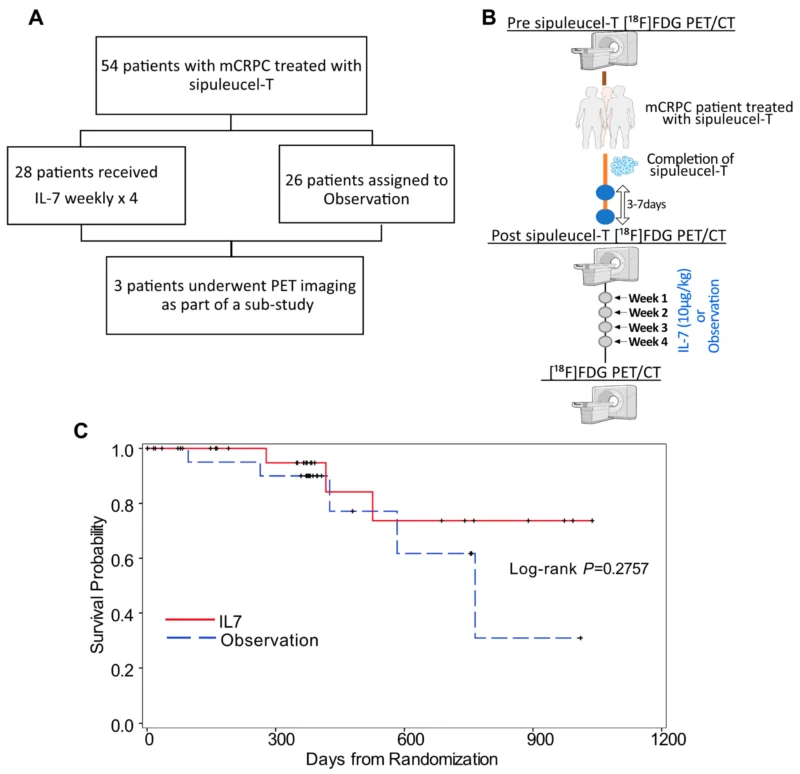
In the broader phase II trial, there were no statistically significant differences in radiographic progression-free survival or overall survival between the groups. However, the IL-7 group showed exploratory numerical signals, including a greater proportion of patients with any PSA decline and longer PSA doubling times. These findings were descriptive and not powered for definitive clinical interpretation.
Conclusion
This exploratory subanalysis suggests that serial [18F]-FDG PET/CT imaging may be feasible in patients with mCRPC receiving sipuleucel-T-based immunotherapy and may provide insights into tumor and immune-related metabolic changes.
However, the findings should be interpreted with caution. Only 3 patients underwent PET/CT imaging, and only 1 patient received sipuleucel-T plus IL-7 in the imaging substudy. Therefore, the results do not establish therapeutic efficacy or validate FDG PET/CT as a biomarker.
The authors concluded that larger prospective studies are needed to determine whether FDG PET/CT can serve as a noninvasive tool for monitoring immune response and treatment-associated biological effects in mCRPC.