A new consensus-based guideline published in Radiotherapy and Oncology provides a much-needed framework for defining the clinical target volume for whole abdominopelvic radiotherapy in patients with soft tissue sarcoma and peritoneal involvement.
Whole abdominopelvic radiotherapy, or WAP-RT, is rarely used but can be important in selected patients with metastatic or primary peritoneal involvement, particularly in pediatric and young adult sarcoma populations. Because these cases are uncommon, contouring practice has often varied between centers, especially around complex anatomical boundaries such as the diaphragm, liver surface, retroperitoneum, bladder, and rectum.
This new work, developed by QUARTET clinician reviewers from the EpSSG Radiotherapy Committee within the FaR-RMS trial framework, aims to standardize the definition of the peritoneal clinical target volume and support more consistent radiotherapy planning across international centers.
Why This Guideline Matters
WAP-RT is technically demanding. The target volume is large, anatomically complex, and close to several organs at risk, including the kidneys, liver, bowel, bladder, rectum, pelvic bones, and growth plates in children.
Historically, WAP-RT was delivered with conventional anterior-posterior and posterior-anterior fields, which often exposed large volumes of healthy tissue. Modern IMRT and image-guided techniques now allow more conformal treatment, but this precision also makes accurate target delineation essential. If the target is not consistently defined, advanced planning techniques may unintentionally miss areas at risk.
The authors highlight that no published contouring guideline previously existed for this setting, despite the clinical relevance of WAP-RT in rare tumors such as rhabdomyosarcoma, desmoplastic small round-cell tumor, Ewing sarcoma, and Wilms tumor with peritoneal dissemination.
How the Consensus Was Developed
The guideline was developed between March and September 2024 by a panel of 10 radiation oncologists from the EpSSG Radiotherapy Committee, representing 10 institutions across 8 European countries.
The group reviewed WAP-RT cases submitted for radiotherapy quality assurance within the Frontline and Relapsed Rhabdomyosarcoma trial, also known as FaR-RMS. These case reviews revealed several recurring areas of variation in target delineation, including the cranial and caudal extent of the peritoneal cavity, the inclusion or exclusion of retroperitoneal structures, liver surface coverage, and approaches to respiratory motion.
Consensus was reached using the Nominal Group Technique. Each recommendation achieved the predefined agreement threshold of at least 80% on the first vote, suggesting strong alignment among the expert panel.
Key Contouring Recommendations
The cranial extent of the CTVm_peritoneum should include the abdominal surface of the diaphragmatic dome. Because this region moves with respiration, 4D-CT imaging is recommended to capture respiratory motion and generate an internal target volume, or ITVm_peritoneum.
The retroperitoneal space should be excluded when not involved. The guideline specifically recommends excluding the esophagus, aorta, subhepatic inferior vena cava, psoas muscles, kidneys, and visible perirenal fat. The iliac bifurcations can be used as a practical anatomical landmark for the caudal extent of the retroperitoneum.
The liver surface should be included because it is covered by peritoneum, but liver parenchyma should be spared when there is no metastatic liver involvement. The authors recommend using a rim of at least 5.0–7.5 mm to ensure adequate coverage of the liver surface, including the gallbladder, porta hepatis, hepatic hilum, and falciform ligament where visible.
At the caudal extent, the bladder should be fully included unless controlled bladder filling or adaptive protocols are used. In those settings, the bladder may be progressively excluded from the target volume starting from the superior aspect of the symphysis pubis.
For the rectum, the upper third should be fully included. Only the anterior component of the middle third should be covered, with attention to the space between the anterior rectal wall and the bladder, prostate, or uterus. The lower third of the rectum should be excluded because it lies outside the peritoneal cavity.
In cases with para-aortic or iliac nodal involvement, nodal target volumes should be delineated separately rather than included automatically within the peritoneal volume.
The Role of 4D-CT and Motion Management
One of the most practical messages from this guideline is the importance of respiratory motion assessment.
The authors recommend 4D-CT imaging to define the maximum inspiration point and ensure coverage of the peritoneal target throughout the respiratory cycle. When 4D-CT is not available, centers should use larger PTV margins that include an additional motion component beyond setup uncertainty.
This is particularly relevant for the diaphragmatic dome and upper abdominal peritoneal surfaces, where respiratory motion can create clinically meaningful uncertainty.
Supporting Modern, Highly Conformal WAP-RT
The guideline also reflects the shift from conventional large-field WAP-RT toward highly conformal radiotherapy. With IMRT, VMAT, and image-guided approaches, clinicians can better spare organs at risk while maintaining target coverage.
However, the authors emphasize that conformality only helps if the target itself is accurately and consistently defined. Standardized contouring is therefore central to both treatment quality and safety, especially in pediatric and adolescent patients where long-term toxicity is a major concern.
By excluding non-involved retroperitoneal structures and carefully defining the liver, bladder, rectum, and diaphragmatic boundaries, the guideline may help reduce unnecessary radiation exposure to critical organs while preserving adequate peritoneal coverage.
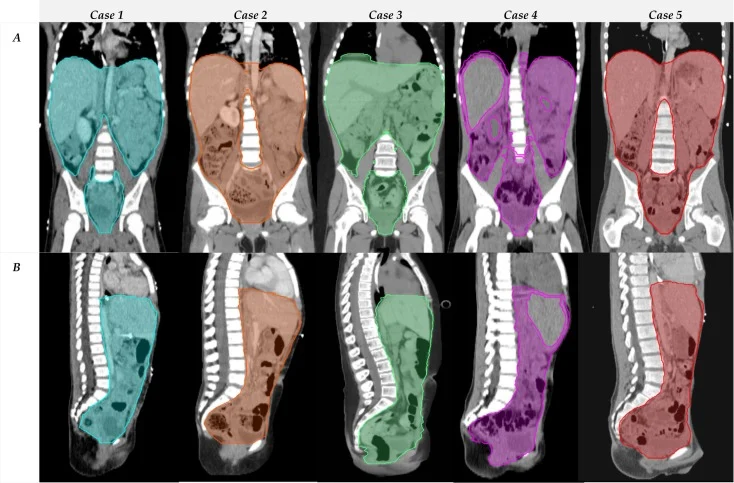
Fig 1 Overview of patients enrolled in the FaR-RMS trial treated with WAP-RT, in coronal (A) and sagittal (B) view.
Clinical Relevance Beyond FaR-RMS
Although the guideline was developed within the FaR-RMS trial and is directly relevant to rhabdomyosarcoma, the authors note that it may also support treatment planning for other rare sarcomas and pediatric malignancies with peritoneal involvement.
This includes desmoplastic small round-cell tumors, Ewing sarcoma, and Wilms tumors with rupture or peritoneal dissemination, where whole abdominopelvic treatment may be considered in selected cases.
Takeaway
This consensus guideline provides the first structured definition of CTVm_peritoneum and ITVm_peritoneum for WAP-RT.
For radiation oncologists treating rare pediatric and young adult sarcomas with peritoneal involvement, it offers a practical atlas-based approach to improve consistency, support radiotherapy quality assurance, and reduce variation across centers.
The key message is clear: as WAP-RT becomes more conformal, target delineation must become more standardized. This work provides an important step toward safer, more reproducible, and more precise treatment for a rare but challenging clinical scenario.
Article link