Personalized circulating tumor DNA (ctDNA) analysis may help assess treatment response and identify patients at increased risk of recurrence after preoperative radiotherapy for localized soft tissue sarcoma. An exploratory analysis of the randomized phase II SU2C-SARC032 trial, published in the Journal of Clinical Oncology, found that ctDNA levels before treatment, after neoadjuvant therapy, and following surgery provided prognostic information beyond established clinical risk factors.
For radiation oncology, the findings draw particular attention to the interval between completion of radiotherapy and surgery. Measuring ctDNA at this point could provide a molecular assessment of residual disease burden, although its use to guide treatment requires prospective validation.
Study Background
SU2C-SARC032 investigated whether adding perioperative pembrolizumab to preoperative radiotherapy and surgery improved outcomes in patients with high-risk, localized soft tissue sarcoma. Eligible patients had stage III, grade 2 or 3 tumors larger than 5 cm, including undifferentiated pleomorphic sarcoma, myxofibrosarcoma, and dedifferentiated or pleomorphic liposarcoma of the extremity.
The parent trial demonstrated improved disease-free survival with the addition of pembrolizumab. However, recurrence remained a concern, highlighting the need for biomarkers that could better characterize risk and monitor response throughout treatment.
Ajay Subramanian and colleagues investigated whether personalized, tumor-informed ctDNA assays could address this need. Sarcomas present a particular challenge for liquid biopsy because of their heterogeneous genomic profiles and relatively few recurrent single-nucleotide variants. Instead of using a fixed panel of commonly mutated genes, the researchers designed individual assays based on each patient’s tumor.
Study Design and Molecular Monitoring
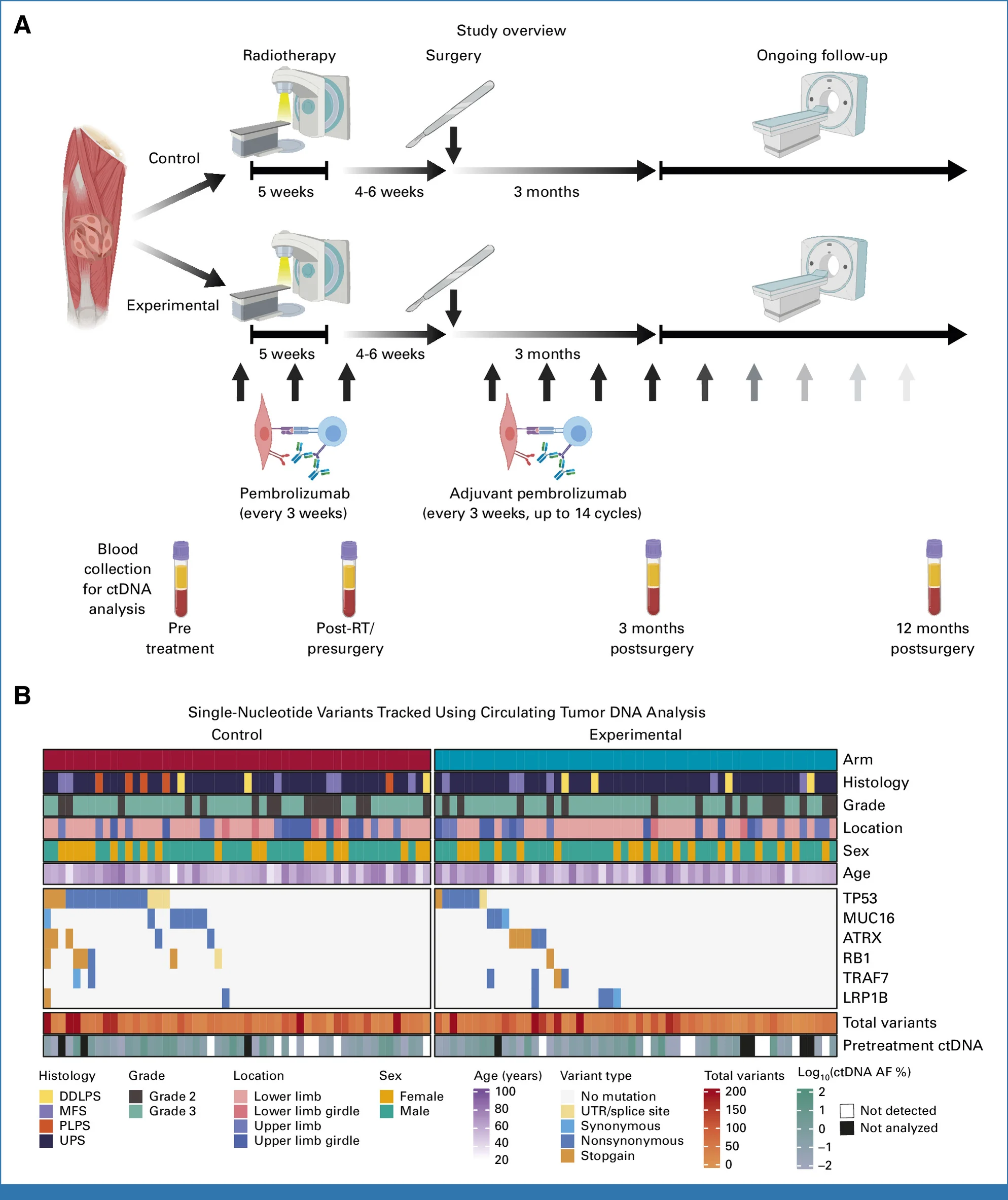
The analysis included 106 of the 127 evaluable patients in SU2C-SARC032 and assessed 313 plasma samples. Patients received either preoperative radiotherapy followed by surgery or the same local treatment with perioperative pembrolizumab.
In the experimental arm, pembrolizumab was administered at 200 mg every three weeks for three doses before, during, and after neoadjuvant radiotherapy, followed by surgery and up to 14 postoperative doses.
Plasma samples were collected at four time points:
- Before treatment.
- Approximately one week after radiotherapy, before surgery.
- Three months after surgery.
- Twelve months after surgery.
Whole-exome sequencing of tumor and matched normal DNA informed the personalized assays, which tracked a median of 46 somatic mutations per patient. Median follow-up in the ctDNA cohort was approximately 51 months for disease-free survival.
The analyses were exploratory, and the trial was not powered specifically for these biomarker investigations.
Baseline ctDNA Reflected Tumor Burden and Biological Risk
Personalized profiling detected ctDNA in 85% of patients before treatment. Among patients with detectable ctDNA, the median allele fraction was 0.13%.
Higher baseline ctDNA levels were associated with larger primary tumor volume, measured on radiation planning CT, and grade 3 disease. The relationship with tumor volume remained significant after accounting for tumor location.
Analysis of matched tumor gene expression also showed enrichment of hypoxia and cell-cycle pathways in tumors from patients with detectable baseline ctDNA. These associations connect circulating DNA measurements with features of tumor biology relevant to radiation oncology. However, the study did not establish ctDNA as a validated measure of tumor hypoxia or radiation sensitivity.
Pretreatment ctDNA levels remained prognostic after adjustment for clinical variables, suggesting that molecular profiling captured risk information beyond conventional tumor characteristics.
ctDNA Changes After Preoperative Radiotherapy
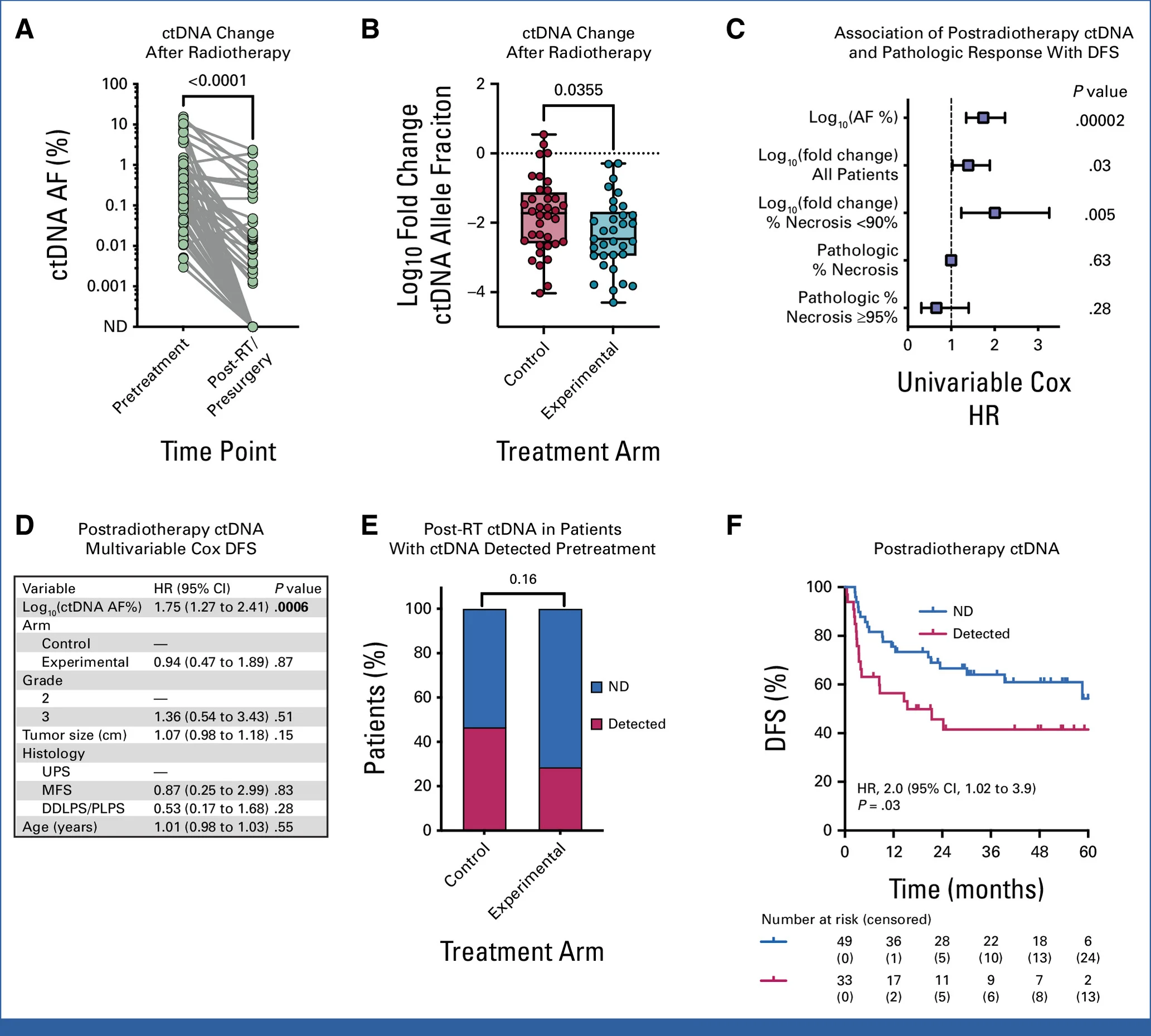
Postradiotherapy, presurgical samples were evaluable in 84 patients. Among those with detectable ctDNA at baseline, levels decreased in most patients after neoadjuvant treatment.
Patients receiving pembrolizumab in addition to radiotherapy experienced a greater decline in ctDNA than those receiving radiotherapy alone. Conversion from detectable to undetectable ctDNA occurred in 71% versus 53%, respectively. This difference was numerical and did not reach statistical significance (P = .16).
These results suggest that ctDNA dynamics may provide an early molecular indication of treatment activity. Nevertheless, the distinction between the absolute posttreatment level and the magnitude of change is important.
Higher postradiotherapy ctDNA levels remained independently associated with worse disease-free survival. In the multivariable model, each tenfold increase in ctDNA allele fraction was associated with a hazard ratio of 1.75 (95% CI, 1.27–2.41; P = .0006).
By comparison, the association between ctDNA fold change and disease-free survival did not remain statistically significant after adjustment: HR 1.29 (95% CI, 0.93–1.80; P = .13).
This finding suggests that the residual molecular burden after neoadjuvant therapy may be more informative than the degree of decline alone.
Distinguishing Local Response From Persistent Systemic Risk
A central issue for radiation oncologists is what a reduction in ctDNA actually represents.
Radiotherapy may substantially reduce DNA shedding from the primary tumor. A large decline could therefore reflect a favorable local response while occult metastatic disease remains present. Consequently, a falling ctDNA level cannot automatically be interpreted as elimination of systemic disease.
The investigators explored this possibility by excluding patients with at least 90% necrosis in their resected tumors. In this subgroup analysis, the association between ctDNA fold change and disease-free survival became stronger, supporting the possibility that marked primary-tumor response can influence the interpretation of circulating DNA dynamics.
Pathologic necrosis itself was not significantly associated with disease-free survival in this cohort, whether assessed continuously or using a threshold of at least 95%. However, pathologic response assessment was not standardized in the trial and was performed locally without central review. These findings therefore do not establish ctDNA as superior to a standardized pathologic assessment.
Postoperative ctDNA and Residual Disease
At three months after surgery, 81 patients had evaluable plasma samples. Detectable ctDNA was associated with worse disease-free and overall survival.
Postoperative ctDNA levels also retained independent prognostic value. Each tenfold increase in ctDNA allele fraction was associated with an adjusted disease-free survival hazard ratio of 1.40 (95% CI, 1.08–1.80; P = .01).
The personalized assays additionally allowed researchers to follow distinct tumor subclones. Detection of multiple clones after surgery was associated with inferior outcomes, even when ctDNA levels were similar between patients with one versus multiple detectable clones. This suggests that the composition of residual circulating tumor DNA may add information beyond its quantity.
For multidisciplinary care, these observations support further investigation of postoperative ctDNA as a tool for identifying patients who may need additional systemic treatment or closer surveillance.
You Can Read Full Article Here